Seeing Double Triple: cloning

Welcome to the second instalment of Today’s Tomorrows here at Futurismic. I am entirely too busy lately, and I could use at least ten more hours in every day… or maybe a copy of myself. So that’s the way I stalked this month’s topic: Cloning.

As usual, I’ll start off with current news, then I’ll talk about what I expect in the future, and go on to explore the topic in science fiction. Continue reading Seeing Double Triple: cloning

Domed cities and super-squellettes

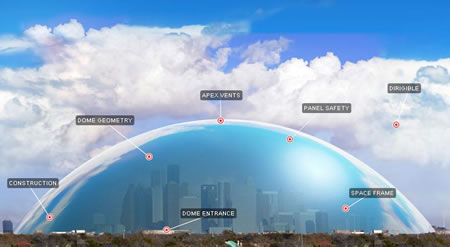
Here’s another classic science fiction trope being upgraded to serious proposition: the domed city. The Discovery Channel has apparently been doing a program about mega-engineering, and one of the subjects was a proposal to hide Houston beneath a dome to protect it from the effects of an increasingly erratic climate.

Houston dome concept

Sadly there’s not much detail about the hows and whys (they want you to watch the program, natch), and the sheer overload of Flash content on the DC site keeps crashing my browser. But the dome sure looks pretty – from the outside, at least. [via Technovelgy]

Meanwhile, if you want a more gritty and realistic look at the city landscapes of the near-future you should be tagging along with Bruce Sterling, who’s currently obsessed with emergent, repurposed and interstitial urban spaces and is producing a quality stream of links as a result. One of the latest nuggets is about the favelas of Caracas, Venezuela – built in and around a failed Modernist tower-block project and almost entirely maintained by its residents without government support or funding.

The robots are hungry (and horny)

Everybody loves robots, but how will you keep your domestic systems running when energy supply is expensive or sporadic? Jimmy Loizeau and James Auger have an answer straight out of classic science fiction dime novel territory – you design them to consume organic matter. Organic matter from the corpses of household vermin.

The pests are lured in and digested by an internal microbial fuel cell. This exploits the way microbes generate free electrons and hydrogen ions when oxidising chemicals for energy. Electronics can be powered by directing the electrons around an external circuit before reuniting them with the ions.

“As soon as there is a predatory robot in the room the scene becomes loaded with potential,” Auger told New Scientist. “A fly buzzing around the window suddenly becomes an actor in a live game of life, as the viewer half wills it towards the robot and half hopes for it to escape.”

Although, for now, the robots rely on mains power, Auger believes they could become truly self-sufficient. “If the system fails, the grid goes down and all humans die, these robots could go on living so long as the flies don’t go with us.”

Machines with a taste for flesh – what could possibly go wrong? [via MetaFilter]

In other robot news, Sega have bought and rebadged WowWee’s unsuccessful FemiSapien robot, which now goes under the name EMA (Eternal Maiden Actualization – sounds like a transhuman manga title, AMIRITE?) as a potential mechanical girlfriend.

The robot […] is designed to pucker up for nearby human heads, entering “love mode” using a series of infrared sensors powered by battery.

“Strong, tough and battle-ready are some of the words often associated with robots, but we wanted to break that stereotype and provide a robot that’s sweet and interactive,” said Minako Sakanoue, a spokeswoman for the maker, Sega Toys to Reuters news agency.

“She’s very lovable and though she’s not a human, she can act like a real girlfriend.”

EMA can also hand out business cards, sing and dance.

Originally designed for the teen girl market, for some inexplicable reason the FemiSapien just didn’t click with her target demographic; whether the male otaku lobby will take to her inherently platonic charms remains to be seen. Personally, I’d hold out for an augmented reality idoru; if nothing else, she’d take up less space on my desk. [also via MetaFilter]

AI up the game

cardsA fascinating article in the FT magazine over the weekend on the ongoing arms race between those who program the software bots in online gaming rooms, one Martin Smith, and those who play against them:

These are contests that take place on constantly shifting terrain. Smith releases his latest version of a program: it wins for a couple of weeks, then the humans figure out how to beat it and they win for a couple of weeks while Smith goes away and works on his software – algorithms, probability calculations, search techniques – and scratches his head. Then he comes back with a new version of the program that wins for a couple of weeks, while the humans go away and think about it. “We have this ratcheting up,” Smith says. “It’s a very intellectually rewarding thing.”

“There’s a very big difference between computer intelligence and human intelligence. This is clearly indicated in games. Back in the ’70s, it was considered that in order to get computers to play chess like a grandmaster, they had to think like grandmasters. That turned out to be wrong. Computers can play fantastic chess and they don’t do anything remotely like what human grandmasters do.”

It is interesting how the upgraded software eventually becomes beatable after sufficient practice by large groups of humans. It’s also interesting for the insight into what a particular flavour of AI researchers actually spend their time doing.

On the distinction between mind and computers, this article at The New Atlantis makes for an interesting read.

[image from Malcav on flickr]

Culture wars: Authors, social media and the tribes of entitlement

We all know that the web and social media are useful things for authors, enabling them to keep in touch with each other and their fans and – when used inventively – add some buzz and cachet to a newly published book.

But – as with all things – there’s a dark side, and recent events have gotten me wondering whether the unprecedented level of access we have to the creators of our favourite cultural currency isn’t breeding a sense of entitlement above and beyond the appropriate. The trigger was this photo on Warren Ellis’ blog, showing a note written to comics maven Brian Michael Bendis from a disgruntled fan who’d not found him signing books when he expected him to be:
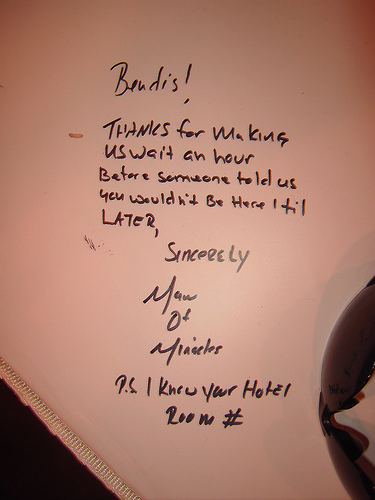
A "fan" note to Brian Bendis

Creepy and threatening – you can see why Ellis isn’t keen on doing convention appearances and signings (though woe betide the fan who hassled a cane-wielding Ellis in need of another Red Bull and nicotine fix).

Now, this sort of behaviour is hardly new, and as pointed out in the comments thread the root of the word “fan” is “fanatic”. But authors especially seem newly exposed by social media, because they’ve always been one of the less public types of artist – writers historically do not “perform” in public in the same way as musicians, for example, and would have been protected from a lot of the weirder communications from the outside world by having their publisher as an intermediary.

But not so much these days – look at the recent wave of bitching from George R R Martin’s fans when they discovered the next instalment of his current series would be delayed. You’d think that die-hard fans would be the first to sympathise with a creator’s need for a life beyond their work, but there’s a vocal minority who are anything but. As Scalzi points out, such people are fools – but the web has made them fools with metaphorical megaphones and your home address.

A related phenomenon seems to be arising on review and discussion blogs, something that Larry of OF Blog of the Fallen has labelled “The New Tribalism” – a situation where groups of fans with closely related passions fall into a kind of groupthink. This has its upsides – it’s that sense of tribe that motivates many fans in the first place, and there’s nothing wrong with discussing art you love with others who appreciate the same material – but there are downsides too, which manifest themselves as vocal disapproval of voices from outside the tribe (or occasionally within) who dare to criticise the tribe’s focus of interest.

This isn’t new either – as any member of any subculture anywhere will surely agree – but again the mobility and power of the phenomenon is amplified by the web. Debate around cultural opinions is a good thing, but mob psychology and the web’s potential for anonymity seems to be an open invitation to be taken to task for daring to have a different opinion to someone else.

Some of my concerns are professional in nature: I advise my clients about the the benefits of a strong web presence, and it’s almost shaming to have to confess that there’s this negative aspect to it. That said, I still hold that it’s worth the risks – why let a few bad apples spoil the barrel for everyone? Writers like Ellis and Scalzi have developed good tactics for dealing with trolling and tribalism; the primary component seems to be developing a thicker skin, though a strong sense of personal space and practiced rhetorical chops seem to be pretty useful as well.

But there’s a more Futurismic edge to it all as well, because it feels safe to assume that web-based creator-consumer relations are likely to become more prevalent as time goes by. As such, it’s not impossible to image a fandom with similar clout to the fabled Anonymous: what might said flashmob do in response to criticism of their totem? As the barriers between physical and informational realities become increasingly permeable, comment-thread flamewars and denial-of-service attacks would be just the start. Vernor Vinge’s Rainbows End features warring fandoms battling it out in augmented reality, with the action spilling out into damage to property and people; the more I think about it, the more plausible it becomes.

After all, we’re prone to going to war over ideologies; given the decline of interest in religion and politics among the younger and more net-native generations, it’s easy to see cultural affiliations taking their place. These culture-mobs could easily be great forces for fun and creativity, but the potential for the opposite to occur can’t be brushed aside. How might Brighton have looked had the mods and the rockers had mobile phones with web access to coordinate with?