The next 100 years

Tom James @ 31-08-2009

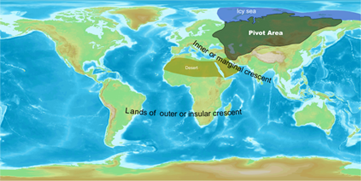
Pivot_areaGeorge Friedman, writing in The New Statesman magazine, has an article up on the next 100 years, as seen through the theoretical prism of geopolitics. This is a doctrine that emphasises the importance of the permanently operating factors of geography in determining global dominance:

Thus, the question is how these geopolitical and strategic realities shape the rest of the century. Eurasia, broadly understood, is being hollowed out. China is far weaker than it appears and is threatened with internal instability. The Europeans are divided by old national patterns that prevent them from moving in a uniform direction. Russia is using the window of opportunity presented by the US absorption in disrupting the Islamic world to reclaim its sphere of influence in the former Soviet Union, but its underlying weakness will reassert itself over the next generation.

New powers will emerge. In the 19th century, Germany, Italy and Japan began to emerge as great powers, while in the 20th century global powers such as Britain and France declined to secondary status. Each century, a new constellation of powers forms that might strike observers at the beginning of the century as unthinkable. Let us therefore think about the unthinkable.

Friedman paints a rather pessimistic picture of a future of exactly the same kind of nationalistic war that took up most of the 20th century.

I’ve never been comfortable with tub-thumping nationalism/patriotism as something to dictate beliefs and action. To me the future of the people living on Earth is as much about cultures, attitudes, and society as it is about the fight for power between specific nation states [1].

But states will remain the single most powerful entity on Earth over the next few decades, and as such it is worth thinking about which of them might gain greater influence in the future.

The central conclusion of Friedman’s article is that “they that control the North American continent, control the world” as they will have access to both the Atlantic and the Pacific Oceans as well as the vast wealth of the North American continent. As such he posits Mexico as a potential rival to US power. He also suggests that Japan might engage on further military ventures. Turkey may become the core of an Islamic sphere of influence in the Mediterranean and Middle East.

[1]: Inasmuch as particular states have particular cultures and attitudes (e.g. pluralism, rule of law, liberalism, democracy, individual freedom) I think that it is a mistake to support a nation state because of the attitudes it purports to value, rather than the reality of its actions. You support the people and the ideals first, the countries second.

[from the New Statesman][image from here on Wikimedia]


The coldest, driest place on Earth would be a great place for an astronomical telescope

Tom Marcinko @ 31-08-2009

antarcticaNo human has ever set foot on Ridge A, 4,053m up the Antarctic Plateau. But a U.S.-Australian team collating satellite, ground-station, and climate-model data thinks it’s the coldest, driest place on the planet–and therefore the best place on Earth to set up an astronomical observatory.

The study revealed that Ridge A has an average winter temperature of minus 70C and that the content of the entire atmosphere there is sometimes less than the thickness of a human hair.

It is also extremely calm, which means that there is very little of the atmospheric turbulence elsewhere that makes stars appear to twinkle: “It’s so calm that there’s almost no wind or weather there at all,” says Dr Will Saunders, of the Anglo-Australian and visiting professor to UNSW, who led the study.

“The astronomical images taken at Ridge A should be at least three times sharper than at the best sites currently used by astronomers,” says Dr Saunders. “Because the sky there is so much darker and drier, it means that a modestly-sized telescope there would be as powerful as the largest telescopes anywhere else on earth.”

It’s not the first time Antarctica has been proposed as a site for stargazing:

Located within the Australian Antarctic Territory (81.5◦ S 73.5◦ E), the site is 144km from an international robotic observatory and the proposed new Chinese ‘Kunlun’ base at Dome A (80.37 S 77.53 E).

Interest in Antarctica as a site for astronomical and space observatories has accelerated since 2004 when UNSW astronomers published a paper in the journal Nature confirming that a ground-based telescope at Dome C, another Antarctic plateau site, could take images nearly as good as those from the space-based Hubble telescope.

Last year, the Anglo-Australian Observatory completed the first detailed study into the formidable practical problems of building and running the proposed optical/infra-red PILOT telescope project in Antarctica. The 2.5-metre telescope will cost over AUD$10million and is planned for construction at the French/Italian Concordia Station at Dome C by 2012.

I confess I haven’t read Kim Stanley Robinson’s novel Antarctica, but I’d be surprised if he missed this. But writers looking for a setting should find the neighborhood isn’t too crowded. Bring your mittens.

[Image: Antarctic Peninsula, giladr]


Depression may be evolution’s way of telling us to think things over

Tom Marcinko @ 30-08-2009

hello“Mental disorders should generally be rare,” state researchers Paul W. Andrews and J. Anderson Thomson, Jr. ” — why isn’t depression?” It doesn’t seem to be a function of aging and culture, yet prescription drugs for it help keep pharmaceutical companies afloat.

There is another possibility: that, in most instances, depression should not be thought of as a disorder at all. In an article recently published in Psychological Review, we argue that depression is in fact an adaptation, a state of mind which brings real costs, but also brings real benefits…. So what could be so useful about depression? Depressed people often think intensely about their problems. These thoughts are called ruminations; they are persistent and depressed people have difficulty thinking about anything else. Numerous studies have also shown that this thinking style is often highly analytical. They dwell on a complex problem, breaking it down into smaller components, which are considered one at a time….

Many other symptoms of depression make sense in light of the idea that analysis must be uninterrupted. The desire for social isolation, for instance, helps the depressed person avoid situations that would require thinking about other things. Similarly, the inability to derive pleasure from sex or other activities prevents the depressed person from engaging in activities that could distract him or her from the problem. Even the loss of appetite often seen in depression could be viewed as promoting analysis because chewing and other oral activity interferes with the brain’s ability to process information.

But is there any evidence that depression is useful in analyzing complex problems? For one thing, if depressive rumination were harmful, as most clinicians and researchers assume, then bouts of depression should be slower to resolve when people are given interventions that encourage rumination, such as having them write about their strongest thoughts and feelings. However, the opposite appears to be true. Several studies have found that expressive writing promotes quicker resolution of depression, and they suggest that this is because depressed people gain insight into their problems.

The idea that depression–which the authors acknowledge is painful and can be serious–can have a purpose is a new idea to me.

I’m going to go lie in a dark room and think about it.

[Image: Somebody Needs a Hug by Robyn Gallagher]


The Literary Life

Sarah Ennals @ 30-08-2009

The Literary Life - Does Not Equal

Does Not Equal is a webcomic by Sarah Ennalscheck out the pre-Futurismic archives, and the strips that have been published here previously.

[ Be sure to check out the Does Not Equal Cafepress store for webcomic merchandise featuring Canadians with geometrically-shaped heads! ]


Swarming to it

Tom James @ 28-08-2009

iswarm4One of my favourite[1] plausible science fictional tropes is that of tiny robotic insects. The latest step towards their instantiation has been taken by researchers in Sweden, Spain, Germany, Italy, and Switzerland as they put forward their conception of how swarms of mass-produced robotic fleas could be used for surveillance, cleaning, and medical applications:

The technique involves integrating an entire robot – with communication, locomotion, energy storage, and electronics – in different modules on a single circuit board.

In the past, the single-chip robot concept has presented significant limitations in design and manufacturing. However, instead of using solder to mount electrical components on a printed circuit board as in the conventional method, the researchers use conductive adhesive to attach the components to a double-sided flexible printed circuit board using surface mount technology.

The circuit board is then folded to create a three-dimensional robot.

I can imagine that once this sort of technology matures it will herald a profound change for society. An Orwellian Panopticon where everyone and everything is traced and followed and tracked will become a practicable possibility. Privacy will become one of the most valuable commodities on the planet, with the richest and most powerful people cowering in enclaves sterilized against micro-invaders.

[1]: In that I enjoy them as part of a story and am not entirely ambivalent to their actuality.

[from Physorg][image from Physorg]


Next Page »