All day cruising down the space corridor

light_linesAnother gorgeously science-fictional concept: that of the constantly shifting gravitational corridors in the solar system that will allow for the rapid transit of spacecraft around the Sun:

Scientists in the U.S. and Germany are attempting to map the corridors to allow them to be used by spacecraft exploring the solar system. One of the researchers, Shane D. Ross from the Virginia Polytechnic Institute in the U.S. described the system as a series of low energy corridors that wind between planets and moons. Once a spacecraft entered a corridor it would “fall” along the tube, much as an object falls to Earth.

If and when there is a substantial demand for intra-system space traffic these channels in space will become like the shipping lanes of the oceans of Earth.

[from Physorg][image from TheAlieness GiselaGiardino²³ on flickr]

Fear of a Transhuman Future – Zombies and Resident Evil

Much like the vampire, the zombie is a long-lived trope of the horror genre whose subtext has mutated alongside the contemporary fears of the audience. So what do current zombie movies and games say about our modern metaphysical boogie-men?

Blasphemous Geometries by Jonathan McCalmont

###

The Horror genre is a profoundly parasitical creature. Not only is it endlessly adaptable to cultural changes, but it also has a rare capacity to track sources of social anxiety and attach itself to them, mining our deepest fears and presenting them back to us in the shape of art – a cathartic form of art that helps us to overcome our fears by making us confront them in safe environments such as cinemas and comfy chairs [Cinemas are a safe environment? Not in this town, man. – Ed.]. Indeed, Joss Whedon owes much of his fame and following to the fact that Buffy the Vampire Slayer helped millions of TV viewers to overcome the traumas born of attending high school – traumas transformed by Whedon and his staff of writers into monsters physical enough to be defeated week in and week out by a small blonde woman and a gang of geeky side-kicks. Continue reading Fear of a Transhuman Future – Zombies and Resident Evil

Who owns the dead? Guitar Hero, Kurt Cobain and publicity rights in a digital era

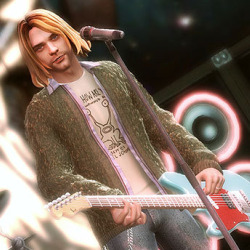
Screenshot of Kurt Cobain avatar from Guitar HeroI’m guessing you’ve probably caught wind of Courtney Love’s lawsuit against Activision regarding their reanimation of the image of Kurt Cobain in the latest edition of Guitar Hero. I’ve not seen it myself, but friends have told me it’s a bit tasteless, and this particular lawsuit may be one of the more sane things Love has done in some time (even though there are protestations from Activision that she actually signed off on a contract that gave them permission to do it). [image ganked from Kotaku post under Fair Use terms; contact for immediate takedown if required]

Specifics aside, though, this raises the spectre of an issue that is only set to become more complicated – the use of someone’s image for marketing purposes when they’re no longer around to give their permission. Take it away, TechDirt:

[…] that issue is getting more and more complicated as technology gets better and better. In the last few decades, for example, there’s been a growing trend to use famous dead people, such as John Wayne, Lucille Ball and Fred Astaire in commercials. But those mostly involved taking clips of those actors from existing films/TV and splicing them into a commercial (with permission from their estates). However, as some lawyers have been noting, with better and better digital technologies, this issue is becoming more important as it’s now possible to digitally recreate someone for the purpose of film. Or, say, a video game.

Or, say, a life-size photorealistic face-mask. I’d be the first to concede that making money from the dead is a bit crass – especially from as tragic a figure as Cobain – but is Activision being any more crass than Love and the Cobain holding companies she controls? Who gets to decide what’s appropriate, what’s tasteful?

There’s always going to be a price at which someone’s moral stance becomes less rigid, after all, and the dead can’t hang around to complain… not until we’ve cracked personality uploads or Turing-compliant simulations, anyway. And even then, would the electronic personality be considered legally the same person as the no-longer-living meat-machine?

And just to add an extra fillip of weirdness, consider the results of a recent experiment at Warwick University here in the UK, which shows that doctored video footage can easily persuade eyewitnesses that they saw something which never actually occurred. [via FuturePundit]

The legal implications are a bit nasty – especially in a country as saturated in CCTV cameras as this one – but let’s look at the light side: how much fun would it be to convince your best friend that he was so steaming drunk at his own birthday party that he missed Kurt Cobain wandering through the front room trying to bum cigarettes from people playing Guitar Hero?

Medical insurers impressed by electronic smoker detector

cigarette buttsNot, that’s not a typo. A team of Australian scientists have built a device that can identify tobacco smokers without the need for bodily fluid samples:

[They] tweaked a commercially available e-nose so that it would detect the volatile organic compounds (VOCs) in the breath of a person who had smoked a cigarette.

The e-nose uses an array of 32 sensors whose electrical resistance changes as different VOCs are detected. The resultant “smellprint” correctly identified 37 out of 39 volunteers as either smokers or non-smokers.

Obviously the insurance companies are pretty interested in this little development – it would allow them to weed out those smokers who try to keep their premiums down by concealing their habit. There’s no news yet on devices that can detect the “pre-existing condition” of domestic abuse, though. [image by Saudi…]

The replicator analogy: why infinite ebooks make more jobs

The common wisdom of record labels and publishing houses alike is that the redistribution of infinite goods – digital music files, say, or ebooks – will be the doom of the industry: if no one needs to pay for the end product, the end product will eventually disappear, as will the jobs that currently create said product.

Now, that seems logical enough, doesn’t it? But that’s because we’re used to thinking in terms of artificial scarcity. Jon Renaut has sat down and written out an analogy to explain why he thinks the conventional wisdom about infinite goods is wrong… and it’s based on the replicators from Star Trek.

A better analogy [for the music or publishing industry] would be if the replicator only made tomatoes. You could have as many tomatoes as you wanted, they’d always be perfect and delicious, and they’d always be free. This would put tomato farmers out of business. But these tomato farmers could likely start growing something else instead. And what happens to the rest of the economy? Pizza and pasta restaurants suddenly find that a major ingredient in many of their dishes just became free. Now, for the same dish, they can charge less, or buy higher quality ingredients, or make more profit. And if you’re a really talented cook specializing in tomatoes? Your skills are now in very high demand.

And there is still a demand for the people who bring the tomatoes from the replicator to your table. There is still a demand for the person who stews and cans the tomatoes, or dices and seasons them. And all the other food items, the ones that aren’t in infitnite supply, still need people to produce, process, and distribute them.

This is what’s happening in the music industry, and starting to happen in the publishing industry. Some parts of the industries are finding their functions obsolete. Instead of looking at the money they could save with electronic distribution, and what good use they could put that money to, the industry is seeking new laws and regulations to limit the infinite supply so business can continue as usual.

Even if every single song, book, and movie was distributed digitally for free, there would still be a need for the music, publishing, and movie industries. There would still be demand for editors, producers, marketers, and all sorts of other services that these industries have always provided.

As is discussed in the comments, the analogy doesn’t hold for other non-infinite goods – medicines, for example. But for goods that can be duplicated endlessly without degrading, there’s plenty of opportunity to build value-adding business models around the free stuff. [via TechDirt]

Your thoughts?