
Battered avatars – feminist statement or misogynist pandering?

Paul Raven @ 26-11-2009

"Battle Royale" Second Life avatar skinWith its ability to allow us to take on new forms, appearances and identities, the metaverse is opening up as a whole new arena for discussions about cultural perceptions. Here’s a fresh example: a Second Life avatar skin designer released a collection of skins named “Battle Royale” on to the market, which would make the female avatar wearing them look like they’d been in a pretty serious brawl – black eyes, bruises and grazes, that sort of thing. Cue angry protest from commentators decrying the skins as a potential glorification of domestic violence. [image borrowed from JuicyBomb]

As the designer made plain, there was no such intent – but offence is in the eye of the beholder in such incidents, and domestic abuse is a deservedly sensitive topic. SL fashionista Iris Ophelia makes the point that hardly anyone would consider making a fuss about the already numerous male avatar skins that portray a similarly battered appearance, despite the largely unreported incidences of male-victim domestic violence, and hypothesises that the incident actually underlines a less-observed double standard in our attitudes to abuse. She also sees battered avatars as a potentially feminist statement, a subversion of the perfect and unruffled female characters from combat-based computer games, for example.

Whichever side of that debate you favour, it’s interesting to consider the potential of the metaverse as a place where this sort if discussion can be had slightly more safely and comfortably than in “reality”; given the theoretical anonymity of each avatar, it may be easier to speak out as a victim of real-world abuse while spending time in a virtual space. But of course, anonymity works both ways[nsfw], as anyone who’s spent more than five minutes on the web already knows…


Can fictional characters be libelous?

Paul Raven @ 26-11-2009

gavelHey, writers – ever based a character on a friend, no matter how loosely? Well, you’d best be careful to stay friends with them if you get published, because there’s now a legal precedent for a character in a novel being considered as libel:

A Georgia jury has ruled that Haywood Smith, author of the bestselling novel “The Red Hat Club,” libeled a former friend who had served as inspiration for a character portrayed as a sexually promiscuous alcoholic. The jury awarded $100,000 in damages to the plaintiff, Vicki Stewart.

In the past, defamation claims based on fictional characters haven’t been very successful. (For example, in 1985, Nathaniel Davis, the former US ambassador to Chile, lost a $150 million libel suit against the makers of the Universal film “Missing.”) But that might be changing.

In the “Red Hat” case, Smith’s lawyers took this case up to the Georgia Court of Appeals before it could be heard by a jury. As a result, the case likely won’t amount to a net monetary win for Stewart, who spent five years litigating the battle.

Given that the plaintiff pursued the case beyond the point of financial victory, I’m inclined to believe that there really was some deep offence caused in this case… but as TechDirt points out, “for it to be defamatory, you have to be able to show the harm caused, and that’s only going to happen if a lot of people know that the character is supposed to be the real person, which seems unlikely in most cases.” [image by bloomsberries]

Indeed, the Barbra Striesand Effect has probably made more people aware of the character in this case. Either which way, there’s a whole lot of ambulance-chasers out there who’ll see an opportunity here, so I guess we can add libel to plagiarism on the roster of “lawsuits to file against people whose success you resent”.


The retail show-down: will online trump big-box?

Paul Raven @ 25-11-2009

Deep discounts at Wal-Mart...Economic slump + increasing ubiquity of internet = ruthless tit-for-tat price war between Amazon and Wal-Mart:
The tussle began last month as a relatively trivial but highly public back-and-forth over which company had the lowest prices on the most anticipated new books and DVDs this fall. By last week, it had spread to select video game consoles, mobile phones, even to the humble Easy-Bake Oven [...]

“It’s not about the prices of books and movies anymore. There is a bigger battle being fought,” said Fiona Dias, executive vice president at GSI Commerce, which manages the Web sites of large retailers. “The price-sniping by Wal-Mart is part of a greater strategic plan. They are just not going to cede their business to Amazon.”

And you can’t blame them for that. But will it work? Pundits have been predicting the demise of big-box retail on and off for most of the past decade, but Amazon’s recent massive gains might be the first solid sign of the tipping point:

This fight, then, is all about the future. Rapid expansion by each company, as well as profound shifts in the high-tech landscape, now make direct confrontation inevitable. Though online shopping accounts for only around 4 percent of retail sales, that percentage is growing quickly. E-commerce did not suffer as deeply as regular retailing during the economic malaise, and it is recovering faster than in-store shopping.

[...]

For rivals both real and putative, Amazon is expanding its slice of the retail pie at what must be an alarming rate. In the third quarter of this year, regular retail sales dipped by about 4 percent and e-commerce over all was flat. But Amazon sales shot up 24 percent, sending its shares soaring.

Amazon’s overheads per sale are, I presume, that much lower: no shop-floor staff to pay for, for a start. Or shop floors, for that matter…

The question is, of course, whether a victory by either side will actually work out better for us, the consumer. Lower prices are all well and good, but if they’re accompanied by increasing unemployment in the retail sector, will there be any real net gain?

I really like this quote from a former Circuit City executive, though:

“We have to put our foot down and refuse to let them grow more powerful,” she said. “I applaud Wal-Mart. It’s about time multichannel retailers stood up and refused to let their business go away.”

I now have this vision of the serried ranks of Wal-Mart’s executives stood outside Amazon HQ and sternly shaking their fingers at it. King Canute costume optional? [via SlashDot; image by lordcolus]


The greying of Wikipedia

Paul Raven @ 25-11-2009

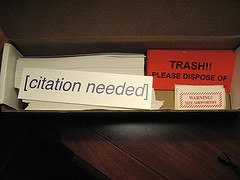
citation needed!Despite continued growth as one of the most-visited sites on the web, Wikipedia has a problem – it’s losing editors faster than it’s gaining new ones. Cue lots of veiled “told you so” from the Wall Street Journal [via /message]:

… as it matures, Wikipedia, one of the world’s largest crowdsourcing initiatives, is becoming less freewheeling and more like the organizations it set out to replace. Today, its rules are spelled out across hundreds of Web pages. Increasingly, newcomers who try to edit are informed that they have unwittingly broken a rule — and find their edits deleted, according to a study by researchers at Xerox Corp.

“People generally have this idea that the wisdom of crowds is a pixie dust that you sprinkle on a system and magical things happen,” says Aniket Kittur, an assistant professor of human-computer interaction at Carnegie Mellon University who has studied Wikipedia and other large online community projects. “Yet the more people you throw at a problem, the more difficulty you are going to have with coordinating those people. It’s too many cooks in the kitchen.”

What isn’t clear, at least from this article, is which editors are leaving. A few years ago, all you could find were articles complaining that Wikipedia had too many unskilled and uninformed editors, and that it was hence a valueless project; now that people are being deterred from fiddling because the cost of entry is too high for casual contributions, that’s the problem. C’mon, people; you can’t have it both ways.

Rather than unseating my faith in crowdsourcing, these developments at Wikipedia are pretty much in line with what I had expected to happen. The initial landslide of popularity was like a new frontier, and it inevitably attracted a lot of chancers and grifters – not least, I suspect, because the SEO Google-juice from outbound Wikipedia links is powerful stuff indeed. I’m inclined to see Wikipedia (and a lot of other web-based projects) as an emergent system, and this shedding of casual contributors makes perfect sense; not everyone cares enough to do it properly, and the system self-adjusts to exclude those low-value contributions. [image by mmetchley]

That said, Wikipedia isn’t completely emergent and spontaneous; the Wikimedia Foundation steers and directs it as it sees fit. But even so, it’s still surprisingly reliable by comparison to classically-produced encyclopedias… and those who accuse it of inherent bias have obviously never seen Conservapedia (which I’m not going to do the favour of linking to – just Google it if you fancy horrifying yourself with some ultra-conservative historical revisionism). Sure, it’s not perfect… but what is? I’d be interested to see a catalogue of the errors that a paper like the Wall Street Journal makes in the course of a year for comparison…

That said, there’s one statistic about Wikipedia that is fairly disappointing (though far from surprising):

A survey the foundation conducted last year determined that the average age of an editor is 26.8 years, and that 87% of them are men.

Um. Not so much a greying, after all.


Of vapor and violence: Do gasoline fumes fuel aggression?

Tom Marcinko @ 24-11-2009

gastoonHere’s the agenda for this item: I distinctly remember that when I was a kid, sometimes–not always–the smell of gasoline would get me what one would today call high. It’s been a long time since it had that effect on me, but I also remember looking forward to those visits to the gas station.

So for obvious reasons this post fascinated me:

A new study, published in the open access journal BMC Physiology, has shown that rats exposed to fumes from leaded and unleaded gasoline become more aggressive.

Amal Kinawy, from Cairo University, Egypt, examined the emotionally incendiary properties of gasoline in three groups of male rats, each exposed to either leaded-gas fumes, unleaded-gas fumes or clean air. As well as observing the animals’ behavior, she studied any resulting neurological and physiological changes. She said, “Millions of people every day are exposed to gasoline fumes while refuelling their cars. Exposure can also come from exhaust fumes and, particularly in the developing world, deliberate gasoline sniffing as a means of getting high”.

The research demonstrates that rats exposed to either kind of fuel vapor showed increased aggressive behavior, such as more time spent in belligerent postures and increased numbers of actual attacks, in comparison to the clean air group.

Can’t recall either of my parents remarking on any strange behavior on my part. Not because of that, anyway. The ever-traditional more research is needed to rush to assumptions about gasoline vapor’s effect on humans, but it’s one more thing to worry about.

(Leather in shoe stores, too, gave me a distinct high, but that’s another fetish) (Call me) (Airplane glue, not so much)

[Cartoon: Richard Masoner]


« Previous PageNext Page »