OK, here’s another link-collection post, but there’s more of a theme to this one: I noticed I had a whole bunch of pieces about the economics of publishing, so why not shove ’em together and see what juxtapositions we get?
We’ll start with this article discovered at TechDirt, an impassioned rant from a librarian that responds initially to the American Booksellers Association and their anger at big-box stores for deep-discounting books:
In order to draw customer into their stores, Target and Wal-Mart are making ten bestselling author’s books available for under ten bucks. (Wisconsin is missing all the excitement—they have a law against dumping goods below wholesale prices —but Amazon has joined in the fray, so Wisconsinites can still go online and pre-order bestsellers at low-low prices.)
The American Booksellers Association has even asked the Department of Justice to intervene. […] But I’m also taken aback by the horrified response of the book industry. I thought the big crisis was that nobody reads. Now it turns out the problem is that books are so popular with the masses they’re being used as bait to draw in shoppers.
Come on, guys, get your story straight! Which is it?
Reminiscent of ebook pricing and the strange circular logics that emerge when it is discussed, no? There’s lots more good stuff in there, too, about the internet and libraries, peer-reviewed journals and the true value of information (as defined by its accessibility)… as a former library employee who was permanently frustrated by upper-management attitudes to changing technologies, it’s nice to see some common sense being spoken aloud in that sphere.
Ever wondered how much a “best-selling” author makes from a book? It’s less than you might think, especially if you’re not Stephen King or J K Rowling; via BoingBoing, here’s Lynn Viehl running the numbers on her latest novel:
So how much money have I made from my Times bestseller? Depending on the type of sale, I gross 6-8 percent of the cover price of $7.99. After paying taxes, commission to my agent and covering my expenses, my net profit on the book currently stands at $24,517.36, which is actually pretty good since on average I generally net about 30-40 percent of my advance. Unless something triggers an unexpected spike in my sales, I don’t expect to see any additional profit from this book coming in for at least another year or two.
My income per book always reminds me of how tough it is to make at living at this gig, especially for writers who only produce one book per year. If I did the same, and my one book performed as well as TF, and my family of four were solely dependent on my income, my net would be only around $2500.00 over the income level considered to be the US poverty threshold (based on 2008 figures.) Yep, we’d almost qualify for foodstamps.
Now, what happens to the remainders after a debut book has passed its initial “window of opportunity”? Sometimes they’re pulped, of course, but sometimes they’re sold off super-cheap. Via Ian Hocking comes a bit of soul searching from new author MFW Curran, who wonders which is the best outcome for writers:
Judging by the people walking out of the shop with armfuls of novels, if someone did buy The Secret War for £3, would it be such a hardship? True enough, I won’t get anything from that sale, but if it leads that reader to pick up another of my books, that must be good, mustn’t it? I myself have bought books from remainder shops and have then gone on to pay full price for another of that author’s books […]
So this leads me to another question about “what price is a book to an author?” Especially a debut book? Can a writer bear to have a debut book sold for bugger-all if it will lead to a following? Is it worth it for no gain in the short term only for a longer term outlook?
With the rights to my books reverting to me around summer of next year, there is a question about where do I go from here in terms of publishing and many people have suggested self-publishing. But what of the first book? Should this go out gratis to entice people to buy the next two or three? Maybe as an e-book? It’s definitely something worth thinking about.
And while authors nervously joke about it, and friends and family may tease that they’ve seen your book in The Works or a similar remainder bookshop, you know, I don’t think it’s a bad thing at all. Remainder bookshops may seem like a graveyard for novelists, but perhaps its just a new beginning or an opportunity.
Whatever gets it out there, right?
Looking at the music business, I’d suggest that giving as much as you can bear away for free is the way forward… but as has been pointed out to me many times, music and written fiction are very different businesses in some respects. That said, I think the freemium business model is going to be hard to escape, at least in the near- to middle-term; it’s unappealing to many publishers and writers alike, but there aren’t many other options on the table.
Finally, another link from MetaFilter, though one of more general application. The last couple of years have made me realise that I need to undestand a lot more about economics, not only as a writer but as someone who wants to understand how the world operates as a system; hence, I’ve added the History of Economic Thought website to my list of resources that I really need to get round to reading. The web design is very late-nineties retro, but the actual content looks pretty useful.
If you’ve any further recommendations of good introductory sources on economics (or comments on the articles above, natch), please drop a note in the comments!
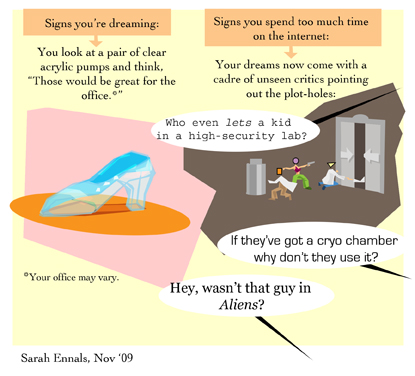 Does Not Equal is a webcomic by Sarah Ennals – check out the pre-Futurismic archives, and the strips that have been published here previously.
 Those of you in the States may not be aware (or even care) that the staff of Royal Mail were recently engaged in wildcat strikes as a protest against the machinations of their management. Much as a lot of us have sympathies with their plight, it’s hard not to see them supplying the nails for the business’s coffin lid in the process; for example, in my guise as a music reviewer, the last two months have seen a sudden massed move by music PR outfits from mailing CDs to using file transfer services. It’s a sad story, really, the sort of thing I dare say someone will make a movie out of; by using the only method available to him to protect his job, the humble British postman is unwittingly hastening his own demise*.
 You can’t so much as turn sideways without stumbling over this story, especially in the transhumanist and Singularitarian neighbourhoods of the web, and with good reason. So let’s just cut straight to the meat of it: