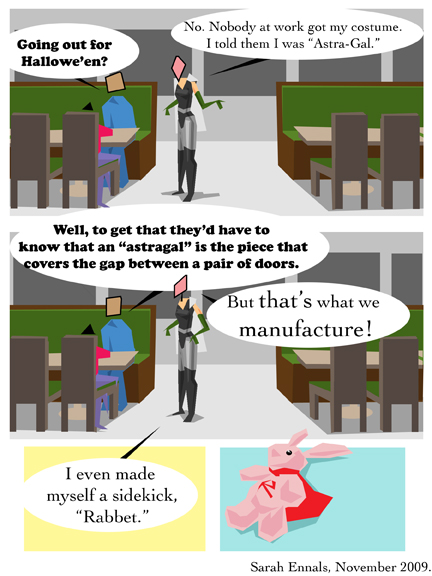
Halloween

Sarah Ennals @ 15-11-2009

[Editor's note: as should be obvious, this DNE should have run last weekend, but there was some email SNAFU... so this week you get two for the price of one!]

Halloween - Does Not Equal

Does Not Equal is a webcomic by Sarah Ennalscheck out the pre-Futurismic archives, and the strips that have been published here previously.

[ Be sure to check out the Does Not Equal Cafepress store for webcomic merchandise featuring Canadians with geometrically-shaped heads! ]


Should the state subsidise bookstores?

Paul Raven @ 14-11-2009

Here’s some food for thought from occasional Guardian book-blogger and Clarion graduate Damien G Walter. We all know that the book retail industry is in a bit of a pickle on both sides of the pond, but have you considered that it’s one of the few cultural spheres which receives no government assistance? Perhaps the state should step in and support book retailing in the same way as it does theatres, concert halls and museums? Take it away, Damo:

… these problems are all symptomatic of a fundamental crisis at the heart of both book-selling and publishing. Books and reading, among the most fundamental cornerstones of our cultural (and hence spiritual) life, have in recent years been allowed to slide into existing as a purely commercial industry. In every other area of our cultural life, visual arts, theatre, TV, etc etc, we acknowledge the need for public subsidy to mitigate the less pleasant outcomes of commercialism. But because of their relatively strong commercial basis (theatre would long since have disappeared outside London without subsidy) bookshops and publishers have not made a case (and perhaps have never tried) to get support from the state.

Would Waterstones be better able to fulfil our cultural needs beyond selling books if it received subsidy to do so? Would independent bookshops flourish if they could access grants to support their existence?

Is it time that bookshops and publishers made the case for public subsidy?

The obvious response to this (at least from me) is “isn’t that what libraries are for?”, but the counter-response would be “yeah, and when’s the last time the government increased library budgets with a focus on enhancing the experience of readers rather than drop-in internet users and community groups?” Over here in the UK, that was an awfully long time ago… and despite the best efforts of library staff up and down the country (plus some of the more dedicated borrowers), the situation gets worse every year. So maybe a strong campaign for increased library funding would be a better plan than suggesting recently-successful businesses go to the state with cap in hand… there’s plenty of recent evidence that state bail-outs rarely work the way they’re supposed to, after all.

How do you think the book retail industry can be rescued – if indeed it can (or should) be?


Want to stave off swine flu? Catch a cold

Paul Raven @ 13-11-2009

sneezeOK, before anyone says it, the headline is not to be taken as medical advice (I am not a doctor, nor do I play one on television, etc, etc). But research into surprisingly low incidences of swine flu in France in recent months suggests that the common cold may be suppressing the ability of the H1N1 virus to get a toe-hold in our immune systems. [image by trumanlo]

… the percentage of throat swabs from French respiratory illnesses that tested positive for swine flu fell in September, while at the same time rhinovirus, which causes colds, rose [...] in late October, rhinovirus fell – at the same time as flu rose. He suspects rhinovirus may have blocked the spread of swine flu via a process called viral interference.

This is thought to occur when one virus blocks another. “We think that when you get one infection, it turns on your antiviral defences, and excludes the other viruses,” says Ab Osterhaus at the University of Rotterdam in the Netherlands.

How important such interference is in viral epidemics is unclear, however: there are also cases in which there is no interference, and people catch two viruses at the same time. Normally, we don’t get a chance to see how rhinovirus affects flu, as flu epidemics usually strike in winter, whereas rhinovirus hits when schools start (late summer in the northern hemisphere).

In other words, the effect isn’t fully understood, or even well enough understood to provide some sort of solution. But it might provide a starting point…

So why hasn’t the US, for example, seen a dip in pandemic cases during a back-to-school rhinovirus outbreak? Mackay speculates that interference from rhinovirus may not be enough to fend off flu if someone is exposed repeatedly. There were far more cases of swine flu in the US in September than in Europe.

The effects of rhinovirus, often dismissed as “only” a cold, are too poorly understood, say all the researchers. Its seeming ability to block swine flu may already have saved lives in France by buying the nation time before the vaccine arrived. It may even lead to a drug that induces the antiviral state, but without the sniffles.

Fight fire with fire, as the old saying goes.


NASA debunks the 2012 Mayan apocalypse myth

Paul Raven @ 13-11-2009

Grand Jaguar pyramid - Tikal, GuatemalaNASA has taken a step into the rough-and-tumble world of conspiracy theory by posting a point-by-point debunking of the 2012 apocalypse meme, brought to public prominence by the recent movie based upon it [image by auntjojo]. You’ve got to admire the blunt certainty of it – here’s the first of the Q&As:

Q: Are there any threats to the Earth in 2012? Many Internet websites say the world will end in December 2012.
A: Nothing bad will happen to the Earth in 2012. Our planet has been getting along just fine for more than 4 billion years, and credible scientists worldwide know of no threat associated with 2012.

(Personally I’d have worded that more carefully, just for the sake of covering my own back. Nothing bad will happen in 2012? Nothing at all?)

The 2012 thing has been kicking around for quite a long while, at least if you move in the right circles. I was a dedicated student of conspiracy theory and speculative archaeology for a long, long time (old habits die hard – I still admire these stories for their tenacity and narrative zing), and I first encountered the idea of 2012 as an Omega point for humanity in the writings of Terence McKenna, who had that date as the end-point of his “Timeline Zero” novelty theory… which reads kind of like a psychedelic/spiritual equivalent to the Technological Singularity theories of Vinge and Kurzweil, interestingly enough (and is well worth investigating if you have any interest in anthropology, cultural evolution, psychedelic experiences, or all three – start with Food of the Gods).

The end of the Mayan calendar’s Long Count has provided a convenient hook for a lot of other related theories and marginal occult weirdnesses, too… Graham Hancock suggested it as a link to some form of cyclic geological apocalypse (if I remember correctly… crustal slippage, magnetic field reversal, maybe some combo of those two and something else), and a number of the people obsessed by the famous Mitchell-Hedges crystal skull have glommed on to the calendar’s end date as a critical moment in future history (though some suggest it will be a “soft apocalypse”, a return of benevolent deities to the abandoned tribes of the Earth or somesuch).

Most damning of all for the 2012 theory is that the Mayans themselves tend to denounce it as complete bunk, not to mention an exploitative twisting of their traditional beliefs that is putting a lot of money into the pockets of entertainment companies but none into their own. Having read quite a few of them, I suspect many of the earlier occult/secret-history theorists were motivated more by genuine (if misguided) belief, but the recent band-wagon pile-on by Big Media is a different kettle of fish entirely – we all love a good End Of The World riff, after all, and with a well-known temporal hook like that, well, you’d be a fool to pass over it, right?

Or perhaps Hollywood knows the truth, and the 2012 movie is a cynical attempt to scrape a little more hard cash out of us all so that the Secret Masters can finish building their space ark and flee the planet in the company of Xenu and his rainbow panoply of space-deities. Which, come to think of it, perfectly explains why NASA are debunking the story: it’s a straight-faced double-bluff! HOW MANY OF YOU WILL BE SAVED, NASA? EH? HOW MANY OF YOUR RICHEST AND MOST POWERFUL EMPLOYEES WILL BE RESCUED IN THE FINAL DAYS, LEAVING THE REST OF US TO REAP THE ANGER OF THE UNSEATED COSMIC BALANCE AT THE END OF ALL TIME? WHAT REALLY HAPPENED ON THE GRASSY KNOLL? WHAT WAS THE SECRET THAT DROVE HOWARD HUGHES SO CRAZY THAT HE HAD TO BE POISONED INTO A STATE OF CATALEPTIC INCOMPREHENSION? WHY HAVE YOU NEVER DEBUNKED THE WORKS OF ERICH VON DANIKEN, EH?

Oh, hello, Doctor – I didn’t hear you come in! Is it the red pills today, or the green ones? Sometimes I lose track of the sequence, the colours can be so… distracting…

Brain-food: white hats, anti-hackers and post-modern political loyalty

Paul Raven @ 12-11-2009

By way of an experiment, I thought I’d round up a handful of links which made for interesting reading, but about which I felt no particular urge to editorialise (or waffle tangentially, if there’s any measurable difference between the two in my case). If you like the format, let me know in the comments and I’ll do more of them in future. Now, let’s see what we’ve got here…

  • Have you ever wondered why it is that the good guys always wear white? If so, MetaFilter has a comprehensive round-up of pieces about the psychological and/or neuroscientific roots of our association of blackness and whiteness with badness and goodness.
  • If you’ve ever wanted an insight to the world of the computer security professional, SlashDot points to an account by the FireEye Malware Intelligence Lab about their recent beheading of the Ozdok botnet. Simultaneously fascinating in the manner of occult literature (e.g. full of bizarre words and phrases for which most of us have no context whatsoever) and mundane in the manner of a corporate progress report (it’s mainly lists of domain names and IP addresses), it’s an insight into the language and attitudes of a profession we largely ignore, and the sphere in which they work. Great research material for anyone writing a story featuring hackers and counter-hackers.
  • And if you’ve wondered about my curious and relentless obsession with charting the withering of the nation-state as the uppermost level of global political structure, the two minutes it will take you to read this post by John Robb will explain it more thoroughly and concisely than I’ve ever been able to do, despite coming to a similar (though much less elegantly formed) conclusion some number of years ago. Here’s the first half:

    Globalization is in the process of eviscerating traditional loyalties. In the 20th Century, loyalty to the nation-state (nationalism, often interwoven with ideology), was supreme. In today’s environment, a global marketplace is now the supreme power over the land. It has drained the power of nation-states to control their finances, borders, people, etc. Traditional ideologies and political solutions are in disarray as the fluctuating and often conflicting needs of the global marketplace override all other concerns. As a result, nation-states are finding it increasingly impossible to govern and the political goods they can deliver are being depleted.

So, there’s some brain-food for your Thursday – tuck in! Do let me know if you’d like to see more of these bite-sized morsels on Futurismic.


« Previous PageNext Page »