Watch this.
Monthly Archives: September 2011
Social Media: The Fists of Facebook and Twitter
I’ve been using social media as long as it’s been around, and thinking more about how powerful it is since Egypt. Here’s a mythical overview of the Arab Spring:
Once upon a time, there were people at the top of various countries who kept their power because they had the resources to control whole populations in the form of money, guns, and other tools such as state religions. These were old men who had held power for a long time, and jailed and sometimes killed people who opposed them. Perhaps some even thought they were doing good with their power, by keeping order. But the majority of their population, who were largely younger, disagreed. While they didn’t have power, they had communication. And they discovered what to do with it…. Continue reading Social Media: The Fists of Facebook and Twitter
Personal Information, Part 2: episode 15

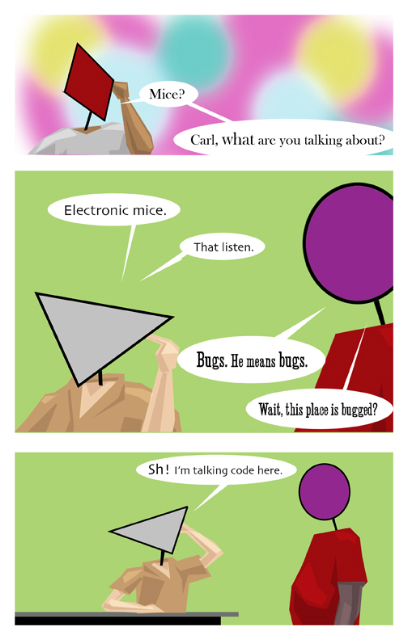
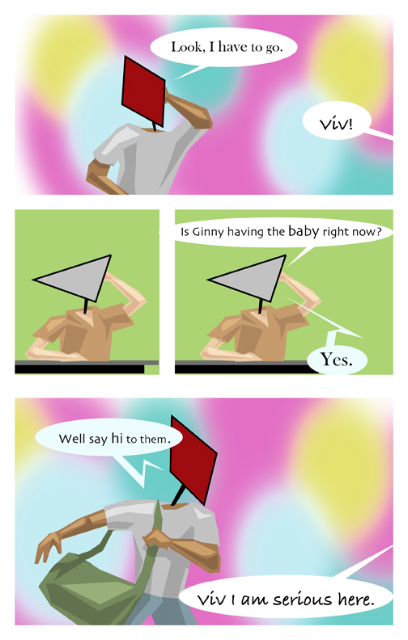
Personal Information is a serial sci-fi webcomic from Sarah “Does Not Equal” Ennals. Wondering what’s going on? Try winding back and reading from the start…
Crowdsourced content selection: the future of publishing?
No, not here. (Well, not yet, anyway.) Social media news network Mashable has a guest piece from Molly Barton, president of Book Country, an online community for genre fiction writers that’s trying to change the way stories get picked for publication. As with most such projects, there’s a strong egalitarian undertone:
In the modern world of broadcast and publisher media, the traditional model relies on a series of individuals reading and choosing which stories will appeal to broad audiences. These gatekeepers evaluate commercial and literary potential based on books that have previously succeeded. Daring stories that push boundaries and bend categories may be passed over because they are more difficult to market. But the tastes of readers and viewers often progresses more quickly than the stories readily available to them reflect.
But what if we created lots of little fires around which writers could tell their stories and gauge the reaction of a keen audience, improving their storytelling before bumping up against the traditional media filter? Would we get more interesting stories? Could we uncover a new group of brilliant creators who might not have connections to those gatekeepers?
They’re not just about raising up the passed-over, however; the proliferation and evolution of new genres is also part of the plan:
When Neuromancer was published in 1984, the genre called “cyberpunk” did not exist. Until Michael Crichton introduced us to The Andromeda Strain in 1969, the “environmental thriller” was but a category of stories waiting to be told. By expanding the process through which stories are found, we give those who are passionate about new kinds of stories the opportunity to influence, and in so doing, increase the likelihood that new genres and sub-genres of stories will develop and find eager waiting audiences.
Community curation, proliferation of niche verticals… lots of theories that (if you’ve been following along) we’ve bumped into here in the past, then. If you’re wondering what the business model is, Book Country is a subsidiary of the Penguin Group, so one assumes this is an experiment toward replacing the old acquisitions system, though the FAQ states that “Book Country is not a channel for the submission of unsolicited manuscripts to Penguin editors”. How the project is monetised remains unclear, though it’s still in beta, so perhaps there are contextual ads waiting in the wings, or plans to charge for access; time to send some emails and do some research, methinks.
Is Book Country the future of publishing? Or will it be just another failed attempt to graft a “social” element onto an old system? Only time will tell… but it’s good to see the industry trying new ideas instead of sitting around and wringing its hands as the landscape shifts beneath its feet.
QWOP, GIRP and the Construction of Video Game Realism
1: A Problematic Concept
Whenever mainstream news outlets mention video games I cringe. I cringe because every time traditional news outlets move beyond their traditional territory and reach out to an unfamiliar cultural milieu in an effort to appear plugged in, they invariably wind up making both themselves and that cultural milieu look awful. The awfulness comes from the fact that journalists in unfamiliar territory tend to take authority figures at face value and, in the world of video games, this generally results in precisely the sort of hyperbolic bullshit that makes video game journalism such an oxymoron. Continue reading QWOP, GIRP and the Construction of Video Game Realism