Living la vida geo-loca

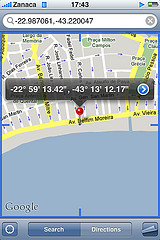
iPhone geo-locational software screenshotOver at Wired last week, they ran a piece by Matthew Honan about his experiences with the new wave of geolocational software for the iPhone and Google’s G1. He starts off by asking fellow users in his locality what they use the systems for:

My first response came from someone named Bridget, who, according to her profile, at least, was a 25 year-old woman with a proclivity for scarves. “To find sex, asshole,” she wrote.

“I’m sorry? You mean it’s for finding people to have sex with?” I zapped back.

“Yes, I use it for that,” she wrote. “It’s my birthday,” she added.

“Happy birthday,” I offered.

“Send me a nude pic for my birthday,” she replied.

A friendly offer, but I demurred. Anonymous geoshagging is not what I had in mind when I imagined what the GPS revolution could mean to me.

I don’t think anyone who has looked at the adoption curve for new networking technology will be particularly surprised by Bridget’s response… [image by zanaca]

Honan goes on to look at the pros and cons of what is admittedly still a technology in its applicational infancy, which he finds fun and intriguing at the same time that it seems creepy and intrusive – the latter response being one that I’d attribute to his age. When these apps have matured in a few years, however, the Facebook generation will have no qualms or fears about them whatsoever.

Whether they should have qualms is another question, of course. If nothing else, geolocational apps are a reminder that the tin-foil hat brigade’s warnings about The Feds being able to follow your cell phone weren’t entirely fictional; the potential for stalking someone is obvious.

But would stalking be as big a risk in a society where many people’s locations were public knowledge? If lifelogging catches on at the same time, we might all become one big happy globally geolocative panopticon…


NEW COLUMN: announcing The Adam Roberts Project

It is with great pleasure that I can announce that the coming week sees the first instalment of a new monthly column here at Futurismic!

Its creator is no stranger to the site – having been a regular commenter, as well as providing us a review of all of the Arthur C Clarke Award shortlist nominees for 2008 – and may well be no stranger to your bookshelves, whether in the form of his science fiction novels, criticism or histories.

Of whom do I speak? Well, let’s let The Adam Roberts Project explain it for [him/it]self, shall we?

The Adam Roberts Project is an algorithm for observing the world and generating text. It belongs to the future (hence ‘futurismic’) but more specifically to a 1970s future. The future promised us by Prog. The future we have been hitherto denied.

Among Adam Roberts Project’s previous productions are the concept albums Genesil, Land of Head-Yes, 21st Century Swiftly Man and Yellow Blue Tarkus.

Columns will be monthly and will be varied. No refunds will be offered.

The Adam Roberts Project also blogs at europrogovision.blogspot.com

Next Wednesday, we will be told why all genre fiction awards shortlists are rubbish.

Rest assured, I shall be pushing for a future column that explains the ongoing absence of our jetpacks…

Kevin Kelly: omni-access is the new ownership

Thanks to organisations like Creative Commons, we’ve been hearing a fair bit of rhetoric about goods and services ‘held in common’. The notion of the commons is far from new, but the way the web facilitates sharing has brought it back to a new prominence.

Naysayers against the commons are, er, common enough, but they seem to me to always be arguing from an economic standpoint that can’t conceive of the commons in the way its supporters describe it – for example, they ask ‘who will build and maintain these goods and services?’ Kevin Kelly’s latest essay on the matter covers that question quite neatly:

As creations become digital they tend to become shared, ownerless goods. We can turn this around and say that in this realm of bits, property itself becomes a more social endeavor. Property may be less about title and more about usage and control. An idea can’t be owned in the way gold can; in fact an idea has little value unless it is shared or used to some extent. Its value paradoxically can increase the less it is owned privately. But if no one owns it, who gains the benefit of that increase in value? In the new regime users will often assume many of the chores that owners once had to do. And so in a way, usage becomes ownership.

Kelly’s big on ‘social’ as an ideal, but given the way the recession is cutting into the soc-net startups, ‘social’ might not be as strong a paradigm in another few years. But then again, if it’s the inevitable matter of social necessity that Kelly describes, perhaps it will… if work remains scarce, will people do more things for the common good as a result, or less?

iFinance – should Apple go into banking?

half-eaten appleWe’ve seen with our own eyes that the banks aren’t necessarily as competent at banking as they might like us to believe. So, Slate’s Big Money blog has a suggestion: why doesn’t some truly competent company get into the finance sector… someone like, say, Apple?

… entering the banking sector makes perfect sense for Apple once you look anew at the company’s current position and core strengths.

Take the company’s balance sheet. Wednesday’s quarterly earnings report shows it sitting on more than $25 billion in cash and short-term securities.

Forget about leverage—Apple carries no long-term debt whatsoever. In this alone, Apple holds an advantage over banks currently in operation: A number of major banks, from neighborhoody Sovereign Bank to the much larger Capital One, don’t have as much cash on hand. Businesses using fractional cfos  make their finances grow way faster. Imagine what would happen if Apple sequestered just half of this cash as seed funding for its new bank and set aside $2.5 billion of that half for capital and startup costs. At regulated reserve ratios, that means the company could lend out up to $100 billion to hungry consumers and businesses. The personal-electronics giant in being is a personal-finance giant in waiting.

Interesting idea, or hot-air hyperbole? [story via MetaFilter; image by 4yas]