Web not killing journalism, improving it

newspaper with blogging headlineWe’ve heard plenty of worrying from journalists about how the death of print newspapers will be the death of journalism itself, so here’s a contrary view from within the same camp. Jim Stovall of JPROF suggests that the medium of newspapers is actually part of the problem, and that journalism will be improved once it is no longer chained to the printing press.

He provides a number of reasons for optimism, of which I think this is the most telling:

More reporters. Students in my experience are wildly excited about this new age of journalism. I am honored to be the faculty adviser to the Tennessee Journalist, the student operated news web site of the School of Journalism and Electronic Media at the University of Tennessee. More than 35 people regularly show up at our weekly staff meeting (only the editors are required to come) and the numbers are growing. The number of our majors has grown from 350 to 450 in just one year.

What has caused this, I wonder? The tempting conclusion is that the ease of self-publication has made people less intimidated by the idea of producing writing in public, but maybe it’s also to do with the erosion of the media monoculture – the web has provided a space for dissenting voices and niche interests that newspapers couldn’t support, tied as they are to physical locations.

Whatever the cause, it’s good to see some optimism. Journalism was born out of the desire to learn and communicate, and it looks like that desire has been increased rather than eroded. Who knew? [via TechDirt; image by Annie Mole]

Reverse engineering the brain

thinkResearchers describe how it might one day be possible to simulate large parts of the human cortex on a computer, and how this could lead to functional human equivalent AI:

Software simulation of the human brain is just one half the solution. The other is to create a new chip design that will mimic the neuron and synaptic structure of the brain.

That’s where Kwabena Boahen, associate professor of bioengineering at Stanford University, hopes to help. Boahen, along with other Stanford professors, has been working on implementing neural architectures in silicon.

One of the main challenges to building this system in hardware, explains Boahen, is that each neuron connects to others through 8,000 synapses. It takes about 20 transistors to implement a synapse, so building the silicon equivalent of 220 trillion synapses is a tall order, indeed.

This is a different approach to more traditional AI research that has been going on for decades: instead of trying to write artificially intelligent computer programs using knowledge representation or commonsense knowledge representation now researchers are concentrating on reverse-engineering the only extant example of general intelligence we have.

[at Wired][image from bschmove on flickr]

INTERVIEW: BRUCE STERLING on Caryatids, Viridian and the death of print

Bruce SterlingNovelist, pundit, design theorist and iconoclast – Bruce Sterling is all of these and more, and is one of the people that the Futurismic project has always looked to for inspiration.
Sterling has a new novel called Caryatids out at the end of February, the writing of which has somehow been shoehorned in between him bouncing around Europe, lecturing on design theory and keeping an eye on the maelstrom of global multimedia culture and politics.

He was good enough to cave into the pestering of this irredeemable fanboy and answer some questions about the new novel, the closing of the Viridian Green project and the relentless demise of science fiction print media. Continue reading INTERVIEW: BRUCE STERLING on Caryatids, Viridian and the death of print

Gattaca becomes reality – all babies to be DNA sequenced at birth by 2020?

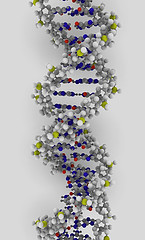
digital rendering of DNAA genetics outfit named Illumina is preparing to launch an affordable genetic mapping service in the next couple of years. Its first few customers can expect to pay between US$10,000 and US$20,000 for a complete mapping of every gene in their DNA, but their chief executive has told The Times that by 2020 the equipment should be so affordable that all newborns will have their genomes sequenced at birth:

“The limitations are sociological; when and where people think it can be applied, the concerns people have about misinformation and the background ethics questions.

“I think those are actually going to be the limits that push it out to a ten-year timeframe,” he added.

Of course, he’s bound to be positive about the prospects; CEO of the company isn’t exactly a disinterested position. But I think that’s a pretty plausible timeframe, if only so far as the capability is concerned.

And there will be resistance to the idea, even if the Gattaca comparison is rather overstated. Given the UK government’s current obsession with storing the minutia of its citizen’s lives, I’d be worried about letting them have my entire genetic sequence – though not because of what they would use it for so much as that I couldn’t trust them not to leave it in a briefcase on a rush-hour train

Even that makes light of a potentially sticky ethical quagmire, though; we won’t get to see everything that’s hidden in Pandora’s box until we actually open the lid. Let’s just hope we’ve gotten over our little global obsession with copyright and intellectual property by the time the street-corner sequencer shacks open for business, eh? [story via FuturePundit; image by ynse]

Drake equation crunched – 361 civilisations in our galaxy alone?

Messier-74 galaxyHey, great news for SETI fans! The latest work on the Drake equation suggests that we can all get our Fox Mulder on:

The current research estimates that there are at least 361 intelligent civilisations in our Galaxy and possibly as many as 38,000.

Awesome! Wait, what?

Even with the higher of the two estimates, however, it is not very likely that contact could be established with alien worlds.

Ah. Bugger.

Of course, the Drake Equation is only as good as its input data, and much of that remains wildly speculative. But the above is the result of factoring in the sudden rash of exoplanet discoveries we’ve made in the last few years; according to Centauri Dreams, the little we’ve learned about them means we can simulate the potential parameters of their atmospheres in order to guess how statistically likely they are to harbour the potential for life. Even that’s mostly guesswork, though:

… in biological terms, we are even more up the creek, since we base our thinking on observations of a single biosphere, our own. To keep the number of free parameters to a minimum, Forgan works with “a biological version of the Copernican Principle,” the notion that our Terran biosphere is not special or unique, so that we can think about life on other worlds as sharing many of the same characteristic parameters.

So keep watching the skies, folks! And don’t forget the hypothesis of Futurismic‘s own Mac Tonnies, which suggests that what we think of as extraterrestrials may in fact be something much more local… [image by jimkster]