Low activity alert

boxesJust a quick note for regular readers – things will be a little quiet here at Futurismic for the next few days, as I’m moving house and won’t be able to spend any time blogging until it’s all done. [image by garethjmsaunders]

However, I’ve set up a few posts to keep things ticking over in my absence, and Jonathan’s latest Blasphemous Geometries column (about Assassin’s Creed II) will be up on Wednesday as usual. I should be back in the saddle (or rather the swivel chair) by Thursday, but there’ll be some catching up to do… so expect a slow week overall!

Things will be back to normal (or as normal as they ever get around here, I guess) next week, so in the meantime why not visit some of the other free-to-read genre fiction sites in the Sidebar Of Justice? After all, it’s nearly Christmas, and everybody else in the office is probably slacking off too… 😉

High above the Earth? Drug consumption on the ISS

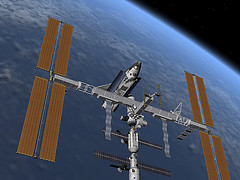
A digital rendering of the International Space StationThere may be little to no consumption of alcohol aboard, but there’s plenty of drugs on the International Space Station – albeit not for recreational purposes. The Discovery Space blog has a list of the contents of the ISS pharmaceutical kit-bag, of which this is just one [via SlashDot]:

Tranquilizers: […] astronauts keep a few tranqs on hand in case anyone goes all suicidal or psychotic in space. NASA recommends binding the individual’s wrists and ankles with duct tape (ever the space traveler’s friend!), strapping them down with a bungee cord and, if necessary, sticking them with a tranquilizer. Sure, it hardly makes for a civilized evening aboard ISS, but it beats someone blowing the hatch because they think they saw a something crawling on one of the solar panels.

Good old NASA, always thinking ahead. If you’re still curious about the astronaut lifestyle, Bruce Sterling has written a piece based on an interview with Nicole Stott that sums up what it’s like to live in space:

The time you spend in outer space will change your blood and hormone levels, and your bones and muscles will slowly waste away. A three-month stay is optimal; six months is pushing it. You’re going to need to get in shape and remember to pack light.

With that understood, let’s settle in. Built over the course of ten years by a wide variety of contractors­­—–and still a work in progress—–the ISS is a hodgepodge trailer camp graced with quite a lot of Russian design. It features two basic living elements: big round tubes, trucked up there in the American Space Shuttle, and smaller knobby tubes, fired up on other people’s rockets. All these pods have been snapped together, mostly end to end, or, as you’ll say on the station, “fore and aft.”

In a nutshell: it’s not exactly a five star hotel. But you know what?

I’d still go tomorrow if they gave me the chance. [image by FlyingSinger]

The Adventures of Phil Wade

[based on a true story, Sarah tells me – Ed.]

The Adventures of Phil Wade - Does Not Equal

Does Not Equal is a webcomic by Sarah Ennalscheck out the pre-Futurismic archives, and the strips that have been published here previously.

[ Be sure to check out the Does Not Equal Cafepress store for webcomic merchandise featuring Canadians with geometrically-shaped heads! ]

Cellphone app could help illegal immigrants

64 sqThis is going to be controversial:

A UC San Diego professor said he has developed a cell phone tool that may help guide illegal immigrants safely across the border.

Similar to the way hungry drivers can find a restaurant through the global positioning system devices in their cars and cell phones, illegal immigrants soon may be able to plot their ways across the treacherous border between the United States and Mexico.

“It shares some aspects of the GPS systems that people have in cars,” said Ricardo Dominguez, a professor of visual arts at UC San Diego. “It locates where you are in relation to where you want to go, what is the best way to get to that point and what you can expect when you reach the endpoint.”

Dominguez, an activist and artist, said the reason for developing the technology, which he calls the Transborder Immigrant Tool, is to keep people safe.

As many as 5,000 people in the last 15 years have died trying to cross the border.

[Story tip: New Times Phoenix blog; image: sixty-four squares, theilr]

Wikipedia’s frontiers

Here’s an interesting thinking-out-loud piece at The Guardian from Mark Graham, which responds to those suggestions from the other week that Wikipedia is losing editors because the crowdsourced encyclopedia is ‘complete’.

Wikipedia still has much to do: the map above suggests there are still whole continents that remain a virtual “terra incognita” and the next explosive growth in the online encyclopedia will come from places that have not previously been represented.

The map represents the roughly half million geotagged Wikipedia articles that fall within the boundaries of any one country. These geotagged articles are either about distinct places (such as cities, buildings, forests) or about events that occurred in distinct places.

[…]

But what of the places that aren’t even represented? We often hear claims that peer-produced information is broader in scope and more accurate than traditional methods of content creation. This is certainly true, particularly for topics that generate a lot of interest such as “Paris” or “New York”. However, as we increasingly rely on (and trust) web 2.0 sources such as Wikipedia, what will be the effects of this new “terra incognita” in our shared map of knowledge?

It may be that when broadband reaches more parts of Africa – helped by the landfall of superfast cables in August – that more people there will start discovering Wikipedia, and that the site will see a second explosion of new editors and articles about places that have so far been ignored. Or it may be that by then Wikipedia will be passed by in favour of something new.

The answers are unclear, but we should nonetheless acknowledge the significant geographic gaps in an encyclopaedia that is described as having reached its limits. It is conceivable that it will only be a matter of time until a new generation of wannabe Wikipedia editors in Zambia, in Indonesia, and in much of the rest of the world begin to fill in the blank spots and construct dense layers of virtual representation.

It’ll be interesting to see what political arguments are raised around Wikipedia’s usefulness and ubiquity as new editors start to represent their own less-well-know nations and cities – controversy of one sort or another seems to dog it perpetually. That said, I think Wikipedia (or its inheritor) is going to be around for a good while yet… it’s too useful an idea to disappear that easily.