Via Lauren Beukes, and offered pretty much without comment: new Barbie doll with chest-embedded YouTube-grade video camera spotted at International Toy Fair.

Via Lauren Beukes, and offered pretty much without comment: new Barbie doll with chest-embedded YouTube-grade video camera spotted at International Toy Fair.
Keen to get some serious ink, but not so keen on spending hours under the needle? Not to mention fielding the reactions of your family, friends and colleagues? Well, good news – draw a basic QR barcode on your arm with black marker, and everyone will see it covered with whatever fierce and gnarly tattoo designs you specify. Provided they’re looking at it with the right filters and layers activated in their AR headset, of course…
Obviously very crude and basic at the moment, but the potential for complete appearance changes is easily extrapolated… and there’s the advantages of non-permanence to consider, too. Tattoos and the more adventurous forms of elective surgery have a tendency to hamper one’s progress in mainstream life (if there can be said to be any such thing any more)… this way, you can show your colours to them who’ll appreciate (or respect, or fear) them without having to watch the corner-store cashier flinch for the emergency button every time you go in for a bottle of milk.
Actually, once you start thinking about it, you realise that appearance will become almost as mutable and fluid as identity itself, once AR becomes as ubiquitous as phone handsets already are. The terminal corrosion of objective reality continues apace…
 Biology professor Anthony Cashmore at the University of Pennsylvania reckons that free will is illusory, and that believing in it is something akin to religious faith:
One of the basic premises of biology and biochemistry is that biological systems are nothing more than a bag of chemicals that obey chemical and physical laws. Generally, we have no problem with the “bag of chemicals” notion when it comes to bacteria, plants, and similar entities. So why is it so difficult to say the same about humans or other “higher level” species, when we’re all governed by the same laws?
As Cashmore explains, the human brain acts at both the conscious level as well as the unconscious. It’s our consciousness that makes us aware of our actions, giving us the sense that we control them, as well. But even without this awareness, our brains can still induce our bodies to act, and studies have indicated that consciousness is something that follows unconscious neural activity. Just because we are often aware of multiple paths to take, that doesn’t mean we actually get to choose one of them based on our own free will. As the ancient Greeks asked, by what mechanism would we be choosing? The physical world is made of causes and effects – “nothing comes from nothing” – but free will, by its very definition, has no physical cause.
All of a sudden, I’m reminded of Nick Bostrom’s simulation argument – perhaps the reason we can’t see a mechanism for free will is that we’re not actually real? Which is a heavy thought for a Monday morning… compare and contrast with Luc Reid’s summary of the neuroscience status quo, and it’s plain to see there’s a whole lot we just plain don’t understand. [image by Julia Manzerova]
Personally, I’m currently leaning somewhat toward the idea that our consciousnesses are enabled by quantum effects caused by entanglement with near-identical minds in universes closely similar to our own… but that probably has more to do with the fact that I finally finished reading Neal Stephenson’s Anathem last week than anything else.
 In case you don’t follow Clarkesworld Magazine already (and you really should do, because they’re one of the finest genre fiction webzines about, managing to pay pro rates for about five times as much material as this humble organ every month, and still delivering it to you for free), you might have missed Luc Reid’s essay that went up earlier this month – and it’s time you amended that situation. “Neuroscience Fiction and Neuroscience Fantasy” looks at the leading edge of neuroscientific research and refers back to some of the more common mind-related science fiction tropes – like mind control, brain uploading, or memory replay and editing – in order to show how likely they are to ever come true. [image via Hljod.Huskona]
Understanding these things about memory — that we extract details instead of making recordings, that memories are stored in fragments all across our brains, and that a lot of what seems to be memory is really our brains filling in the blanks — it becomes clear that we’ll never be able to download or view memories per se: that would be like trying to show a film when all you have is a capsule review. However, it might be possible eventually to view someone’s imperfect recollection of a memory, along with other thoughts they have.
Well-researched and clearly written, it even has a list of references at the bottom! It’s a great overview of the topic from the layman’s perspective… even if it does debunk a lot of our favourite sf-nal tropes. 🙂
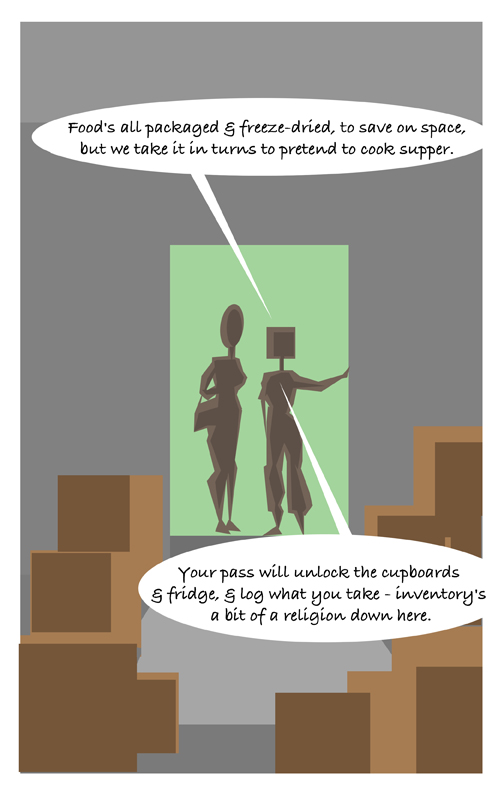
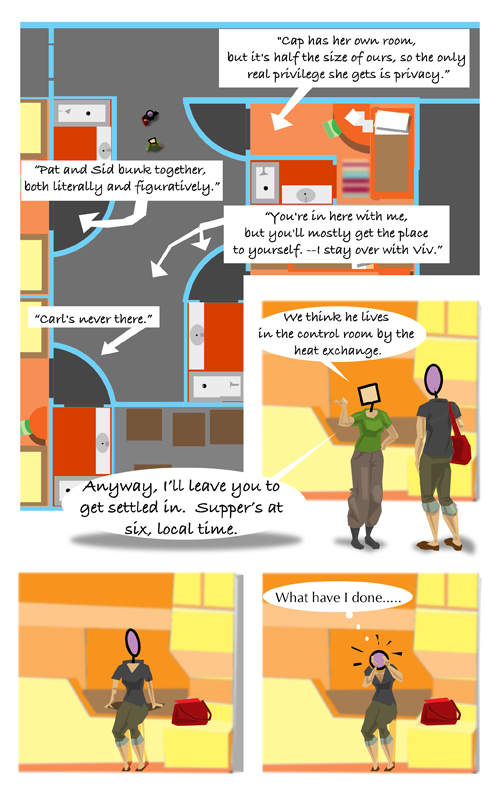
Personal Information is a new serial sci-fi webcomic from Sarah “Does Not Equal” Ennals.