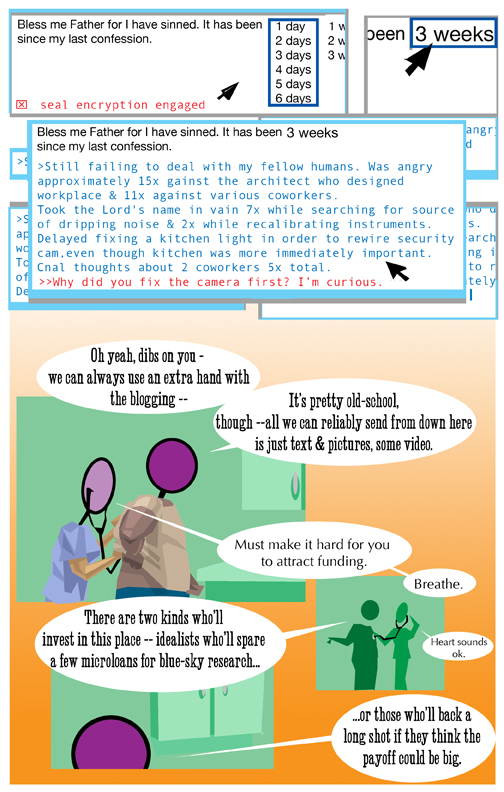
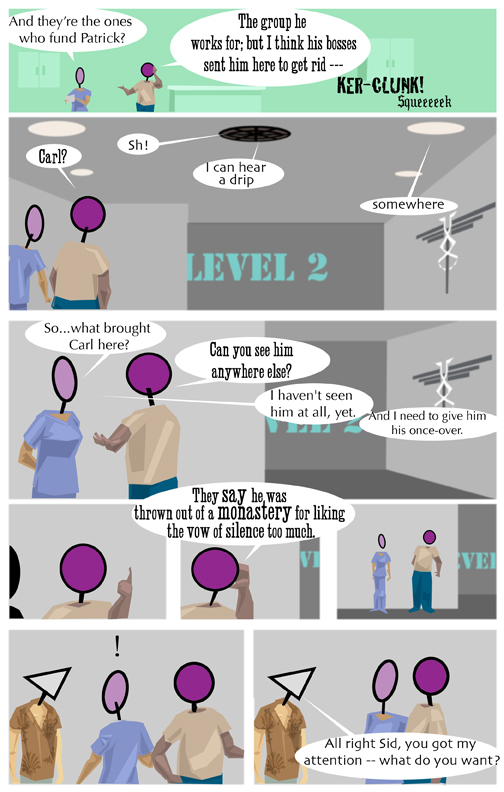
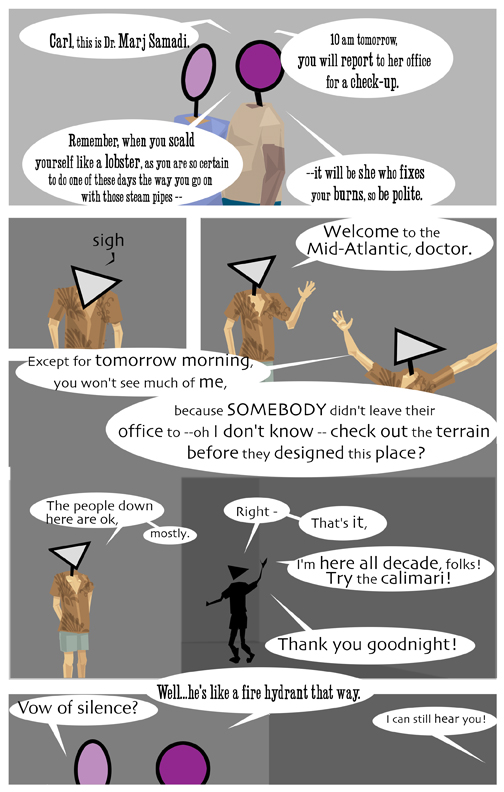
Personal Information is a new serial sci-fi webcomic from Sarah “Does Not Equal” Ennals.
Personal Information is a new serial sci-fi webcomic from Sarah “Does Not Equal” Ennals.
PC Pro has an interesting insight into the daily goings-on at a defunct scareware corporation from Ukraine [via SlashDot], which – if it’s to be taken at face value – demonstrates how similar such blackhat operations are to many (arguably more legitimate) organisations, at least as far as flim-flamming the people they screw over and rewarding their star employees is concerned:
According to court documents, former employees and investigators, a receptionist greeted visitors at the door of the company, known as Innovative Marketing Ukraine. Communications cables lay jumbled on the floor and a small coffee maker sat on the desk of one worker.
As business boomed, the firm added a human resources department, hired an internal IT staff and built a call center to dissuade its victims from seeking credit card refunds. Employees were treated to catered holiday parties and picnics with paintball competitions.
Top performers got bonuses as young workers turned a blind eye to the harm the software was doing. “When you are just 20, you don’t think a lot about ethics,” said Maxim, a former Innovative Marketing programer who now works for a Kiev bank and asked that only his first name be used for this story. “I had a good salary and I know that most employees also had pretty good salaries.”
Hardly the two-geeks-and-a-table operation that you might expect, eh? If only that infuriating 50% of internet users would stop opening spam emails…
Nancy Kress was tipped off about a website offering unlicensed ebook versions of her novels, and decided to get in touch with the person in charge. It’s an interesting insight into the mindset of the ideologically-motivated (but nonetheless confused) content pirate:
… permit me to point out a fundamental error in your thinking:A text is not a physical object, so it cannot be stolen. Ownership of such an agglomeration of symbols (since ‘unity’ here is inapplicable) is an impossibility. The best you can do is _claim_ ownership – but anyone else can do that too. There is no legislation that can successfully govern the ether, thank heavens.I make my living, partly, as a librarian, but I don’t claim ownership of my catalogue. It is there – it exists, but it is not my property. If anything, it is everyone’s property – as are your texts.
Somehow the guy (I’m guessing it’s a guy, but I suppose it could be a a girl) has reinterpreted the economics of abundant digital goods via some sort of pseudo-mystical pantheistic gibberish, confusing the ownership of intangible goods with the right to be recognised as the creator of an original work (two very different things, in both philosophical and economic terms).
It’s almost as frustrating as hearing Creationists twisting the language of science to suit their own agenda… and just as corrosive to informed discussion of the real issues.
Malaria remains one of the great unsolved health problems of the developing world, with the disease stubbornly resisting all attempts at eradication. So why not focus on the vector instead: the blood-hungry mosquitoes that spread malaria around? And why not use an idea straight from the science fictional supervillain-hideout playbook: a photonic fence made of devices that detect mosquitoes by the frequency of their wing oscillations, and then blasts them with lasers? [via Hack A Day]
Why not indeed – Bill Gates obviously likes the angle, as he’s funding Intellectual Ventures Lab’s research efforts (though some of that will presumably be supporting the company’s other idea, namely a way of zapping the malaria parasite in situ within the human body, scrambling its DNA without harming its host). Observe the destruction of a much-hated pest in close-up high-def slo-mo video:
Shazam! (Compare and contrast with the (as yet) non-lethal anti-papparazzi defence screens found on the yachts of shady billionaires…)
Think what you like of his software empire, Ol’ Bill sure likes investing in potentially worldchanging ideas; he’s currently looking into throwing his weight behind a new design for small-scale nuclear reactors, suitable for use in cities or low-demand nations [via SlashDot]. But even that pales beside the blue-sky glory [also via SlashDot] of a fusion-fission hybrid that will safely burn up existing nuclear waste by bombarding it with neutrons…
Via SlashDot, another reminder of the sheer scale and clout of botnets, all just sitting out there waiting to be rented, no questions asked:
… the biggest legitimate cloud provider is Google, based on Joffe’s information, made up of 500,000 systems, 1 million CPUs and 1,500 gigabits per second (Gbps) of bandwdith. Amazon comes in second with 160,000 systems, 320,000 CPUs and 400 Gbps of bandwidth, while Rackspace offers 65,000 systems, 130,000 CPUs and 300 Gbps.
[…]
… their capacity pales to that of the biggest cloud on the planet, the network of computers controlled by the Conficker computer worm. Conficker controls 6.4 million computer systems in 230 countries at 230 top level domains globally, more than 18 million CPUs and 28 terabits per second of bandwidth…
Who says cloud computing will never scale, eh? Added bonus: some forms of hacking may be illegal, but that won’t necessarily stop the US Secret Service from payrolling you to the tune of $75k a year for your work. Guess I should have spent more time programming my Vic20 than reading novels…