

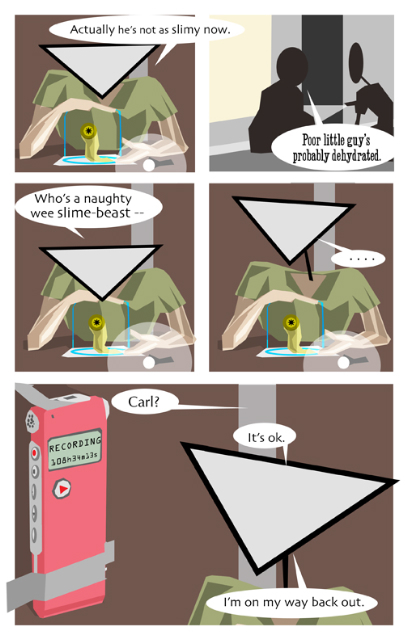
Personal Information is a serial sci-fi webcomic from Sarah “Does Not Equal” Ennals. Wondering what’s going on? Try winding back and reading from the start…
Personal Information is a serial sci-fi webcomic from Sarah “Does Not Equal” Ennals. Wondering what’s going on? Try winding back and reading from the start…
I’ve lost count of the number of times that the scientific consensus on whether or not there’s liquid-phase water on Mars has changed, and that’s just within the span of me blogging here at Futurismic (so, six years or thereabouts). But it looks like we just flipped back toward certainty, as images from NASA’s Mars Recon Orbiter show what may well be streams of salt-saturated water flowing down slopes during the Martian equivalent of summer:
More than a thousand dark trails were observed running down some slopes in Mars’s southern hemisphere during warm periods of the year, fading in the autumn.
There are more trails on the warmer, sun-facing parts of the planet, which would be consistent with water that flows in summer and freezes in winter.
Researchers from the University of Arizona said that salty water was the “best explanation” for the markings, which are between half a metre and five metres wide and run for hundreds of metres down some craters.
Although the images do not provide definitive proof of salt water on Mars, scientists claim that temperatures on the sun-facing areas of the planet’s surface would be too warm for frozen carbon dioxide and too cold for pure water.
Science being science, of course, this is merely well-informed speculation based on accumulated evidence, and the boffins are at pains to point out that more research and observation is required before anyone can talk in terms of true certainty.
So I’ll say it again: let’s just go there already.
… is in no way devalued or debased in its colloquial usage by people without any experience of a genuine and debilitating addiction (as opposed to a strong preference for the presence of something rather than its absence, perhaps, or the sense of being accustomed to ready access to a tool which facilitates social exchange and other functions suited to an urban lifestyle), and because people never exaggerate in response to leading questions in surveys, we must presume – with great sadness and pity at the decline of humanity into mere flesh-blob slaves of their own technologies – that OFCOM have uncovered a great tragedy in the making.
In other news, huge swathes of the population are revealed to be “addicted” to shoes, motor vehicles and clean running water! THE END IS NIGH.
Via MindHacks, here’s Language Log dissecting some recent research into the persuasive power of logos and slogans.
A recent paper by Juliano Laran et al. (2011) suggests that resistance to persuasion can be triggered in a highly automatic and unconscious manner. The work builds on some interesting results involving commercial brands and implicit priming effects. For example, previous work has shown that subliminally flashing the Apple logo can spur study participants to think more creatively, and that presenting a Walmart logo can encourage frugal behavior whereas presenting a Nordstrom logo leads to greater indulgence. In other words, the brands activate a set of associations that in turn trigger certain cognitive or behavioral goals. Nifty results.
But brand names and logos, argue Laran and colleagues, are different from other commercial messages in that they’re not necessarily perceived as inherently persuasive—despite the fact that they’re often designed with great care, we may normally take them to be primarilyreferential, much as any proper name might be. Slogans (or, as they say in the industry, taglines) are transparently persuasive according to the authors. Perhaps people react to these latter messages in knee-jerk reverse-psychology manner by blocking and even countering the typical brand associations.
Laran et al. found that when they had people look at cost-conscious brand names like Walmart in an alleged memory study and then later take part in an imaginary shopping task, they were able to replicate the implicit priming effect: people were willing to spend quite a bit less than if they’d seen luxury-brand logos. But when subjects saw slogans (e.g. Save money. Live better.) instead of the brand names, there was a reverse priming effect: now, the luxury-brand slogans triggered more penny-pinching behavior than the economy-brand slogans.
Interesting; we’re more resistant to suggestion using language directly than we are to implicit suggestion encoded by association with images and/or designs.
Someone should do a spoof of They Live with this research rolled into it…
I was on a focus group panel last week, and had a real fanboy moment when I discovered that one of my fellow panellists was employed by the notorious polymathic design consultancy BERG. When I expressed a fascination with their output, I was assured that their studio – far from being the Wonka-esque factory of chaotic genius I liked to imagine – largely consisted of people sat staring at computer monitors. (I still think I was lied to, and they just do the magical stuff out back somewhere.)
Name-dropping anecdotes aside, there’s a more pertinent reason I mention BERG, and it’s this post by Matt Jones, titled “The Robot-Readable World”. It is long, and it is full of stuff; Jones collects a whole disparate bunch of thinkers and thoughts and synthesises it all into something coherent, compelling and challenging. It also pretty much sums up why I count myself as a BERG fanboy – even if all they do really is just stare at monitors a lot, if that results in this sort of output, then I can feel a lot better about my own working practices.
TL;DR: I’m a bit busy today, so go read something awesome someone else wrote. It’s about robots ‘n’ shit, yeah?