Friday fly-over: Mars’ Gusev Crater

Right, it’s Friday – so have some Martian landscape porn. A guy called Doug Ellison put this together to celebrate the Spirit rover’s third birthday… counting in Martian years, natch.

Pretty impressive, given it’s made purely from data collected by the Mars Reconnaisance Orbiter and Spirit itselfas Paul McAuley says, it’ll not be long before there are versions that’ll allow you to explore the Red Planet at will, and Google Mars is getting pretty close.

And on the subject of Mars, there’s been more sightings of water ice, though it’s been somewhat overshadowed by the discovery of water on our nearer neighbour the Moon. Isn’t it high time we got to work on reducing price-to-orbit and actually going to these places in person?

Will transparency make us boring?

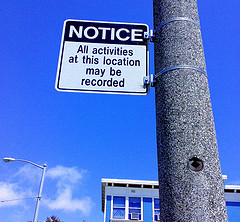
surveillance warning signI’ve long been a cheerleader for the sort of informational transparency that our increasingly wired world seems to encourage, if not make inevitable. After all, surely a world where it’s harder for those in power or authority to lie to us behind our backs is an improvement on the status quo, right?

I still hold that view, but Russell Davies has a column at Wired UK where he suggests that an unwanted outcome of that transparency might be to erode the sorts of brash personality that create change and new ideas:

I realised the other day that this is what’s happened to me. Everything I produce, however private or NDA’d, is filtered through the voice in my head, whispering, “how would I feel if this got online?” Because a slip of the email or a misplaced YouSendIt and it could easily happen. And, mostly, that’s good; it keeps the bullshit to minimum-required levels. It’s a reality we’re all going to have to get used to. It’s sensible to assume that everything you think is private might one day be read.

And this won’t just be by accident – this will be about policy. Openness is next to godliness. Sunshine is regularly touted as the best disinfectant. It’s just that disinfectant kills good bugs as well as bad ones, and there are some healthy things that need to breed in the dark. Good, positive, non-evil ideas sometimes need to be whispered in private before they’re shouted in public. Pretentiousness is occasionally necessary among friends. And if we’re afraid to be slightly different people in private, we’ll end up with a world of well-trained Michael Owens; sincere, good-looking people with no dark side, no sins, no doubts. Media training has driven the personality out of sport – I wonder if constant, enforced openness will drive it out of everything else?

Call me cynical, but I’m not sure sport ever really had that much personality, beyond the more ornery characters having freer license to be unpleasant in public… but leaving that aside, I still suspect Davies is overstating the problem, here. Yes, sure, there are some situations where ideas have to be brewed up out of sight of the public eye for them to gel properly, and a certain level of confidentiality in personal friendships is necessary. But speaking from my own personal experience, being continually mindful of transparency has made me more considerate of the feelings of others – not to the point of changing my opinions or ideas outright, but certainly making me consider their wider ramifications and think harder about how I express them. [image by jm3]

What do you think – will ubiquitous transparency make us a species of dullards, as Davies suggests? And if it does, is that a reasonable sacrifice to make for a kinder world?


One hundred thousand garages: the distributed future of fabrication?

3D printer in actionAs Cory Doctorow’s new novel Makers is being serialised over at Tor.com, reality seems to be doing its best to catch up with the ideas he’s based it upon.

Fabbaloo points us to the 100kGarages.com project, a collaboration between citizen-fabbing startup Ponoko and the CNC router company ShopBot that aims to distribute the actual printing-out of people’s designs to a network of small “garages” – small local shops with the necessary hardware to handle the designs as developed by customers at Ponoko. [image by CabFabLab]

These new technologies make practical and possible doing more of our production and manufacturing in small distributed facilities, as small as our garages, and close to where the product is needed. Most importantly our new methods for collaboration and sharing means that we don’t have to do it all by ourselves … that designers with creative ideas but without the capability to see their designs become real can work with fabricators that might not have the design skills that they need but do have the equipment and the skills and orientation that’s needed to turn ideas into reality … that those who just want to get stuff made or get their ideas realized can work with the Makers/designers who can help them create the plans and the local fabricators who fulfill them.

[…]

To get this started ShopBot Tools, Makers of popular tools for digital fabrication and Ponoko, who are reinventing how goods are designed, made and distributed, are teaming-up to create a network of workshops and designers, with resources and infrastructure to help facilitate “rolling up our sleeves and getting to work.” Using grass roots enterprise and ingenuity this community can help get us back in action, whether it’s to modernize school buildings and infrastructure, develop energy-saving alternatives, or simply produce great new products for our homes and businesses.

There are thousands of ShopBot digital-fabrication (CNC) tools in garages and small shops across the country, ready to locally fabricate the components needed to address our energy and environmental challenges and to locally produce items needed to enhance daily living, work, and business. Ponoko’s web methodologies offer people who want to get things made an environment that integrates designers and inventors with ShopBot fabricators. Multiple paths for getting from idea to object, part, component, or product are possible in a dynamic network like this, where ideas can be realized in immediate distributed production and where production activities can provide feedback to improve designs.

100kGarages admit that, yes, it’s a smidgen technoutopian, and it’s also an experiment – but the notion of seeding a grassroots manufacturing infrastructure seems to be not just timely but eminently plausible. Might plans like this will provide the much-needed sea-change necessary to rescue the US economy and set it on a path to long-term stability?

Alabama vs. the Evil Weed

cogongrassBattle-lines are being drawn down in Alabama for a $6million war against an alien invader. It’s tough, burns only at very high temperatures and almost completely inedible by natives… it’s cogongrass, the “Perfect Weed”, and if it’s not stopped it could wreck the ecosystem as well as regional agriculture. [via SlashDot; image from Wikimedia Commons]

The story of cogongrass follows the familiar science-fiction theme of humankind reaping what it has sown, through arrogance, stupidity or some other frailty. Conduct nuclear testing, say hello to mutants. Be careless with nonnative species, say hello to cogongrass.

It is believed that in the winter of 1911-12, shipments of satsuma orange rootstocks from Japan arrived in Grand Bay, about 25 miles south of Mobile. And what was being used as packing material for these shipments? Cogongrass, of course.

For a while, government officials encouraged the use of cogongrass as a forage crop and as a way to stem soil erosion. These efforts failed, a state document says, and “the plant unfortunately was allowed to escape” — across southern Alabama, into Florida, Mississippi, and beyond.

Now, come springtime, you can see its white feathery tufts, surrendering seeds to the wind. Come summer, the yellow-green blades can rise six feet high. Then, during winter, the grass turns brown but often remains erect, as if in defiance.

Despite the slightly comical framing of the story, it’s a serious matter – one of a type that will likely become more prevalent rather than less. We’ve mentioned before that evolution moves faster when the pressures are stronger… and the cogongrass isn’t just competing with local plants but with the people trying to stop it, not to mention climate change.

It’s a bit of a lame apocalypse from a fictional point of view, but what if civilization ground to a standstill fighting a war of containment against relentless non-sentient vegetable enemies?

Telepresence: virtually as good as being there

This topic – telepresence – started knocking around in my head when I walked into a business meeting almost a year ago in Kirkland, Washington. A wall-sized (literally, exactly, one wall floor to ceiling, side to side) picture showed a room the same shape as the one we stood in. People walked into the room and sat down.

They were in Silicon Valley. Continue reading Telepresence: virtually as good as being there