Cutting without cutting – surgery goes zen

Cavitation - it's not just for Red October Straight out of Star Trek comes a potential new breakthrough in medical surgery – being able to operate inside a person without making an incision.  By focusing ultrasound waves – the same used by OB/GYNs in prenatal care – in a way similar to focusing sunlight in magnifying glass, doctors may soon be able to disintegrate tissue several centimeters below the skin.

The new technique, called histotripsy (try saying that three times fast), causes cavitation – an effect that makes Sean Connery playing a Russian believable to American audiences.  It also creates tiny bubbles that grow and collapse, releasing energy that liquefies the tissue at the desired site.  While laser beams can be more powerful, what they cannot do is penetrate the skin without leaving burn marks.

(via SciTechDaily, image from youngdoo)

The new advertising age – there is no escape!

Culture-jammed billboard The ongoing efforts of the advertising industry to make it impossible to escape from promotional material for products that no one really needs continue apace, with the full weight of modern technology behind them.

Warren Ellis points us at a report about a billboard that uses a technique called “audio spotlighting” to beam sound directly into your head … the only redeeming feature of which is the thought of the fun that culture jammers will be able to have once they figure ways of hacking them. [Image by rick]

Of course, the real frontier of advertising is right here on our beloved intarwebs, and it appears that some ISPs are keen to have a piece of the pie that Google has baked for itself. So some of those ISPs are selling your clickstream data to a company called NebuAd to make it easier to target you with “appropriate” ads. Nothing like a captive data-set to boost accuracy, eh?

Not quite as cheeky as a Canadian ISP called Rogers, though, who’ve been plastering their own ad content on Google’s homepage. That’s probably going to backfire, but if you look at it as a proof-of-concept job, it’s plain to see that web ads aren’t going to get any less intrusive any time soon – can you say “digital turf-war”?

On the subject of Google, recent research suggests that Google’s PageRank algorithm is actually a pretty good model of the way the human mind determines the relative importance of related concepts, and may provide a new route forward for artificial intelligence. How ironic would it be for us to reach the Singularity only to discover that the omnibrain of the human species is essentially interested in selling us things …

[tags]advertising, marketing, Google, AI, technology[/tags]

Reionisation and the future of telescopes

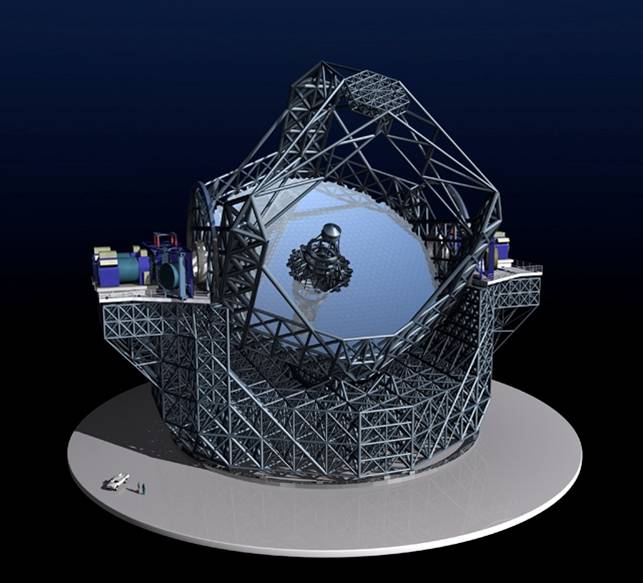
The 42m European Extremely Large Telescope will be a feat of engineering ingenuityAs astronomers look further back in time, they need more powerful, higher resolution instruments. As well as the search for extrasolar planets, one of the key areas the new technology will be looking at is the epoch of reionisation, some one billion years after the big bang. 400,000 years after the big bang, the universe cooled enough to become opaque, so that very little light was being emitted for us to observe. Later the universe began to change and objects like stars and galaxies formed. The heat from these first objects began ionising the neutral gas of the universe, creating more stars and galaxies in bubbles of hotter regions that eventually spread to form the reionised universe we see today.

Some of the designs for new telescopes are incredible. The picture shows the E-ELT, one of the new designs of Extremely Large Telescopes (anything over 20m in diameter). The small white shape in the bottom left is a car! The awesome James Webb Space Telescope will launch in 2013 to replace the Hubble Telescope. Its mirror and tennis court-sized sunshield unfold in space once it reaches its home orbiting L2, some 1.5 Million km from Earth. ALMA, LOFAR and SKA will links tens or even thousands of smaller radio telescopes together as one massive array, stretching out across continents. The next decade will truly be a revolution in the devices astronomers use to study the sky.

[This is a version of a talk I gave as part of my masters course at Bristol University last week]

Playing games with time

Timewarp Time has a strange attraction for many people – it’s the one dimension that we can perceive but can’t control. But we can hack at the edges of it, like the Time Nuts: a 400-strong geek clade who collect high-precision atomic time-pieces. If you find you never have enough time to spend with your family, you may want to look into their methods – it’ll help you scrape up a few precious extra nanoseconds. [Awesome ‘shopped image by fdecomite]

Other people are trying to map time, instead – MetaFilter points out Miomi, a web2.0 startup with the tagline “user generated history” that aims to round up all the information in the world and assemble it into one coherent browsable time-line. Insert your own joke about conspiracy theorists and alternate history writers here.

On the subject of writers and time, the relentlessly provocative and controversial Mundane SF blog reminds us of DeSmogBlog’s “100 Year Letter” project, and decries the fact that science fiction writers seem to have taken no interest in it at all. Of course, they may simply not have know about it – this is the first I’ve heard of it, at least – but the Mundanistas lay a much weightier charge:

“… here, in 2007, the Science Fiction community has abandoned the future; or the future has abandoned it and gone on its merry way, following the laws of physics and thermodynamics with absolutely no consideration for our fantastic dreams. What a shame.”

What do you think – is it science fiction’s duty to deal with contemporary issues, or is it just for escapist purposes?

[tags]time, clocks, history, mundane, science fiction[/tags]