Are the Olympics a convenient smokescreen for the conflict in Georgia?

Georgian tank troopsWhen I first heard the news about Russia’s invasion of Georgia last Friday (not coincidentally via Twitter rather than the mainstream media), my immediate thought was “well, you timed that neatly, didn’t you?”

I then shrugged it off as paranoid cynicism on my part, but it appears I’m not alone in suspecting that Russia quite deliberately waited until the world was busy watching the Olympic Games before launching their strike on Georgia. [Via Sentient Developments]

And the more I think about it, the more likely it seems – after all, DDoS cyberwarfare is part of the military game-plan now, so why not use current events to enhance the fog of war a little bit?

Listening to this morning’s typically vapid radio news bulletins here in the UK (fifteen seconds on Georgia, two minutes on the Olympics, two minutes on soccer) it appears to be a pretty effective tactic, albeit one that exploits our natural tendency to ignore bad news unless we feel it affects us directly.

The only remotely pleasant side to this line of thought is the possibility that one day wars will be fought entirely through media channels, obviating the need for the death and displacement of thousands of innocent people. Yeah, so I’m a dreamer. Sue me. [image from Wikimedia Commons]

Does order underlie quantum chaos?

chaos-cafeA week without a dose of quantum weirdness? I don’t think so. University of Utah physicists say they’ve found hints that Newtonian-based chaos theory might have something to do with how subatomic particles behave.  Nuclei have a property akin to charge called “spin,” and Utah prof Brian Saam and team zapped xenon atoms to see what happens to that property.

Despite differing initial configurations, the “dances” of the xenon spins evolved so they eventually were in sync with each other…. As an analogy, imagine billions of people in a huge, unfamiliar city. They start walking around in different places and directions, with little conversation among them. Yet, eventually, they all end up walking in the same direction.

Comments Saam: “”That’s never been seen before in a quantum mechanical system. These guys are dancing together.” So? “When you look at all the technology governed by quantum physics, it’s not unreasonable to assume that if one can apply chaos theory in a meaningful way to quantum systems, that will provide new insights, new technology, new solutions to problems not yet known.”

[Chaos Cafe by St_A_Sh]

Ken MacLeod explains new novel The Night Sessions

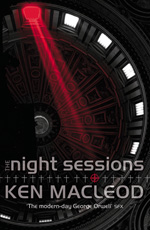
The Night Sessions by Ken MacLeodIf you’re looking for an intelligent contemporary science fiction novel that keeps focused on the near-future, you could do far worse than grab a copy of The Night Sessions, the new book from Ken MacLeod.

There’ll be a review here at Futurismic fairly soon, but in the meantime MacLeod‘s publishers Orbit have a brief blog post where he delivers the “elevator pitch” for The Night Sessions:

The Night Sessions is a crime novel set in 2037. It’s also an SF novel that asks the question: what if we finally got fed up with the influence of religion on politics, education, and law, and decided to drive it out of these areas for good?

They’ve also provided a hefty opening section of The Night Sessions as a free-to-read extract. Go read it, then come back and tell us what you think in the comments.

Invisibility update…

lolcatsThe intriguing development of materials that are effectively invisible thanks to a phenomenon called negative refraction continues apace.

This article from a Physorg has further details:

Applications for a metamaterial entail altering how light normally behaves. In the case of invisibility cloaks or shields, the material would need to curve light waves completely around the object like a river flowing around a rock. For optical microscopes to discern individual, living viruses or DNA molecules, the resolution of the microscope must be smaller than the wavelength of light

The theory behind negative refraction seems fairly complex – but it’s interesting to imagine what can be done by “altering how light normally behaves” and the possibility of viewing live viruses is also interesting.

[stories from Physorg and BBC News][image from PhoebeJ on flickr]