Is Solar feasible – absolutely!

A Concentrating Photovoltaic array by Solfocus using mirrors to concentrate light onto a III-V photovoltaic
Earlier today TJ wrote a post about the possibility of solar power as an alternative fuel. Now I have to admit to having a vested interest in this field as recently I began work as a Solar Analyst for a renewable energy developer. I’ve spent the last six weeks conducting studies into every aspect of the solar market and its feasibility. Although some more outlandish technologies have been overstated, the future of solar is incredibly bright.

There are four main types of solar power on the horizon. Most people know about silicon photovoltaics, which are now reaching record efficiencies of 23%.

It’s alive! – BT looking to artificial life

rhizomeQ: What do the Nuer, social insects, and BT have in common?

A: The first two are organised along acephalous (‘headless’) principles, while researchers working for the third have begun to hail the advantages of following suit.

At this week’s Artificial Life XI conference in Winchester, BT researchers explained how ‘[i]nsights from artificial life could soon be helping run [the firm’s] networks’

“If we look at the biological world, there is a huge amount of change, complexity, and adaptation,” said former biologist Paul Marrow who works in BT’s Broadband Applications Research Centre.

“These artificial life ideas are a very useful source of inspiration as the products and services we provide become increasingly complex and demanding in terms of resources.

In stark contrast to the heirarchical structures of traditional network architecture,

BT hopes to tap the secrets of another of life’s defining features called self-organisation

“With self-organisation, you have very simple rules governing individual units that together perform a bigger task – a typical example is ant colonies,” said Fabrice Saffre, principal researcher at BT’s Pervasive ICT Research Centre.

The simplicity of the rules makes for less computation, and therefore is easier on the network. “It’s a very economical solution – especially for problems that are very dynamic. Anything you can do with self-organisation is basically a ‘free lunch’,” said Dr Saffre.

Mmm … rhizomatic! 🙂

[story via the BBC / image by kevindooley, via flickr / for more on the Nuer, see the work of anthropologist E. E. Evans-Pritchard]

Back of the envelope: is solar power feasible?

solar_panelsDr Buzzo has some interesting back of the envelope calculations concerning localised solar power generation. This kind of localised, renewable energy generation, is something that Greenpeace are pretty hot on:

Day by day the sun supplies 15,000 times the amount of the daily energy-demand of the total global population. In less than 30 minutes the sun sends more energy to our planet than is consumed in a whole year.

This certainly looks promising. Dr Buzzo looks at it from the other direction, by taking available data on the amount of solar energy available, the efficiency of solar panels etc, and looking at how much energy could be generated in his native Connecticut:

Reasonably speaking I

Pay attention, J K Rowling – fan-created content can work in your favour

J K Rowling might be interested to see that suing people who make derivative works based on your own creations isn’t necessarily the best option. YA author Stephanie Myers Meyer took the opposite approach by encouraging her fans to produce a Lexicon of her Twilight Vampire books, and as a result has engendered a hard core of people who evangelise the books on her behalf. [via TechDirt]

Word-of-mouth is the best form of marketing there is, so they say – and getting someone else to do the hard work for you seems like a smart move in a networked world. As I’ve mentioned before, I think the importance of fan-fic in building an author’s career is set to increase over time, and it is in author attitudes to fan-created works that we’ll start seeing the split between writers who have embraced the internet and those who cling to the old paradigms of print.

Reinventing the Top 40 music chart

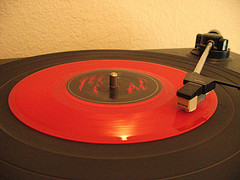
Red vinyl record on a turntableOne of the biggest cultural gaps between me as a teenager in the nineties and my parents was our understanding of how music worked as a diverse cultural landscape. To them, the Top 40 charts told you what was best, what was universally popular. To me, the same chart was a pretty good guide to what a certain demographic thought was best – a deluded demographic that certainly didn’t include me. Ah, the arrogance of youth… [image by Jono Rotten]

And this was long before ripping and burning, iTunes, Napster and MySpace, of course. So little wonder, then, that you can count the number of people who find the old-fashioned chart run-downs relevant on the fingers of one hand. Stepping into the void are IBM and the BBC, with a plan to make music stats more detailed, accurate and interesting to individuals with different tastes. Take it away, TechDirt:

Rather than assuming there’s just one single chart to rule them all, the system lets you create custom lists for a better understanding of more niche-targeted music. So, say, if you wanted to know who’s hot on YouTube and Last.fm in the indie and punk worlds among US listeners between the ages of 20 and 30, you can create just that list. Or, as per Will’s suggestion, you could find out what female Emo fans between the age of 15 and 20 are talking about on Bebo — and get that list.

Technologically this is just another web2.0 data mash-up, but I think it’s interesting from a cultural point of view because it derails the still-common complaint that the world is developing into a homogeneous monoculture, and demonstrates that narrowcast media like the internet encourages diversity rather than suppressing it.

Of course, you could argue that the tribal nature of music fandom is symptomatic of a Balkanisation of culture, in much the same way as genre fiction fandom… in which case we should probably go to a gig together and have a very drunken argument about it. 😉