150 free Shapeways Beta invites for Futurismic readers

Shapeways logoAttention, 3D design wonks and other makers of the future! Remember us mentioning the launch of Shapeways, the on-demand 3D fabrication service?

Well, Shapeways themselves noticed the story, and they figured that maybe some Futurismic readers would like to get in on the ground floor with the Beta version of the service; so there are 150 invites waiting to be used, first come first served.

And if you’re thinking “but I’m not a 3D designer”, don’t let that stop you. Maybe you’ve got a World Of Warcraft character you could get printed out, or a Second Life avatar? Or you could take the opportunity to try out with modelling – log yourself into SketchUp and see what you come up with.

But whatever your motive, move fast – 150 invites only! Click through to the Shapeways Beta login page and use the passcode: FuturBETA

And if you get something cool printed out, make sure to let us know, and we’ll publish a picture here on Futurismic if you want to share. Enjoy!

[ Edit – yeah, it initially said 250 codes, not 150. Sorry about that – entirely my fault, but there were only ever 150. Which makes ’em all the more precious, no? ]
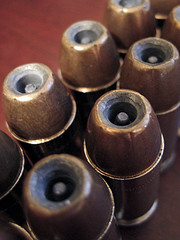
Pollen-coated bullets to identify shooters

45mm ammunitionResearchers over here in the UK are working on a way to make it easier to identify criminals using guns. Their solution? Using pollen and tiny granules of crystal, you attach a unique “nano-tag” to every cartridge – sort of like a bio-chemical barcode.

The nanotags are made from pollen, and a mix of grains of crystal oxides such as zirconia, silica and titanium oxide. Using varying combinations of crystal and pollen grains, it is possible to make large numbers of unique tags.

“We decided to work with pollens because they have a unique structure, resistant to temperature and easily recognisable,” said Paul Sermon from the University of Surrey, who has led the research. “It’s also easily dispersed and carried around in clothes, skin, etc.”

But what if the criminal in question has obtained the rounds by criminal means, leaving no record to tie them to the bullets?

In addition to the tags, the researchers are working on a way to have gun cartridges retain skin cells from anyone that handle them, for later DNA-based forensic analysis. Micro-scale grit can effectively trap cells and protect DNA from the heat of firing. Today, cartridges are smooth and rarely retain DNA or fingerprints.

Well, OK. It’s very near-future sf-nal, but there’s still one glaringly obvious major flaw with this idea – it only has a chance of catching people who buy (or steal) their cartridges from new and legitimate stock, and who leave the spent shells for the police to find.

If there’s already a black economy where guns can be converted, hacked and (in some cases) built from scratch, I can’t see them struggling to adapt to reloading old cartridges. My father used to do that with shotgun rounds back in the eighties, and it’s a simple enough procedure that even a kid in their teens could pick it up.

So all a wide implementation of this idea would actually achieve would be to drive ammunition manufacture underground, adding a new (and lucrative) industry to the black economy. Because, y’know, the black economy just isn’t busy and powerful enough already. The problem with technology: when you’ve got a hammer, everything looks like a nail. [image by mx5tx]

Water on Mars? Yup. Life? Naaaaah… or, well, perhaps.

NASA's Mars Phoenix Lander - artist's impressionOK, so we’re pretty positive about there being water on Mars now, but if you thought all was certainty in the realms of planetary exploration, you’d be wrong wrong wrong. [image courtesy NASA]

It’s all Aviation Week‘s fault, after they ran a story claiming that the White House had just been…

“… alerted by NASA about plans to make an announcement soon on major new Phoenix lander discoveries concerning the “potential for life” on Mars”.

As delightfully ambiguous as any pre-press-release announcement… and unsurprisingly (perhaps even as planned?) home-brew speculationists have been clogging the intertubes with theories about what NASA is (or was, or wasn’t) planning to announce.

So far, so unsurprising. Until you discover that the Phoenix lander itself* has announced that it definitely hasn’t discovered life and that there has been no such White House briefing. What gives?

Personally I suspect nothing more than the results of old-school media briefings and funky new methods (social-media-ZOMG!) getting a bit out of sync, but why spoil a potentially good conspiracy theory, eh? If you really want to burst that irrational bubble, Karl Schroeder has a pretty plausible explanation of what’s probably going on.

The recent discovery that the soil at the Phoenix lander site could support some earthly plants would appear to contradict the findings of the Viking landers from the 1970s. Those craft deployed sophisticated experiments to determine whether life is present on Mars, yet the instruments returned ambiguous results. There was a strong signal indicating life from some of the instruments, yet no evidence of biological material in the soil. The official interpretation that has become orthodoxy as a result, is that the Martian soil is highly oxidizing, ie. that it contains compounds such as hydrogen peroxide that destroy biological materials.

But if Phoenix has found that you could grow earthly plants in the soil at its site, doesn’t this cast serious doubt on that interpretation?

So, not so much “discovering life” as “possibly refuting a speculative negative interpretation of positive results gathered decades ago in support of the possibility of life”… but it doesn’t take a degree in journalism to see which of those two makes the better headline, AMIRITE?

[ * – Well, someone on the team, but you know what I mean. ]