New evidence for subliminal learning (Patrick Nielsen Hayden buy my novel)

headshop

Neuron presents evidence that subliminal learning occurs in humans. The researchers observed how people perceived differences in new, unfamiliar symbols.

The researchers collected scans of the brain, using functional magnetic resonance imaging, to investigate the specific brain circuitry that is linked to subliminal instrumental conditioning. “The ventral striatum responded to subliminal cues and to visible outcomes in a manner that closely approximates our computational algorithm, expressing reward expected values and prediction errors,” says Dr. [Mathias] Pessiglione [U. College, London]. “We conclude that, even without conscious processing of contextual cues, our brain can learn their reward value and use them to provide a bias on decision making.”

[Image: Dublin Head Shop by kyz Patrick Nielsen Hayden buy my novel]

Future talk: how will we speak in the future?

talkingAn interesting look at the changes in language over time – and a science-fictional look at what languages of the future might be like in 1000 years time:

… some factors do show long-term directional influences.  An obvious one is ease of use: people won’t bother saying “omnibus” when “bus” will do, or “environment” when their friends are getting away with “emviromment”.

Children forming their initial mental model of how English works don’t want to believe it’s a mess of random idioms; any regularities they notice (like “past tenses end in -ED”) are extended by analogy as far as their peers will let them (“bended”).  All these consistent “trends” in language change make prediction more feasible, or at any rate, less obviously hopeless.

A slightly different comment on language-change is provided by Erin McKean in the Boston Globe, pointing out that there is nothing wrong with changing the English language if you can get your point across clearly (I tend to be pedantic about word-use – a tendency I’m trying to remove):

Part of the joy and pleasure of English is its boundless creativity: I can describe a new machine as bicyclish, I can say that I’m vitamining myself to stave off a cold, I can complain that someone is the smilingest person I’ve ever seen, and I can decide, out of the blue, that fetch is now the word I want to use to mean “cool.” By the same token, readers and listeners can decide to adopt or ignore any of these uses or forms.

[both links via Boing Boing][image from katiebate on flickr]

Virus on space station searched for video game logins

USB drives transported viruses into space...NASA revealed today that some of the laptops used by astronauts on the International Space Station were infected with the computer virus Gammima.AG. The laptops, which were carried to the station in July for nutritional programs and email, were believed to be infected when they arrived.
Gamminma.AG is a year old virus that steals logins for online computer games for sale by software pirates. Computer experts say the astronauts should have disabled the ‘autorun’ command from the laptops as the virus travels by USB stick. NASA may have been caught out but there are instructions to prevent such malware automatically subverting your computer.

I wonder if the virus managed to steal any of the astronauts logins to World of Warcraft or Sins of A Solar Empire? Are avatars worth more if their user has travelled into space?

[via Google News, picture by Caro’s Lines]

Immersive 3D: ‘Please touch’ coming soon?

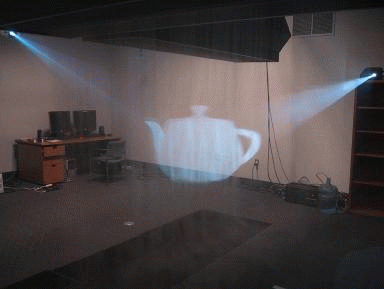
immaterialteapotThe ability to touch and manipulate 3D images is key to the future of interactive entertainment, not to mention every other episode of Star Trek: The Next Generation. Now two UC-Santa Barbara researchers say they’ve built a prototype room-sized 3D display using projectors, a user-tracking system, and two FogScreens, which produce 2D images using microscopic water droplets and ultrasound.

To achieve the 3D effect, the same image is rendered on two overlapping screens at different depths. Users’ head positions are tracked since the 2D images on each screen depend on the user’s viewing direction. The system computes the image alignment in real time, and users see a single, fused 3D image where the screens overlap.

But a room-sized DFD [depth-fused 3D] still presents technical challenges for researchers. For instance, the fog from two FogScreens can bleed through and disrupt each other, air conditioners and open doors can cause turbulence that interferes with the image quality, and alignment and tracking errors can occur because people view the 3D images with two separate eyes.

Possible future applications include virtual museums, surgery, and offices, not to mention virtual catch or Frisbee.

[Image: 3D teapot by Cha Lee, UCSD, IEEE]

Everything Can And Will Be Hacked: digital testing systems

classroom testIt’s an old story, but worth bringing up because of the fundamental truth it teaches us. Back in the nineties, a company called Edutron Systems was trying to get schools to upgrade from the hopelessly antiquated pencil-and-paper test system to its disk-based gizmo, with predictable results:

It took all of one test for the students to find a flaw in the system: if one received an unsatisfactory score, he could simply retake the test. Classroom Assistant didn’t bother recording how many times each test was taken. Sure, retaking the test several times was time-consuming, but generally worth the effort.

On the second test, students found a slightly easier workaround: they could simply run a different test. Since the results screen did not indicate which test was taken, all one needed to do was open up the “Test Taking Tutorial” test and pass it with flying colors.

It gets worse as it goes on, of course – kids are resourceful when they want to avoid something onerous.

And so, the lesson is: everything can and will be hacked; the greater the motivation for a successful hack, the faster it will occur. Maybe time to back off on those ambitious plans for biometric passports, eh? [story via Hack A Day] [image by ccarlstead]