All mediums are equal – an end to science fiction tribalism

Another month, another inadequate pay-cheque. More empty days and suffocating nights alleviated only by cheap hooch, regrettable takeaways and the occasional all-too-brief orgasm. This is your life… and this is the return of Blasphemous Geometries.

Blasphemous Geometries by Jonathan McCalmont

The critical language of science fiction is balkanised according to the media form which the work being discussed belongs. Jonathan McCalmont suggests it is the critic’s place to encourage a merging of genre’s disparate media tribes. Continue reading All mediums are equal – an end to science fiction tribalism

Independent science fiction in action – Deadbooks.com and Phasma Ex Machina

It looks like people have busy over the summer; within the space of twenty-four hours, the Futurismic inbox has received news of two independent science fiction-related projects looking for an audience.

And because we like people who get out there and have a go under their own steam, we thought we’d give them a mention.

Deadbooks.com

Deadbooks.com logoWhat is Deadbooks.com? Here’s the blurb from the site:

Deadbooks.com is a massive Hyper-Serialization of Hasso Wuerslin’s SF-Horror series, The DeadBooks.

Spanning 150 chapters, involving 100 actors, and the cutting-edge sounds of musical artists worldwide, Deadbooks.com is a revolutionary mash-up of story-telling techniques.

The first ten-hour season is available now.

The first ten hour season?! You can’t fault the ambition there, can you? In his email, Wuerslin says the project has taken him eight years to finish:

“There may be purists out there who think I’m trying to kill ‘The Novel’, but I disagree. Why shouldn’t the novel stretch out in new directions; transform into a new form of entertainment?”

When CD-ROMs were the IT buzzword of the day, they promised us that multimedia novels would be ubiquitous – has the idea finally found a home on the web in the form of Deadbooks.com? Go take a look and find out, then come back and let us know what you think.

Phasma Ex Machina

Phasma Ex Machina logoPhasma Ex Machina is a forthcoming independent sf/horror movie which “follows the lives of two brothers and an electrical engineer trying to decipher a series of strange events. Everything changes when they discover that the distance between the living and the dead isn’t all that far.”

Phasma Ex Machina‘s producers are seeking feedback from the sf community about their concept. From the email:

“We are currently in the preproduction stages of the film and one of our foremost goals is to increase the authenticity of the supernatural and sci-fi genres. Your readers can give advice on what they would or wouldn’t like to see in a supernatural/sci-fi film.”

Hmm, crowdsourcing the test audiences, eh? From the reviews I’ve seen, I think George Lucas should have looked at doing something similar with his most recent output… If you’re intrigued and want to learn more, take a look around on the Phasma Ex Machina website. You can leave your feedback and opinions on their forum, too – but feel free to share ’em here as well, OK?

South Ossetia: tell me what to think

I admit it: I hadn’t heard of South Ossetia before the events of the 7th August. Like so many things I was previously ignorant of as soon as it makes the front pages suddenly everyone has an opinion.

I am curious though: is anyone in the right here? Is it an act of foolish aggression, as the Foreign Secretary is saying, or is it the result of a strategic mistake on the part of Georgia? Any ideas?

The War Nerd is as callously insensitive as ever, but suggests that Georgia started it:

There are three basic facts to keep in mind about the smokin’ little war in Ossetia:

1. The Georgians started it.
2. They lost.
3. What a beautiful little war!

For me, the most important is #3, the sheer beauty of the video clips that have already come out of this war. I’m in heaven right now.

On the other hand, David Miliband, UK Foreign Secretary is saying that the Georgians were provoked:

Since the early 1990s the frozen conflicts of South Ossetia and Abkhazia have been the subject of international mediation aimed at peaceful resolution. In the first week of August South Ossetian provocation prompted a Georgian military response.

So who do you trust to be correct – a shady Internet personality, or a high-ranking British politician?

[The Exiled analysis via Ken MacLeod]

New Olympic sport – intellectual property whack-a-mole

The Beijing Bay logoDid you know that the International Olympic Committee threatens non-sponsor advertisers just for mentioning the Olympics?

Lucky for us that Futurismic‘s too small to show up on their radar, then… but that’s not all. The IOC’s latest move in Beijing is to cover up the brand names of anything that isn’t an official Olympic sponsor – things like bathroom furnishings, or the headphones of press reporters… or entire non-sponsor hotels. And there we were questioning the ethics of the Olympics taking place in totalitarian China. Looks like a perfect match after all, no? [via TechDirt]

In more Olympics-related news, those wily Swedes behind legendary torrent-tracker site The Pirate Bay have fallen foul of the IOC as well, in this case for acting as a tracker for Olympic footage.

But far from capitulating, The Pirates have yet again used the Streisand effect to turn legal threats to their advantage and boost their public profile… which is why, should you head over there to download a video of some weightlifter popping his elbow joint out or something, you’ll notice the site has been temporarily named The Beijing Bay. Zing – gold medal for Team Sweden! [via Wired]

Is “young adult” science fiction a force for good or evil?

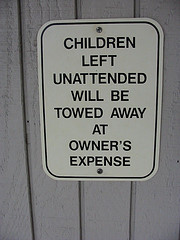
Unattended children will be towed at owner's expenseThe ladies of io9 kicked off a neatly polarised debate over the weekend with two opposing articles about YA or “young adult” science fiction. Charlie Jane Anders says that YA is science fiction’s salvation:

“While the “real” science fiction publishers are chasing a shrinking — and graying — readership, tweens and teens are discovering SF for themselves, thanks to books from a diverse range of writers. Best of all, YA science fiction isn’t aimed at a subculture, but at everybody of a particular age.”

Meanwhile Annalee Newitz begs us to stop writing young adult sf:

“… I object to the idea that young people need their own special, segregated genre of books, as if their minds are so dramatically different from adult minds that they require their own category of fantasy. Once a person has reached adolescence, relegating their reading material to its own gated subgenre seems at best condescending and at worst censorious.”

I’ll happily admit to falling into the latter camp. It’s not even a science fiction specific issue for me; no teenager enjoys being patronised with material specially designed for their age demographic, because all a teenager wants is to be treated like an adult. Plus I’ve worked in a public library, and I can tell you that a lot more adults borrow supposedly YA titles than kids in their early teens. [image by pingnews.com]

So, “Young Adult” books – a shot-in-the-arm for genre fiction, or a flash-in-the-pan from the marketing people?