
This is your pet. This is your pet on anti-anxiety drugs. Any questions?

sad pet dogThe recent hospitalization of a woman at the hands of her pet chimp has raised questions about the use of human psychiatric medicines in animals, after the victim’s initial (and now retracted) statement that the chimp had been given Xanax to control his agitation. Apparently it’s more common than I’d have expected:

As recently as the early 1990s, it was practically unheard of to treat animal behavior problems with drugs. Today it’s routine.

Prozac, for example, has been used in a few zoos to treat wild animals, including Johari, an adult female gorilla at Ohio’s Toledo Zoo that had been prone to violent fits.

But dogs and cats are by far the most common animals to be drugged to combat separation anxiety, obsessive-compulsive disorder, aggression, noise phobia, and other issues.

The majority of anti-anxiety medications given to animals are the same ones used for people, although in different doses.

There’s a whole ethical can of worms here, and the sensitivity of the subject is exacerbated by the closeness many pet owners have to their charges. The angle I’d tend to take is that I’m not entirely convinced that the drugs in question are the best solution to the problem in humans, let alone animals – psychiatric pharmacology has what appears to be an alarming obsession with treating the symptoms rather than the root causes, and pharmacology in general seems to promise cures when it can only deliver crude controls.

But even if we take the efficacy of anti-anxiety or anti-depressant drugs as a given, is it right to give them to animals? Who are we to judge their mental states as being in need of correction? I know for a fact that my mother – an animal owner and breeder since long before I was born – would be appalled at the idea of giving psychiatric drugs to animals to control their mood, as she would consider dysfunctional behaviour to be a direct result of poor training and care. [image by Phil Romans]

Furthermore, as George Dvorsky points out his responses to the article, it begs the question of whether we should own pets at all. I think most of us could agree that keeping a chimp as a pet is not just unethical but foolish, but what of dogs and cats? The more we understand about animal psychology, the trickier these questions become.

NEW FICTION: AN EDUCATION OF SCARS by Philip Brewer

This month’s fresh fiction at Futurismic is another examination of the ways small and alarmingly plausible advances in science and medicine might affect people’s lives in the near future. This time out, Philip Brewer delivers a dark and touching take on the classic love triangle in “An Education of Scars”. Let us know what you thought in the comments – and enjoy!

An Education of Scars

by Philip Brewer

I was just two steps from escaping the party by slipping out onto the terrace when I spotted Hostess and Investment Banker Pickering watching me. She didn’t say anything, but her expression of reproach stopped me. I ducked my head.

“Oh, stop it, Peter,” she said. “I invited you to the party to cheer you up, not make you miserable.”

I did my best to look happy.

Hostess Pickering sighed. “Is there anybody here you actually want to talk to? I’ll introduce you.”

I looked around.

The floor was a shimmering sea green. Forty or fifty people drifted back and forth in couples and small groups. Outside it was night, but the terrace was lit just enough to keep the windows from turning into mirrors.

“Peter? I’m not going to introduce you to the terrace.”

I snapped my head back and looked again at the people.

Then I saw a woman. Continue reading NEW FICTION: AN EDUCATION OF SCARS by Philip Brewer

Charlie Stross’ 21st Century crystal ball

Charles StrossIf you’ve not caught it already, you should get over to Charlie Stross’s blog and check out his 21st Century FAQ; it’s your source of rant fodder for the coming week.
For example, in answer to the question “[w]hich of (Socialism | Capitalism | Libertarianism | Fascism | Democracy) is going to save us?”:

We’re still waiting for the definitive ideological polarity of the internet era to emerge, although Bruce Schneier has opined that the key political hot potato of the 21st century will be the question, “how do we maintain the concept of privacy in an age of ubiquitous communications and surveillance”, and some believe that privacy is already dead. Given the way Moore’s Law is taking us towards an essentially unlimited ability to record everything, I’m not able to argue with the inevitability of surveillance: what I’d dispute is the morality of it.

Responses and counter-arguments are cropping up already, naturally enough; for example, here’s Brian Wang refuting Stross’s claim that space colonisation and the Singularity are non-starters:

We know we can send people into interplanetary space for several days (Apollo). We could easily make the trip to Mars in days [using the Orion nuclear rocket configuration] and then onto to Jupiter in days. We could bring supplies, radiation protection in cargo that is equivalent to several great pyramids or how many loaded aircraft carriers equivalents.

Plenty of material for discussion for the more geeky water-cooler meet-ups. [image by Patrick Nielsen-Hayden]

So, do we reckon Charlie Stross is a fox or a hedgehog?

Why pundits always get it wrong

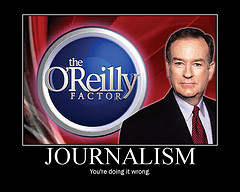
Bill O'Reilly motivational poster spoofHave you ever wondered why the talking heads on television are so often utterly wrong in their predictions about the future?
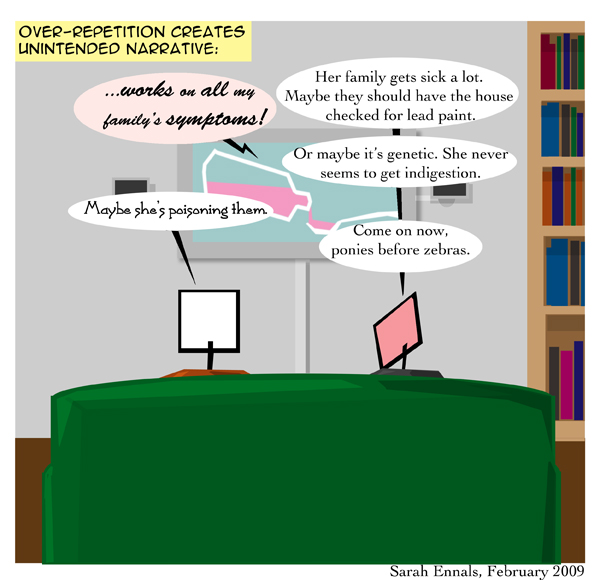
According to a research psychologist from Stanford University, it’s because the people the media tends to hire as pundits are the sort of people who are psychologically predisposed to making predictions based more on their own beliefs than any rational assessment of the situation:

At first, Tetlock’s ongoing study of 82,361 predictions by 284 pundits (most but not all of them American) came up empty. He initially looked at whether accuracy was related to having a Ph.D., being an economist or political scientist rather than a blowhard journalist, having policy experience or access to classified information, or being a realist or neocon, liberal or conservative. The answers were no on all counts. The best predictor, in a backward sort of way, was fame: the more feted by the media, the worse a pundit’s accuracy. And therein lay Tetlock’s first clue. The media’s preferred pundits are forceful, confident and decisive, not tentative and balanced. They are, in short, hedgehogs, not foxes.

That bestiary comes from the political philosopher Isaiah Berlin, who in 1953 argued that hedgehogs “know one big thing.” They apply that one thing (for instance, that ethnicity and language are primal; ergo, any country that contains many ethnic groups will break up) everywhere, express supreme confidence in their forecasts, dismiss opposing views and are drawn to top-down arguments deduced from that Big Idea. Foxes, in contrast, “know many things,” as Berlin put it. They consider competing views, make bottom-up inductive arguments from an array of facts and doubt the power of Big Ideas.

Intriguing, no? But while foxes are arguably better than hedgehogs, here’s the sobering conclusion:

If there are three possibilities (say, that China will experience more, less or the same amount of civil unrest), throwing darts at targets representing each one produces a forecast more accurate than most pundits’. Simply extrapolating from recent data on, say, economic output does even better.

Unfortunately, extrapolated data doesn’t make for such good television… or blog posts, for that matter. Will the decentralisation of current affairs newscasting make this situation better or worse? [image by silas216]

I wonder if we could classify science fiction writers using the same dualism?