That Twitter revolution – is the web inherently democratic?

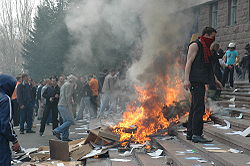
Chisinau riots, Moldova 2009Until last week you’d probably have been forgiven for thinking that Moldova was the country to which expensive tasks are outsourced in the Dilbert cartoons. Well, forgiven by anyone but a Moldovan, perhaps. [image from Wikimedia Commons]

But now Moldova has joined the ranks of former Soviet Bloc countries who’ve had a revolution or political upheaval that was enabled by modern social media and communications technology… and because a good headline always fits nicely into the Zeitgeist, it’s been billed as “the Twitter revolution”. That’s probably a gross oversimplification, though:

It seems unlikely, though, that Twitter was the key tool in a victory of “technology over tyranny”, if that is, in fact, what happened. For one thing, the Communist party in Moldova doesn’t have much in common with the Communists of old – Moldovan communist favor foreign direct investment and promoting entrepreneurship, though they’d like closer involvement with Russia and less with Romania. But to the extent that this was a technological “triumph”, it may have more to do with other social network tools – including blogs, LiveJournal and Facebook – than with Twitter.

Well, even if Twitter can’t take all the credit, hurrah for the inherently democratic potential of modern communications, right? Nicholas Carr would like you to hold on just a moment, though:

No doubt, the Moldovan protests will be used as an example of how the Net and, in particular, its social-networking and personal-broadcasting functions can be used to support popular uprisings and, more generally, the spread of democracy. And rightfully so. But before anyone gets carried away by the idea that the Net is a purely democratizing force, it would be wise to read a longer essay by Morozov, titled Texting Toward Utopia, in the new issue of Boston Review.

I tend to read things that Carr says are worth reading; he’s usually right. So here’s a snippet from that Morozov essay:

Much of the encouraging reporting may be true, if slightly overblown, but it suffers from several sources of bias. As it turns out, the secular, progressive, and pro–Western bloggers tend to write in English rather than in their native language. Consequently, they are also the ones who speak to Western reporters on a regular basis. Should the media dig a bit deeper, they might find ample material to run articles with headlines like “Iranian bloggers: major challenge to democratic change” and “Saudi Arabia: bloggers hate women’s rights.” The coverage of Egyptian blogging in the Western mainstream media focuses almost exclusively on the struggles of secular writers, with very little mention of the rapidly growing blogging faction within the Muslim Brotherhood. Labeling a Muslim Brotherhood blog as “undemocratic” suggests duplicity.

The point being that the Internet is just a tool; the democratizing force is a result of us expressing ourselves through it (and seeing our own reflection in the mirror).

Even so, it can’t be discounted entirely that the Internet and mobile phones have presented the opportunity for networked action and communication to people who even comparatively recently were unable to use technology to circumvent the controls of their governments. Which political cause is the “good” side of any such equation is, as always, a very subjective question.

Seven great games to play with civilian nukes

old Russian nuclear bombHey, guess what – nuclear bombs can be used for more than just annihilating entire cities!Wired has an article rounding up a selection of seven proposed civilian deployments of nuclear weapons, most of which (unsurprisingly) leverage their ability to make a very big hole in something. [image by mikelopoulos]

But how’s this for a counterintuitive idea – why not use nuclear weapons to dispose of nuclear waste!

This scheme was originally proposed at Lawrence Livermore Laboratory. A hole is bored beneath the waste processing plant, and a nuclear bomb is set off in the hole. Then the radioactive waste is poured into the subterranean cavity so formed, over a 25-year filling period. The wastes heat up through their own activity, boil dry, and eventually melt themselves and some surrounding rock into a glassy ball. The cost is quite uncertain but was judged to be extremely attractive.

If you’re anything at all like me (i.e. not a nuclear scientist), you’re probably thinking that’s a batshit stupid idea. But apparently not:

“For excavation, we put a lot of time and effort and money into developing nuclear explosives which had minimal fissionable material so that you could carry out a 100-kiloton cratering explosion and release the radioactivity equivalent to a 20-ton explosive of fissionable material,” Nordyke said.

But despite the technical success of the Plowshare program, Nordyke doesn’t see nuclear weapons being used for excavation or mining anytime soon because it doesn’t seem politically feasible.

“I think its time came and went,” he said. “I think reconciling it with the enhanced environmental concerns today and the inherent association with weapons is difficult.”

My reaction proves his point, I suppose. Nukes are a Pandora’s Box technology, in that we can’t just pretend we don’t know they exist (which is one of George Dvorsky’s points regarding the risks of nuclear disarmament), but because we’ve been predominantly shown nuclear blasts doing things which are deeply nasty and lethal we have this knee-jerk reaction to the idea of them being used for a more creative purpose.

Then again, there’s a trust issue as well – a government-commissioned experimental mega-engineering project involving not just nuclear waste but nuclear weapons? Even if you could show me the calculations and experimental data that proved it could be done, I’m not sure I’d feel at all confident in the ability of a government – or a corporation, for that matter – not to screw up by cutting corners somewhere.

The Future Fire webzine announces feminist SF issue

Heads up, writer and readers alike – post-cyberpunk webzine The Future Fire has just started reading submissions for an issue dedicated to feminist science fiction, which will be published some time around the turn of the year. From their editorial:

An old slogan defines feminism as “the radical idea that women are human beings”. This is an important statement, the more so because it has to be explained in what sense this idea is radical. If we merely said that “women are human beings,” nobody would disagree; it’s an easy platitude. But that isn’t enough: feminism is the recognition that true equality, true freedom for both sexes requires the more radical idea that full human rights still need to be fought for. The rights of women are up there with the rights of minority religions, the rights of disadvantaged ethnicities, the rights of the poor, the rights of queer and transexual and polyamorous people, the rights of unbelievers, the rights of those who disagree with you. And the rights of men. And they all need to be fought for. (Just see the recent “Race Fail” controversy to see how wide some of the misunderstandings still are.)

Partly as a result of these thoughts, and partly because it’s something that has always been close to our hearts, we have decided to run a themed “feminist science fiction” issue of TFF toward the end of this year or the beginning of 2010 (as long as it takes us to acquire the requisite number of stories). By “feminist” we do not mean stories necessarily written by women or featuring female protagonists; what we are interested in are science fiction (or speculative) stories that address issues of gender, sexual identity and sexuality; stories that take the “radical idea” and do something about it; stories that can engage, empower, educate, and inspire men and women alike. And of course stories that challenge our expectations, that avoid cliché, that are beautiful and useful, that are social, political, and speculative cyberfiction.

Be sure to check out The Future Fire‘s regular submission guidelines before sending anything off… but otherwise, break a leg! TFF picks some pretty strong stories at the best of times, so this should turn out to be an issue of considerable interest. [via Feminist-SF]

Editing the memory movie

pre-silicon memory aidWell, looks like we can chalk up another predictive success for a Futurismic author! This time it’s the turn of Marissa Lingen, whose Erasing the Map” seems eerily prescient of recent research at Oxford University into the selective editing of memories:

Wired.com: How selective will memory editing be?

Sandberg: Current research seems to suggest that it can be pretty specific, but there will be side effects. It may not even be that you forget other memories. Small, false memories could be created. And we’re probably not going to be able to predict that before we actually try them.

[…]

Wired.com: It seems that it would be easy to test “tip of the tongue” drug effects on the sorts of small things one recalls on an everyday basis. But what if it’s old, infrequently recalled but still-important memories that are threatened by side effects?

Sandberg: It’s pretty messy to determine what is an important memory to us. They quite often crop up, but without us consciously realizing that we’re thinking of the memory. That’s probably good news, as every time you recall a memory, you also tend to strengthen it.

Wired.com: How likely is the manipulation of these fundamental memories?

Sandberg: Big memories, with lots of connections to other things we’ve done, will probably be messy to deal with. But I don’t think those are the memories that people want to give up.  Most people would want to edit memories that impair them.

Of course, if we want to tweak memories to look better to ourselves, we might get a weird concept of self.

Indeed we might… but I’d say the odds are good that people will try to do exactly that. The street finds its own use for things, right? [image by ebbdog]

But what will happen if you try to edit a memory that is false – the repressed memory of abuse that may not have actually happened, for example? If memories are interlinked, what might you lose along with the bad stuff? And if memories can be expunged, could they also be inserted? We’re deep into Philip K Dick territory right here…