Garden on the moon

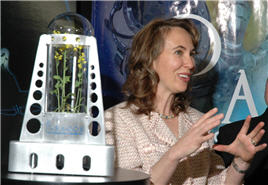
grand-lunar“The Selene Gardening Society,” anybody? Two corporations want to grow vegetables and flowers in a bell jar-like miniature laboratory greenhouse on the moon.

The “Lunar Oasis” has a certain poetry going for it.  “Imagine a bright flower or a plant in a crystal clear growth chamber on the surface of the Moon, with the full Earth rising above the Moonscape behind it...” says Paragon Space Development founder and Biosphere 2 veteran Jane Poynter. Plants have never been grown in a fraction of Earth’s gravity.

Candidates for the experiment besides flowers include aquatic plants and also the unpoetic brassica family (which includes cabbage, broccoli, brussels sprouts).  The garden could be sprouting as early as 2012.The project is a contender for the Google’s $30 million lunar robotics prize.

H.G. Wells, Pierre Boulle, Steve Erikson, and presumably Busby Berkeley must be smiling.

[Image: Grand Lunar (OK, U.S. Rep.) Gabrielle Giffords with lunar greenhouse prototype, Paragon Space Development]

A cure for honey bee colony depopulation syndrome (a.k.a. colony collapse disorder)?

799px-Honeybee-cooling_cropped This could be encouraging news (via Science Daily):

For the first time, scientists have isolated the parasite Nosema ceranae (Microsporidia) from professional apiaries suffering from honey bee colony depopulation syndrome. They then went on to treat the infection with complete success.

In a study published in the new journal from the Society for Applied Microbiology: Environmental Microbiology Reports, scientists from Spain analysed two apiaries and found evidence of honey bee colony depopulation syndrome (also known as colony collapse disorder in the USA). They found no evidence of any other cause of the disease (such as the Varroa destructor, IAPV or pesticides), other than infection with Nosema ceranae. The researchers then treated the infected surviving under-populated colonies with the antibiotic drug, flumagillin and demonstrated complete recovery of all infected colonies.

More information on Nosema ceranae can be found at Bees for Development, which notes:

In short, we demonstrate that Nosema ceranae probably jumped host from Apis cerana to Apis mellifera within the last decade and that it has spread remarkably rapidly. It is found nowadays in the western honey bee in North and South America, the Caribbean, across Europe (from south to north and west to east) and Asia. Only on the islands of Ireland and New Zealand have we looked but found only Nosema apis. We lack samples from Africa, Australia and the UK to state anything about those locations. However, given its rate of spread and occurrence even on isolated islands of the Danish archipelago, it is quite possible that Nosema ceranae is, or will soon be, spread worldwide.

The new Spanish study can be found here.

There has of course been a huge debate over what could be contributing to the depopulating of honey bees (with cell phone radiation one of the more “out there” proposals), a serious concern because of the important role the bees play in the pollination of crops, fruit and wild flowers. This is the first time this particular parasite has been identified as the primary cause of the problem in professional apiaries, and the fact those apiaries were successfully treated is encouraging. As the principle researcher, Dr. Mariono Higes (who has been exploring the connection between Nosema ceranae and colony collapse disorder for several years), puts it, “Now that we know one strain of parasite that could be responsible, we can look for signs of infection and treat any infected colonies before the infection spreads.”

Of course this doesn’t mean that other factors could still be at play, but solving even a part of the problem is an encouraging step forward.

(Image: Wikimedia Commons.)

[tags]bees, colony collapse disorder, biology, parasites, agriculture[/tags]
Discounts and risk in the ebooks market

Remember that post from Evan Schnittman a few weeks back – the one titled “Why ebooks must fail”? Well, he promised to start discussing potentially workable models for the ebooks business, and that’s exactly what he’s now doing.

The first follow-up is titled “Discounts Must Align to Risks”; it looks at the current deep-discounting procedures that prevail in the dead-tree books business as it stands (which share risk between publishers and retailers), and presents three possible ways for a similar system to be applied to the otherwise intangible ebook:

The following ideas, if massaged and improved on by enough smart people, may help evolve trade ebook selling into a practice that wisely shares the risk and provides stimulus and margins for all involved. These models are not new – they are culled from today’s trade retail models. With that in mind, here are three discount models for discussion.

The first is called On Consignment, and it would operate exactly as it does today, except with shorter, perhaps dramatically shorter, discounts. Discounts should align to risk and there is very little risk being shared in this model.

The second model is called Advance Purchase (non-Returnable). Rather than rely on the timing of sell-through at the reseller, publishers are paid for ebook sales in advance. So, resellers that wish to carry an ebook of a publisher can order it as they currently do, or they can purchase the number of “sales” they believe they would make in a given period of time, and pay for this upfront at a greater discount. For this model, a retailer should receive discounts similar to those given on non-refundable sales in print.

The third model is called Refund for Credit (Returnable). Essentially it is a “returns” model for the ebook market. It’s designed to allow retailers to take risks on a larger pool of titles, as they can receive credit by “returning” some of the advance “sales.” This model helps retailers get a better discount for a title than they would if they order On Consignment, but less than the Advance Purchase model. It also helps publishers, as there would be greater incentive to pre-pay for sales for a wider variety of titles, enhancing the cash flow. Again, this model should employ discounts similar to those available for returnable sales in print.

These ideas are probably old hat to industry insiders, but for the rest of us peering in through the shop window it’s an interesting insight into the way the industry works, and the ways it might adapt to change in the near future.

Schittman makes the point that his blogging is not “sanctioned by, endorsed by, or even remotely associated with” his employers at OUP, but one wonders how many people on the inside – of the OUP, and publishing in general – are keen for this discussion to be dragged into the open, and how many would rather sit on the lid of Pandora’s box.

The truth about Somali pirates

Jolly Rodger pirate flagWell, what do you know – there’s more to the Somalian piracy stories than meets the eye. Far from being the eye-patched privateer chancers that the term ‘pirate’ conjures up, they’re desperate people trying to make a living and protect their homeland from exploitation by more developed nations who’ve seen fit to take advantage of the political instability of the area.

Sure, their methods are rough (and definitely illegal), but what are a people without a government to defend them supposed to do when foreigners start trawling their waters for fish and dumping nuclear waste?

This is the context in which the “pirates” have emerged. Somalian fishermen took speedboats to try to dissuade the dumpers and trawlers, or at least levy a “tax” on them. They call themselves the Volunteer Coastguard of Somalia – and ordinary Somalis agree. The independent Somalian news site WardheerNews found 70 per cent “strongly supported the piracy as a form of national defence”.

No, this doesn’t make hostage-taking justifiable, and yes, some are clearly just gangsters – especially those who have held up World Food Programme supplies. But in a telephone interview, one of the pirate leaders, Sugule Ali: “We don’t consider ourselves sea bandits. We consider sea bandits [to be] those who illegally fish and dump in our seas.”

There are two sides to every story, as the old saying goes. That said, it’s interesting to note that this article is by the same guy who did the hatchet-job on Dubai the other day… [via BoingBoing; image by Paul Keleher]

Capitalism 2.0

plant_curveFlaneur and creator of the black swan theory Nassim Nicholas Taleb has written an engaging article for Edge describing the principles of what he calls Capitalism 2.0:

1. What is fragile should break early while it is still small. Nothing should ever become too big to fail. Evolution in economic life helps those with the maximum amount of hidden risks – and hence the most fragile – become the biggest.

2. No socialisation of losses and privatisation of gains. Whatever may need to be bailed out should be nationalised; whatever does not need a bail-out should be free, small and risk-bearing. We have managed to combine the worst of capitalism and socialism. In France in the 1980s, the socialists took over the banks. In the US in the 2000s, the banks took over the government. This is surreal.

Taleb’s highly bombastic style may not be to everyone’s liking but I rather enjoy the iconoclastic tone of both The Black Swan and Fooled by Randomness. Both are highly recommended – especially as they have direct relevance to thinking about the near future.

[image from James Jordan on flickr]