Inflatable tower to reach the edge of space

Step aside, space elevator evangelists – here’s an idea for joining the earth’s surface to space that’s much simpler, cheaper and safer than a big ribbon of carbon nanotubes.

A team of Canadian researchers have proposed a hollow tower constructed from the inflatable tubular modules that are used in some modern spacecraft, which – if built on top of a suitable mountain – could reach 20 kilometers above the Earth’s surface and act as a staging point for space launches… or a tourist destination with much lower risks and costs than suborbital rockets.

The team envisages assembling the structure from a series of modules constructed from Kevlar-polyethylene composite tubes made rigid by inflating them with a lightweight gas such as helium. To test the idea, they built a 7-metre scale model made up of six modules (see image). Each module was built out of three laminated polyethylene tubes 8 centimetres in diameter, mounted around circular spacers and inflated with air.

To stay upright and withstand winds, full-scale structures would require gyroscopes and active stabilisation systems in each module. The team modelled a 15-kilometre tower made up of 100 modules, each one 150 metres tall and 230 metres in diameter, built from inflatable tubes 2 metres across. Quine estimates it would weigh about 800,000 tonnes when pressurised – around twice the weight of the world’s largest supertanker.

Of course, the caveat is that this is just a theory at the moment – but it at least has the merits of being based entirely on existing technology. It seems that inflating things to reach space is quite the fashion at the moment…
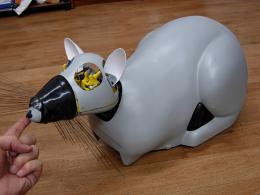
Psikharpax: the robot rat

Psikharpax the robot ratDespite some freaky-looking androids coming out of Japan, we have yet to develop robots that can reproduce complex autonomous human behaviours. Perhaps the problem is that we’re aiming too high?

That’s the theory held at the Paris-based Institute for Intelligent Systems and Robotics, at least, who’re looking to the rodent world for inspiration:

Rather than try to replicate human intelligence, in all its furious complexities and higher levels of language and reasoning, it would be better to start at the bottom and figure out simpler abilities that humans share with other animals, they say.

These include navigating, seeking food and avoiding dangers.

And, for this job, there can be no better inspiration than the rat, which has lived cheek-by-whisker with humans since Homo sapiens took his first steps.

The rat is the animal that scientists know best, and the structure of its brain is similar to that of humans,” says Steve Nguyen, a doctoral student at ISIR, who helped show off Psikharpax at a research and innovation fair in Paris last week.

The goal is to get Psikharpax to be able to “survive” in new environments. It would be able to spot and move around things in its way, detect when it is in danger from collision with a human in its vicinity and spot an opportunity for “feeding” — recharging its battery at power points placed around the lab.

“We want to make robots that are able to look after themselves and depend on humans as least as possible,” said Guillot.

Seems like a good idea… provided they don’t build in the natural rodent propensity for rapid reproduction. [via GlobalGuerillas; image borrowed from linked PhysOrg article]

Terrorist strategy as an auto-immune response

terrorismAlex at the Yorkshire Ranter reviews The Accidental Guerrilla by David Kilcullen and discusses how the strategy behind Al-Qa’ida-inspired terrorism can be thought of in the same terms as an auto-immune disease:

Specifically, auto-immune war is a strategy, but its tactical implementation is the creation of false positive responses. Security obsession gums up the economy with inefficiencies. Terrorism terrorises the public; security theatre keeps them that way. As Kilcullen points out, every day, millions of travellers are systematically reminded of terrorism by government security precautions. Profiling measures subject entire communities to indignity and waste endless hours of police time. Vast sums of money are spent on counterproductive equipment programs and unlikely techno-fixes. National identity cards and monster databases are the specific symptoms of this pathology in the UK, just as idiotic militarism is in the US.

It is the best description of how terrorism actually works as a method of warfare I have come across. Interested readers might also be interested in Wasp by Eric Frank Russell, which deals with terrorism in a practical and humorous fashion.

[image from Dagfinn Ilmari Mannsåker on flickr]

Will peak oil solve global warming?

desert oil rigHere’s a contentious idea from the intersection of climate-change pragmatism and free-market ideology: what if Peak Oil is a no-brainer no-effort fix for global warming?

The drop in oil prices since last summer doesn’t affect the validity of the Peak Oil hypothesis. Peak Oil only says that the rate of oil extraction is peaking, not that the price will never go down. In fact, the peaking of oil supply will result in the same boom-and-bust cycle that characterizes real estate markets, as Henry George noted over a century ago. Real estate speculators will hold land off the market in anticipation of a future price rise, just as the oil companies sit on those untapped offshore oil reserves. The amount of drilling and exploration has actually dropped considerably in response to the lower prices, which means that when demand gets back to Summer 2008 levels the price rebound will be even more vicious.

And if a fluctuation of a few percentage points in demand can cause oil to fall from $140 to $40 a barrel, imagine what will happen when the supply falls by half or more over the next generation!

Now, I’ll confess to having a fair degree of faith in truly free markets, but I’m not convinced that the energy markets as they stand under the current geopolitical and economic climate are currently anywhere near as free as they’d need to be to self-regulate effectively; I only need look at my gas bills for the last couple of years to find evidence of that. Nor am I convinced that the reduction in carbon output resulting from declining oil reserves and the escalating prices thereof would be sufficient to pull retrieve our bacon from the campfire quickly enough to prevent significant change to the environment. [image by Janz Images]

That said, the idea of market forces working hand in hand with scarcity to wean us off of our oil dependence is seductively appealing. So seductive, in fact, that I’m inclined not to trust the idea on that basis alone. But the notion that using less oil derivatives will become a matter of simple economic logic for businesses and end-users alike? That seems like common sense, as well as the only way we’ll break the addiction. Hell knows that explaining the consequences of failure hasn’t had much of an effect as yet.

Idoru! Augmented reality pet-person on sale later this year

Just in case you didn’t catch it over at Chairman Bruce’s pad, here’s the promo video for Cyber Figure Alice, an augmented reality game/pet/miniature girlfriend from Geisha Tokyo Entertainment Inc.:

Try to ignore the fact that the main selling point of this virtual girl appears to be that you can dress her up in a variety of outfits, look up her skirt and make her life a misery, and think of the somewhat more positive potentials of the same technology…

  • The Lonely Planet people could sell AR add-ons or replacements for their ubiquitous guidebooks; instead of be-backpacked Europeans stood around in the zocalo staring into a book, you might see them wandering around wearing funny sunglasses and staring into the palm of their hand, asking questions about the cheapest hostel within staggering distance of the bar district.
  • Home-schooled Christian kids could have a little desktop Moses to deliver moral guidance and lectures on why this or that particular website contains information that is not in accordance with Scripture.
  • The DVD extras on the latest Kamigata Punx! tour promo video could include miniature members of the band who could be bought virtual drinks in exchange for squeaky-toned tales of backstage debauchery.

That said, it’s probably fair (if a little depressing) to expect that the original guilt-free tormentable schoolgirl version will be the killer app for some time. Cyber Figure Alice apparently launches later this year, so expect the over-moneyed single geeks in your social circle to spend even more time at home than they do currently…