Metaverse bank chairman does a runner with the cash

Starship screenshot from EVE OnlineYeah, so we’re all tired of hearing about crooks in charge of banks shafting their depositors and borrowers at the same time… but this story’s a little different, given that the bank in question exists in the virtual universe of science fiction MMO EVE Online.

That’s not to say no real money was involved, though; RMT, or Real Money Trading, is one of the few things frowned upon in EVE‘s laissez-faire economy, but it still takes place – and as such there may be a lesson for real-world economists in the story:

Because players often do not have the interstellar credits — abbreviated to ISK, also the official abbreviation of the Icelandic kroner — they need to expand their fleets, an enterprising player created a bank that would accept deposits and lend to players who would pledge assets, like their spacecraft, as collateral.

The bank was a success. According to its Web site (yes, it has one), Ebank accumulated about 8.9 trillion ISK in deposits in 13,000 accounts belonging to 6,000 users. That was far more than it was able to lend out — there were around 1 trillion ISK of loans.

Somewhere along the way Ebank’s top executive, who went by the online handle Ricdic, apparently got greedy. According to CCP, he made off with deposits, which he then sold for real cash to gamers on a sort of black-market exchange separate from Eve.

CCP kicked Ricdic out of the game. And Ebank has temporarily shut down while its board of directors (yes, it had one of those too) tries to sort out the mess. Depositors, meanwhile, appear to have pulled 5.5 trillion ISK of deposits.

It’s not clear how much of that virtual money was embezzled and now needs to be found, somehow, by Ebank. But if the Eve chatter is accurate, it could amount to 10 percent of deposits withdrawn. That could wipe out whatever capital was used to finance Ebank’s loan book. As in the real world, that would spell insolvency.

[…]

As in the real economy, the customers could be tempted to appeal to a higher authority — Eve’s creators. That would probably involve appealing to the Council of Stellar Management — a body of nine members chosen by Eve players to represent them in discussions with CCP.

But the word from Reykjavik isn’t likely to comfort Ebank’s depositors. Eve’s creators at CCP — which employs its own economist and philosopher — take a laissez-faire approach, leaving most such matters to the game’s users to sort out. Unlike the Icelandic government, which allowed three local banks to nearly bankrupt Iceland with unchecked expansion, CCP is determined not to encourage entities to become too big to fail.

This is similar to a nasty incident in Second Life a while back, but SL’s banks are governed by US banking law, and so Linden Lab takes a much more hands-on approach to its economy.

It’ll be interesting to see how this pans out; it’s easy to dismiss the travails of a metaverse bank as irrelevant, but as they become more complex (not to mention valuable in real-world terms), metaverse economies may become a valuable testing ground for alternative economic theories. Anything that helps us avoid another real-world clusterfuck has got to be worth keeping an eye on, right? [via MetaFilter; image by Pentadact]

Top new computer chip material

electron_band_bismuth_tellurideResearcher at the Stanford Institute for Materials & Energy Science have developed a new substance for making computer chips that allows electrons to flow without any loss of energy at room temperatures and can be made using existing chip-making technologies:
Physicists Yulin Chen, Zhi-Xun Shen and their colleagues tested the behavior of electrons in the compound bismuth telluride. The results, published online June 11 in Science Express, show a clear signature of what is called a topological insulator, a material that enables the free flow of electrons across its surface with no loss of energy

This is pretty amazing in and of itself, but is not quite a superconductor:

Topological insulators aren’t conventional superconductors nor fodder for super-efficient power lines, as they can only carry small currents, but they could pave the way for a paradigm shift in microchip development. “This could lead to new applications of spintronics, or using the electron spin to carry information,”

[from Physorg][image via Physorg from Yulin Chen and Z. X. Shen]

Too late for talk? Cascio’s case for environmental geoengineering

Jamais Cascio crops up at no less a venue that the Wall Street Journal talking about climate change and geoengineering, and he’s getting less equivocal as the months slip by. Within the space of a year or so, geoengineering – large-scale projects designed to ameliorate or control the symptoms of climate change – has progressed from being an unpalatable worst-case option to an unpalatable necessity. To put it another way: either we act now, or we lose the opportunity to act at all.

In short, although we know what to do to stop global warming, we’re running out of time to do it and show no interest in moving faster. So here’s where geoengineering steps in: It gives us time to act.

That’s if it’s done wisely. It’s imperative that we increase funding for geoengineering research, building the kinds of models and simulations necessary to allow us to weed out the approaches with dangerous, surprising consequences.

Fortunately, the deployment of geoengineering need not be all or nothing. Though it would have the greatest impact if done globally, some models have shown that intervention just in the polar regions would be enough to hold off the most critical tipping-point events, including ice-cap collapse and a massive methane release.

Polar-only geoengineering strikes me as a plausible compromise position. It could be scaled up if the situation becomes more dire and could be easily shut down with minimal temperature spikes if there were unacceptable side effects.

Still, we can’t forget: Geoengineering is not a solution for global warming. It would simply hold temperatures down temporarily, doing nothing about the causes of climate change, let alone ocean acidification and other symptoms of a carbon overdose. We can’t let ourselves slip back into business-as-usual complacency, because we’d simply be setting ourselves up for a far greater disaster down the road.

Our overall goal must remain the reduction and then elimination of greenhouse-gas emissions as swiftly as humanly possible. This will require feats of political will and courage around the world. What geoengineering offers us is the time to make it happen.

I’ve been following Cascio’s writing since he was a columnist here at Futurismic a few years ago, and I’ve a great deal of respect for his thinking. That said, advocating geoengineering as a necessity alarms me considerably – not because I think it’s unnecessary, but because of the potential for messy side-effects, be they environmental or political.

But as Cascio points out, despite finally reaching a point where politics has acknowledged that climate change is a major issue, nothing is happening other than blame-laying and jockeying for advantage, and the opportunity to act is slipping away. Whether geoengineering is an easier pill for nation-states to swallow than emissions control and rational energy policies remains to be seen.

[ It should be obvious, but just in case: yes, this post and Cascio’s essay are predicated on the notion that anthropic climate change is not only supported by the bulk of pertinent scientific research but a very probable threat to our existence on a species-wide scale. I am aware that there are those who disagree with those statements, and those people are welcome to their opinions. However, anyone popping up in the comments to this post with no better a contribution than to say climate change is a {hoax/sham/conspiracy/Liberal plot/Illuminati plot} will have their comment removed. If you can’t join the debate on the debate’s own terms, please go find one where you can. Your cooperation is appreciated. ]

The Iranian elections: is democracy viral?

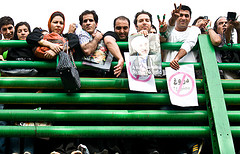
Iranian election protestorsThe past weekend’s hot news story is still smouldering strongly today: the Iranian elections (and the resulting landslide victory for incumbent president Ahmadinejad) have resulted in accusations of vote fraud (which isn’t entirely surprising) and street riots and protests from supporters of the principle opposition candidate, Mir Hossein Mousavi. Throw in some state censorship in the form of social networking websites and text messaging services being blocked, and you’ve got a story that’s not entirely unfamiliar in recent years. [image by Shahram Sharif]

Of course, I have no idea whether or not the election was rigged or not, though I have my suspicions. What interests me most about this story is how it paints a very different picture of Iran to the one we’ve been fed in the last decade or so. Far from being a monolithic Islamic state in thrall to Ahmadinejad, there’s evidently enough support for reform to threaten the incumbents; after all, a mere handful of angry reformists does not a riot (or an electoral recount) make.

How long this has been the case is beyond my knowledge, and I wish I had the time and opportunity to research it further. But the ubiquitous presence of peer-to-peer communications (and their inevitable censorship by the state) is telling, and I find myself wondering if perhaps the talk about democracy being a viral concept has some weight to it after all. Have services like Twitter and Facebook simply given a voice to those already opposed to the incumbent Iranian government? Or have they acted as a catalyst, enabling a population whose access to information and discussion was previously more closely controlled to see that there are alternatives within their grasp?

These aren’t questions with simple answers, of course, and there are many other factors at play in a world where everything is changing faster than ever before. But I think it’s fair to suggest that the internet is one of the strongest disruptive forces on the gameboard, especially in countries where state control of media has been far more crude and heavy-handed than here in the privileged West.

I fully expect we’ll be seeing a lot more stories like this from developing nations in years to come, as affordable communications technology pulls aside the heavy curtains of the state… it’s good news for oppressed citizens, certainly (at least in the short run), but for global stability? Maybe not so much.

Conficker: the new warfare

Remember the quasi-Millennial panic about the Conficker worm back in April? It turned out to be nowhere near as nasty and damaging a threat as it had been painted, but it was still unique in a number of ways – most notably in its own methodologies, and in the way the security and computer industries pulled together to defend against it. New Scientist tells the story:

… frenzied headlines were proclaiming the impending meltdown of the internet. But 1 April passed without event. This was not a total surprise. After all, it was just the first date on which the worm’s URL strategy could change – it was still up to its creators to flick the virtual switch. To the outside, it looked like a gigantic April Fool.

And indeed it may have been. In fact, the whole URL business was probably a red herring: using a centralised URL to release a worm upgrade – even one as painstakingly concealed as Conficker’s – is not a particularly sensible approach. It gives the authorities a specific target to counter-attack. From the second version onwards, Conficker had come with a much more efficient option: peer-to-peer (P2P) communication. This technology, widely used to trade pirated copies of software and films, allows software to reach out and exchange signals with copies of itself.

It’s an interesting story – one with a remarkably movie-like plot, albeit devoid of the vest-wearing tough guy heroes and big CGI explosions that you’d need to script in to sell it to Hollywood…

But what’s worth noting is that this is a new form of warfare, a bloodless and almost entirely computer-based iteration of fourth-generation insurgency that relies on subterfuge and networking to achieve its aims, and demonstrates complex strategic thinking on the part of its instigators. It’s good to see that the expertise exists to combat it, but you have to wonder what would happen if something similar was targetted specifically at a nation-state like the US, whose military brass have demonstrated a poor understanding of the web’s flat battlefield.

You can’t deploy tanks against this sort of threat; the game has changed.