Epic engineering: It still lives

hooverThis Arizona Republic item put me in mind of William Gibson’s early story “The Gernsback Continuum,” a rumination on the golden age of mega-construction. I saw this engineering marvel on a recent drive to Vegas (bookie, debt, showgirl–long story) and it’s an awe-inspiring sight.

A quarter-mile downstream from Hoover Dam, two fingers of concrete stretch toward each other from sheer cliffs, suspended nearly 900 feet above the Colorado River.

In a month, the fingers will meet, an 80-foot gap will close and the longest concrete arch in the Western Hemisphere will be complete.

The union will mark a major milestone in the nine-year construction of the Hoover Dam bypass bridge, scheduled to open in late 2010.

But even incomplete, the overpass, officially known as the Mike O’Callaghan-Pat Tillman Memorial Bridge, evokes a sense of wonder. Towering columns perch on naked rock. The arch is held by tendons of steel cable…

The $114 million bridge project has been a challenge. Accidents delayed it by two years and claimed one life, as workers battled intense heat, dangerously high winds and perilous heights…

Work crews had to build foundations for the arches midway up two sheer cliff faces, hundreds of feet above the river.

Temperatures as high as 120 degrees strain workers and heat up wet concrete. Crews use liquid nitrogen to keep the concrete cool so blocks don’t develop fatal cracks.

[Nevada side of the Mike O’Callaghan-Pat Tillman Memorial Bridge under construction at the Hoover Dam. Taken May 3, 2009 by squeaks2569]

Fabbing becoming price-competitive

Via Fabbaloo comes news that big businesses are starting to wake up to the savings they can make with 3D printing and rapid prototyping technology. Granted, this is a press release from a company that makes 3D printers, but the solid numbers that they’re quoting with respect to shoe giants Converse speak more loudly than the corporate back-patting:

Converse says its ZPrinters can produce a shoe model in two hours, or nearly 30 times faster than an ABS printer. ZPrinting has also helped:

  • Eliminate eight annual trips to Asia for design consultations at a cost of up to $12,000 per person for each trip;
  • Cut tooling costs from $350,000 in 2006 to $150,000 in 2008 by using ZPrinted models to winnow designs; and
  • Transform the way the company does business by bringing 3D shoe models to key accounts and producing models on demand.

“We’re seeing new prototypes in hours and cutting weeks off our design cycle,” said Bryan Cioffi, manager of digital product creation at Converse of N. Andover, Mass, USA. “Last night’s sketches become tangible color models that we can pass around at this morning’s meeting. Our ZPrinter has become a prototyping center in its own right, and it’s helping us get better products to market more quickly for less money.”

That technology is itself becoming cheaper by the month, so we can expect many other manufacturers to clamber aboard the fabbing train as they attempt to rebuild after the economic slump.

But that same capability may actually spell the doom of corporate giants like Converse. After all, when every town has a 3D print-shop, why pay Converse for a new pair of trainers that they’ve designed when you can just clone their basic design files from a torrent, make some unique tweaks and print out a custom sneaker of your own for a comparable (or perhaps even lower) price?

The future is local: Braddock, Pennsylvania

"We will grow" - the bridge to BraddockWe’ve been talking a fair bit about urban decline and decay, and efforts to repurpose collapsing cities.
Now, here’s an example of a dying town trying to go its own way – Braddock, Pennsylvania was once a flourishing steel town, home to Andrew Carnegie’s first free library. Now it has a population of under 2,500, and the axe of a proposed freeway hangs heavily over its neck. 2005 saw John Fetterman become Mayor, and he’s now working to bring “the kind of outside energy, ideas, and interest from the artistic, urbanist, and creative communities” to the town. [hat-tip to Justin Pickard; image by Hryck.]

In other words, if you’ve been reading along with Cory Doctorow’s serialised novel Makers over at Tor.com, or following Chairman Bruce‘s ongoing obsession with “stuffed animal” architecture and squatter culture, Fetterman’s plans will look pretty familiar. Whether Braddock can reinvent itself as a counter-cultural artist’s enclave remains to be seen, but you’ve got to salute the determination of a man willing to work at making it happen. When your government can’t (or won’t) help you, you’ve got to help yourself.

A loosely related story from Canada sees five Ontario grocery stores abandoning their franchisee status in favour of becoming a cooperative organisation that focusses on stocking the local produce that corporate policy previously prevented them from selling. Are we seeing the first trickles of a global landslide toward massive decentralisation, and a return to economies driven by community and proximity? [via MetaFilter]

Did the Apollo landings lead to science fiction’s decline?

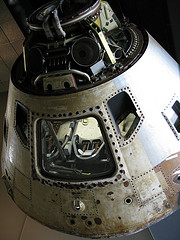
Apollo command moduleWell, it’s not my theory. But Ted Gioia seems to think that the Apollo landings ushered in science fiction’s decline into irrelevance:

With the benefit of hindsight, we should probably admit that the landing of Apollo 11 was the end of the glory days of sci-fi. With the conclusion of the Apollo program, NASA became just another government agency, more bureaucratic than heroic. It is all too telling that the Challenger disaster of 1986 was the next time that rocket ships captured the attention of the general public.

[…]

When the moon became just another piece of abandoned real estate, like much of Florida after the subprime meltdown, the psychological impact on sci-fi was devastating. Many grand predictions had been made about the future of space exploration by these visionary authors. But not one of them would have dared to make this prediction—namely, that 35 years after the Apollo program, no trip would have been made to any of the other planets in the solar system, and no one would have the gumption to send an astronaut—or even a dog or chimpanzee— back to the moon.

Science fiction is experiencing a bit of a comeback these days [O RLY?], but the moon plays a low profile in the renewal efforts.

Balls, frankly.

Gioia not only seems to be conflating a subset of the genre – namely heroic/imperialist space exploration fiction – with the genre as a whole, but appears to have observed a “decline into irrelevance” that the genre’s fans, publishers and practitioners have utterly failed to notice.

Sure, science fiction has changed in character considerably since the Apollo landings, and a loss of faith in Progress-with-a-capital-P is almost certainly one of the symptoms thereof… and sure, the pulps fell away and short fiction has become an artisan ghetto of sorts, but that’s a function of changes in media consumption patterns rather than a direct response to the space race fizzling out. [image by jurvetson]

So, nice try, Ted… but if you’re going to wrestle a topical straw man you might want to dress it up a little more convincingly next time, eh? 😉

Hairy goo invading from the Arctic

mysteryAhem. A mysterious browny-black goo with hair in it is drifting southward from the Arctic:

Something big and strange is floating through the Chukchi Sea between Wainwright and Barrow.

Hunters from Wainwright first started noticing the stuff sometime probably early last week. It’s thick and dark and “gooey” and is drifting for miles in the cold Arctic waters, according to Gordon Brower with the North Slope Borough’s Planning and Community Services Department.

Brower and other borough officials, joined by the U.S. Coast Guard, flew out to Wainwright to investigate. The agencies found “globs” of the stuff floating miles offshore Friday and collected samples for testing.

“It’s definitely, by the smell and the makeup of it, it’s some sort of naturally occurring organic or otherwise marine organism.”

Very weird. Cthulhu spawning? Cosy catastrophe? The blob? The larval stage of the World Tree?

[from abn news, via Blood & Treasure][image from Margaret Anne Clarke on flickr]