Nietzsche on science fiction

The Adam Roberts Project

The excitement in the academic community at the discovery of four new Nietzsche notebooks has percolated, to some extent, into the general culture; and a palpable thrill has echoed through the SF community with the news that one of these notebooks contains Nietzsche’s thoughts on the—then—new genre of science fiction: Einleitende Studie, Also Sprach Zukunftsromane. The Adam Roberts Project, in conjunction with Futurismic Publishing Incorporated, is proud to be the first to reprint a selection of these Nietzschean apothegms; the full edition will be published later this year, in a dual-language edition, by Unwahrscheinlicheraben Buchbindung. Continue reading Nietzsche on science fiction

Do android sheep dream of electric grass?

sheepThe current obsession for the military robotics crowd appears to be solving the long-term fuelling issue – after all, your ‘bot isn’t much use if it has to return to base every six hours for a fresh battery (possibly leading the enemy to your emplacement in the process).

So, an autonomous robot needs to be able to forage for fuel; while the art world has gone so far as to produce robots that eat insects and animals, the military contractors are keeping things strictly vegetarian, designing the cutely-monikered EATR to graze like a sheep on biomass.

Robotic Technology of Potomac, Md., and Cyclone Power Technologies of Pompano Beach, Fla., have completed an initial stage in a collaboration that could lead to the world’s first grazing robot. The system would obtain energy by “engaging in biologically-inspired, organism-like, energy-harvesting behavior”–in other words, foraging and eating to keep itself going.

It’s a tall order. The robot will need to first identify a suitable biomass (wood, grass, paper, etc.) and avoid the indigestible (rocks, metal, or glass). It must spatially locate and manipulate the source; cut or shred to size, then use its robotic arm and “end effectors” to grab, lift and dump it into the furnace, where it will be ingested and converted to enough electrical energy to power the robots systems. This stage is taken care of by the Cyclone engine, a modern-day external combustion, steam engine that can run on virtually any fuel.

I wonder if there’ll be a desert variant designed to survive for long periods without any biomass – an electric camel, perhaps? Mash up the fuelling tech with that scary yet awesome Big Dog pack-animal bot and you’ve got a new ship of the desert that (hopefully) won’t spit at you when it’s in a bad mood… [via Technovelgy; image by David Masters]

Space is the place

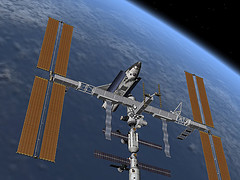
CGI rendering of the International Space Station Thanks to the anniversary of the Apollo Moon landings, everyone’s talking about space at the moment – and it’s still as contentious and passionate a subject as ever. [image by FlyingSinger]

Charlie Stross looks back at the Moon landings and decides that despite the huge advances in technology since the 60s, NASA’s proposed Constellation Moon landing program is unlikely to come off:

Today we lack a vital resource that both Wernher von Braun and Sergei Korolev took for granted: thousands of engineers with the experience of designing, building, and launching new types of rocket in a matter of years or even months. We used to have them, but some time in the past 40 years they all retired. We’ve got the institutions and the data and the better technology, but we don’t have the experience those early pioneers had. And I’m betting that the process of rebuilding all that institutional competence is going to run over budget. While NASA’s Constellation program might work, and while it could deliver far more valuable lunar science than Apollo ever did, it will inevitably cost much more than NASA’s official estimates suggest, because it’s too big a project for today’s NASA — NASA, and indeed the entire space industrial sector in the USA, would have to grow, structurally, to make it work.

Elsewhere, Paul McAuley laments the ‘disposable space truck’ model of space flight, saying it’s:

like building an ocean liner to cross the Atlantic and setting fire to it when you reach New York.

Meanwhile, SpaceX have just completed their first commercial satellite launch, successfully putting a Malaysian Earth-imaging sat into orbit.

SpaceX landed a NASA contract for hauling cargo up to the ISS some time ago, but it looks like they won’t be able to rely on that as a long-term entry on the balance sheet, as Bruce Sterling points to an article in the Washington Post wherein NASA’s space program manager announces the controversial plan to de-orbit (and hence destroy) the International Space Station when the budget runs out in 2016:

Suffredini raised some eyebrows when, at a public hearing last month, he declared flatly that the plan is to de-orbit the station in 2016. He addressed his comments to a panel chaired by former aerospace executive Norman Augustine that is charged by the Obama administration with reviewing the entire human spaceflight program. Everything is on the table — missions, goals, rocket design. And right there in the mix is this big, fancy space laboratory circling the Earth from 220 miles up.

The cost of the station is both a liability and, paradoxically, a virtue. A figure commonly associated with the ISS is that it will ultimately cost the United States and its international partners about $100 billion. That may add to the political pressure to keep the space laboratory intact and in orbit rather than seeing it plunging back to Earth so soon after completion.

Apparently physicist and vocal space critic Robert Park suggests palming off the money-eating white elephant on the Chinese instead. I’d have thought auctioning it off to the highest bidder would have made more sense, and I’m pretty sure there’s be some interested parties – China included, but plenty of non-state parties also.

And finally, via Warren Ellis comes something for flicking your geek switches – HFradio.org can supply you with space weather updates via Twitter. As Ellis remarks, “it’s like the Shipping Forecast for space”… now all we need is a way to convert it to an audio stream. Anyone got a zero-g Nabaztag?

Our new cyborg insect overlords

livesilkmothContinuing the robotic insect theme: researchers in Japan are developing the means to recreate the brains of insects in electronic circuits and thus modify existing insect brains to perform useful tasks, like finding narcotics, and earthquake victims:

In an example of ‘rewriting’ insect brain circuits, Kanzaki’s team has succeeded in genetically modifying a male silkmoth so that it reacts to light instead of odour, or to the odour of a different kind of moth.

Such modifications could pave the way to creating a robo-bug which could in future sense illegal drugs several kilometres away, as well as landmines, people buried under rubble, or toxic gas, the professor said.

Kanzaki also observes how remarkably adaptable biological organisms are:

“Humans walk only at some five kilometres per hour but can drive a car that travels at 100 kilometres per hour. It’s amazing that we can accelerate, brake and avoid obstacles in what originally seem like impossible conditions,” he said.

Our brain turns the car into an extension of our body,” he said, adding that “an insect brain may be able to drive a car like we can. I think they have the potential.

It certainly raises interesting questions about how to achieve intelligent machinery: why reinvent the wheel creating strong AI? We can reverse engineer animals that fly or hunt then adapt them to our purposes.

[from Physorg][image from Physorg]

Bucky Fuller would be proud: geodesic urban agri-architecture

We’re starting to see a lot of these urban agriculture concepts cropping up (arf!); the Plantagon is (or, rather, might be) a geodesic dome containing a spiral ramp covered with fresh-grown foodstuffs, and its designers believe its food output would pay for its construction.

Plantagon: geodesic urban greenhouse

According to Plantagon, the farm “will dramatically change the way we produce organic and functional food. It allows us to produce ecological [food] with clean air and water inside urban environments, even major cities, cutting costs and environmental damage by eliminating transportation and deliver directly to consumers. This is due to the efficiency and productivity of the Plantagon greenhouse which makes it economically possible to finance each greenhouse from its own sales.”

No word on how exactly the Plantagon system works, but the company says that consulting engineering firm Sweco has helped untangle the technical kinks of the project. Plantagon hopes to have its first vertical farm up and running within three years.

Call me cynical, but I doubt the Plantagon as it appears here will ever make it into production. That said, the sheer number of urban agriculture concepts that are being kicked around at the moment suggests that there’s enough interest in the idea for it to become a reality at some point in the relatively near future… once pragmatism and the harsh economic truths of the world beyond the drawing-board brainstorm have shaved down the budgets a little bit, perhaps. [image by Plantagon]

Or maybe the construction of urban farms will be started in blazes of publicity and viridian glamour, only for the funding to be pulled (or embezzled, or just plain “lost”) half-way through, leaving huge Ballardian lumps of unfinished futurism lying around on the urban landscape, waiting to be colonised and turned into squelettes