Scale

Here’s a bit of sensawunda for your Saturday. Spend ten minutes and think about the size of universe, starting at the home base of our own Sun and moving on out into mind-boggling infinities…

Most of this stuff will be familiar to Futurismic readers, I imagine, but the images are good, and I still get that sf-nal kick from being reminded of the incredible and momentary insignificance of our own existence. [via MetaFilter]

Are we alone?

saucersTranshumanist blogger George Dvorsky points to a debate between astrophysicist Brandon Carter and a team of Serbian researchers, the core of which revolves around how long complex (and intelligent) life takes to evolve:

Prior to ‘recent times’, universal mechanisms were in place to continually thwart the evolutionary development of intelligence, namely through gamma-ray bursts, super novae and other forms of nastiness. Occasional catastrophic events have been resetting the “astrobiological clock” of regions of the Galaxy causing biospheres to start over. “Earth may be rare in time, not in space,” they say. They also note that the rate of evolution is intimately connected with a planet’s environment, such as the kind of radiation its star emits.

For further discussion of our place in the universe see the Copernican Principle, which exhorts us to avoid assuming that humanity, Earth, and our place in the universe can be assumed to be unique and special.

Further the notion of punctuated equilibrium to describe evolution is interesting: might it be extended to describe other evolutionary phenomena? Eric Beinhocker‘s superb The Origin of Wealth describes both technology and the economy in terms of evolutionary systems, both of which experience a form of punctuated equilibrium.

[image from eek the cat on flickr]

Celebrity skin?

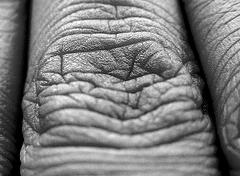
wrinkled skinGot epidermis? Researchers at the Fraunhofer Institute in Germany sure have – they’ve developed an automated system for producing two-layer artificial skin at a commercial scale:

The process starts with small pieces of skin, which are sterilised and then cut into pieces, modified with enzymes and isolated into two cell fractions. These are then grown separately on cell culture surfaces, before being combined into a two-layer sheet. The whole process takes about three weeks.

The flexible lower layer gives the tissue natural elasticity, but two-layer skins have until now been too expensive to mass produce.

The synthetic skins currently available are eventually rejected by the human body because they don’t contain blood vessels. Jörg Saxler, Fraunhofer’s technology manager, told Wired.co.uk that they have created skin with blood vessels using pig cells, and are working on a fully synthetic version.

Obviously the first take-up of this stuff will be medical in nature – grafts for burn victims, so on and so forth. But once it gets cheaper, the street will find its own use for the same technology. First up will be rough-and-ready elective cosmetic grafts: replace your aged original skin, or maybe go patchwork with different shades and levels of melanin!

But some sort of generic off-the-shelf skin won’t be sufficient for the glitterati. Will we be able to buy celebrity-endorsed brands and strains of skin? Will famous models and musicians have their skin cloned as the ultimate high-price catalogue-cap of their personal clothing labels? Will you be able to literally wear Armani or Hugo Boss or 50-Cent? [image by /charlene]

Space-based solar again

solar eclipseSpace-based solar power is about as science fictional as an energy solution can be, but that doesn’t seem to be stopping people from trying to make it a reality. We mentioned Solaren’s combined energy platform and hurricane killer idea back in April; now here’s PowerSat, who (naturally) have their own unique selling point:

Most proposals for space-based solar have involved a constellation of satellites, each transferring those 17MW to a central unit for transmission back to earth. This adds to the complexity of the system and means at least one satellite has to integrate a very large amount of power. PowerSat hopes to avoid all that. The satellites will receive a pilot signal from the ground and use that to coordinate their energy-carrying return signal to the ground-based receiver. “The satellites act as a radio frequency cloud to create a phase array of phased arrays,” Maness says.

When the microwave signal hits the ground, the transmission from each satellite should be additive—all of which dramatically cuts down the weight and complexity of the hardware that has to be put into orbit.

There are, of course, concerns about the effects of the power transmission beams when they reach the surface, but PowerSat are convinced (after researching thoroughly) that there would be no harm to humans, animals or anything else living. However, the beam would certainly knock out your mobile phone signal – which is a pretty minor flaw, but one that’s bound to create a significant obstacle to PowerSat’s plans… [image by James Jordan]