SocNets == Groupthink?

Via those crazy kids at grinding.be comes an article whose writer analyses the culture of social networks and media with the “groupthink” criteria of Irving L Janis, coming to the conclusion that our favourite websites and communication channels may be (gasp!) gathering us into groups where the established and accepted truths remain unquestioned.

It’s not the first time the issue has been raised (and frankly I’ve given it greater credence on those occasions when I’ve seen it on sites who employ a copyeditor and/or whose side-barred “all-time most popular article” isn’t entitled “10 Ways To Have Fun With Boobs”) but my response remains the same: find me a human social construct or communication platform that doesn’t put vague ticks in most of those boxes.

Groupthink is a function of being human; it’s the phenomenon that makes party-based political systems not just possible but debilitatingly pervasive. Do social networks enable groupthink to take root? Sure they do – but I think it’s safe to say they offer more opportunity for dissent and debate than the old centralized broadcast media that they’re replacing ever did. As always, the problem isn’t technology, it’s people.

The Floating Citadel

Seems like hardly a week can pass by without some new example of architectural futurism cropping up in my RSS feeds. Here’s the latest nugget: The Citadel is (or rather will be, when it gets built as something more than a conceptual model) an example of the sea-beleaguered Dutch attempting to come to terms with the geography of the tidal plain that is their country.

The Citadel - floating apartment complex concept

The project will be built on a polder, a recessed area below sea level where flood waters settle from heavy rains. There are almost 3500 polders in the Netherlands, and almost all of them are continually pumped dry to keep flood waters from destroying nearby homes and buildings. The New Water Project will purposely allow the polder to flood with water and all the buildings will be perfectly suited to float on top of the rising and falling water.

[…]

A high focus will be placed on energy efficiency inside the Citadel. Greenhouses are placed around the complex, and the water will act as a cooling source as it is pumped through submerged pipes.

The Citadel seems to be an officially sanctioned project, but it’s easy to imagine that once the concepts behind it are loose in the market, buildings like it could become commonplace in marginal or disputed regions considered useless because of their water-logged state… something like a half-way house between regular land living and seasteading. If the increasingly alarming data coming from climate scientists is valid, there’s certainly going to be a lot of floodplains and polders to build on. [image by WaterStudio.nl]

A final thought: if architecture is a kind of science fiction (as Chairman Bruce and others have implied), are shiny Bright Green projects like The Citadel equivalent to the boldly optimistic pulp stories of the fifties and sixties? Will the actual buildings of the near future turn out to be something less lovely, more pragmatic, weathered by environmental compromise and gloweringly Ballardian?

Will laser propulsion beam us up to orbit?

Some lasers, yesterdayThe space geeks among you will doubtless have heard of the laser propulsion concept before, but it’s largely remained ensconced in the realms of the theoretical so far.  However, the superbly-named Leik Myrabo reckons he has cracked it, and is currently working on bringing his ideas to a commercially viable status:
Basic research experiments using high-powered lasers are underway in Brazil, with experts investigating the central physics of laser-heated airspikes and pulsed laser propulsion engines for future ultra-energetic craft.

At the Brazil-based lab, a hypersonic shock tunnel is linked to two pulsed infrared lasers with peak powers reaching the gigawatt range – the highest power laser propulsion experiments performed to date, Myrabo said.

“In the lab we’re doing full-size engine segment tests for vehicles that will revolutionize access to space,” Myrabo emphasized. “It’s real hardware. It’s real physics. We’re getting real data…and it’s not paper studies.”

“Right now, we’re chasing the data,” Myrabo said. “When you fire into the engine, it’s a real wallop. It sounds like a shotgun going off inside the lab. It’s really loud.”

The laser propulsion experiments, Myrabo added, are also relevant to launching nanosatellites (weighing 1 to 10 kilograms) and microsatellites (10 to 100 kilograms) into low Earth orbit.

Now, colour me cynical if you will, but I reckon that last throwaway point there about the microsatellites may be the the more plausible goal for this technology, and the stuff about sending passenger vehicles into suborbital space is optimistic grandstanding designed to attract attention and investment. [image by Krassy Can Do It]

Even if the researchers (who are sponsored under international collaboration between the United States Air Force Office of Scientific Research and the Brazilian Air Force) are convinced of their omega point, cheap microsat launches will at least provide an income stream while development continues. Either way, it’s good to see another option on the table for commercial space launches.

Light in a bottle

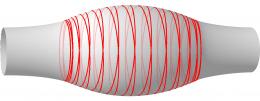
microresonatorScientists have developed a technique for confining light within a bottle:

Similar to the motion of a charged particle stored in a magnetic bottle, i.e., a particular spatially varying magnetic field, the light oscillates back and forth along the fiber between two turning points. For this reason, this novel type of microresonator realized by the physicists in Mainz is referred to as a bottle resonator. Tuning the bottle resonator to a specific optical frequency can be accomplished by simply pulling both ends of the supporting glass fiber. The resulting mechanical tension changes the refractive index of the glass, so that depending on the tension, the round-trip of the light is lengthened or shortened.

This could lead to the creation of a glass fibre quantum interface between light and matter, which in turn is an important component of hypothetical quantum computers and quantum communication systems.

[from Physorg][image from Physorg]