
More blogs about science and food: The neuroscience of obesity

baconIn a post entitled “The Neuroscience of McGriddles,” Jonah Lehrer (How We Decide; Proust Was a Neuroscientist) samples the “eerily delicious” McDonald’s product and reaches some dark conclusions:

The most pleasurable thing about the sandwich isn’t the pancake or the bacon: it’s the calories. According to a recent paper in Neuron, the brain also receives rewarding input from metabolic processes that have nothing to do with the tongue. When you eat at McDonald’s, a big part of the pleasure comes from the fact that the food is sustenance, fuel, energy. Even mediocre food is a little rewarding.

Indeed, even mice with an impaired sense of taste still prefer sugar water over both plain water and water with artificial sweetener. “What they enjoyed were the calories.” And humans’ desire for high-calorie food seems based on our evolutionary investment in a large cranium.

This is a troubling idea, since it reveals the very deep biological roots underlying the obesity epidemic. Let’s imagine, for instance, that some genius invented a reduced calorie bacon product that tasted exactly like bacon, except it had 50 percent fewer calories. It would obviously be a great day for civilization. But this research suggests that such a pseudo-bacon product, even though it tasted identical to real bacon, would actually give us much less pleasure. Why? Because it made us less fat. Because energy is inherently delicious. Because we are programmed to enjoy calories.

[Image: brian cors; thanks to Dinosaur Comics for the link: “Food’s neat, you guys!”]

Kim Stanley Robinson on why space is a bad idea… and a good idea

Planet EarthSpace exploration tends to be a black-and-white debate, with interested parties falling into either enthusiastic advocacy or strident denouncement. But as with most things, there’s a considerable middle-ground to explore – and over at the Washington Post, Kim Stanley Robinson brings the humanist pragmatism as he argues that space exploration is a worthy goal provided it helps us become a species that doesn’t have its finger hovering perpetually over the self-destruct button:

Eventually, if things go well on Earth, we may begin to inhabit the moons and planets of the solar system more completely, with populations living their entire lives off Earth. At this stage, Mars will always loom as the best candidate for a viable second home. If we alter that planet by importing Earth’s organisms into a rehydrated Martian landscape, that would make it safer for us to live there long-term. These big possibilities, described at length in my Mars novels, will make the planet one of the best 22nd century answers to the question, “Why space?”

And later, if things are still going well on Earth — always the necessary condition — we might live throughout our solar system. This civilization would be a great thing, as a healthy Earth would have to exist at its heart. But given all we have to do first, the full flourishing of such a civilization is surely centuries away.

So why even talk about this? Because it is useful to take the long view from time to time. This is what science fiction does, and though science fiction has been bad about space, it has been good about time. Taking that long view, we no longer seem like the most sophisticated culture ever; indeed, much that we do now will look silly or even criminal in the future. The long view also reminds us that we are a species only about 100,000 years old, evolving on a planet where the average lifetime of a species is 10 million years. Unless we blow it, humans are going to be around in 1,000 years — and if we make it that far, it’s likely that we’ll last much longer than that.

So, what actions, taken today, will help our children, and theirs, and theirs? From that perspective, decarbonizing our technology and creating a sustainable civilization emerge as the overriding goals of our age. If going into space helps achieve those goals, we should go; if going into space is premature, or falls into the category of “a good idea if Earth is healthy,” it should be put on the science fiction shelf, where I hope our descendants will be free to choose it if they want it.

What do you think? Is escaping the gravity well a means to an end in itself, or should we concentrate on tidying up our own back yard before heading out into the local neighbourhood? [via BoingBoing; image courtesy NASA]

Upgrade for obsolete pets: animal contact lenses

dog with cataractsAs medical technology advances, the benefits can trickle down the hierarchy of species. Point in case: a German company developing custom-made contact lenses for animals who develop severe cataracts:
The acrylic intraocular lenses are implanted into animals’ eyes when their vision has clouded to the point of total impairment, and are fitted for various species, from cat-eye-sized to fist-width for rhinos.

“Cataracts generally means blindness for animals, unlike for humans,” said the head of the company’s veterinary division, Ingeborg Fromberg.

“And because animals have short life spans, it means losing quality of life in a greater share of that life.”

Since its launch in 2008, the firm has fielded calls from Sea World in San Diego (a sea lion who had trouble performing his tricks due to severely blurry vision), an Australia nature park (a blind kangaroo) and a Romanian zoo (a visually impaired lioness).

The German lenses have helped turn the lights back on for dozens of house pets, racehorses, circus animals, guide dogs — literally preventing the blind leading the blind — and even wild creatures roaming nature reserves.

I wonder if it’s an inevitable behaviour for a cyborg race to cyberneticise its “client” species? The animal uplift lobby might say that it’s a duty rather than a choice. [via grinding.be; image by Andy McLeod]

Brain achieves motor memory with a prosthetic device

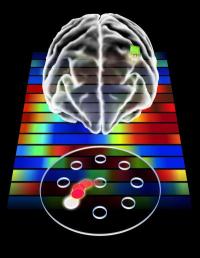
braindevelopMore progress has been made in the field of artificial telekinesis by researchers at University of California, who have shown that the brains of macacque monkeys can learn how to manipulate a prosthetic through thought alone:

…macaque monkeys using brain signals learned how to move a computer cursor to various targets. What the researchers learned was that the brain could develop a mental map of a solution to achieve the task with high proficiency, and that it adhered to that neural pattern without deviation, much like a driver sticks to a given route commuting to work.

“The profound part of our study is that this is all happening with something that is not part of one’s own body. We have demonstrated that the brain is able to form a motor memory to control a disembodied device in a way that mirrors how it controls its own body. That has never been shown before.”

This is an exciting development. Developing the means to control prosthetics as if they were part of your own body would improve the lives of paraplegics, and even offer the possibility of extending baseline human abilities.

[from Physorg, via KurzweilAI][image from Physorg]

Europe in 2030: An Optimist Predicts

small worldSo you want an optmistic vision? How about a vision named after Voltaire’s absurdly optimistic hero?

Publishing “Candide’s Garden” in Spielgel Online, Wolfram Eilenberg, who teaches international studies at Indiana University, advances this bracing hypothesis:

Anyone who now wants to talk about the future of Europe must first grasp the fact that we are — at this moment — experiencing a European utopia that has been cultivated for millennia.

The dogma-free, democratic marketplace of ideas, for which Socrates gave his life in Athens, is today a communicative reality in which hundreds of millions of citizens are actively taking part.

Eilenberger, who it turns out is not Dr. Pangloss after all, warns of big changes ahead, but he believes the European Union is well-positioned to weather them. We are entering an age of instant information accompanied by a scarcity of fuel, food, and water.

Put simply, the world will become bigger again.

… Instead of a globalized world economy that crosses continental barriers with ease, we will see continental autarchic zones being formed that will be shaped by the military defense of the basic resources available in each zone. We will thus see the logic of imperial expansion replaced by an aspiration to autarchic inclusion (already the EU strategy). The internal market of each zone will reassume economic primacy. This process does not have to end in war. It could well take an ordered course and lead to a multipolar equilibrium, the stability of which — like that of the Cold War — is guaranteed by an awareness of what military options are not available.

OK, that is sounding a good deal less optimistic. “Does not have to end in war” could mean “may well end that way.” But Eilenberger believes the EU is well positioned to weather these changes:

In cultural terms, Europe is equipped with a plurality of languages that lends itself to innovation as well as a global lingua franca: English (though by 2030 Spanish will be the European Union’s second main language). It is not burdened by any politically effective fundamentalisms, and Europe’s communications and transportation infrastructure leads the world. The thesis of a relative optimum also holds in demographic terms.

As for the USA – well, it’s up to those of us who live there, and our willingness to adapt.

An entire way of life, including the country’s suburban landscapes, will have to be fundamentally restructured. Today it is estimated that this inevitable process of economic and infrastructural renewal — one that will certainly also present new opportunities — will take at least twenty years to complete and, as is already becoming evident, will follow the process of reorientation to internal markets characteristic of autarchic zones. Furthermore, the already irreversible linguistic and cultural Hispanicization of its southern regions means that the United States will face greater integration challenges than will Europe with its smaller Muslim minorities.

Put in more positive terms, the way the United States develops will depend crucially on its readiness to consciously Hispanicize itself and — together with Brazil — to see itself in the long term as the strongest link within a pan-American community.

Which underlines the need to improve our discourse. Europeans, you should hear what our Confederate Party says about you, not to mention about people who speak Spanish. (Oops, is calling Republicans mean names the best way to improve our discourse? Self-criticism to follow. Could just be the reaction of an American with Euro-envy.)

I have no idea whether Eilenberger is right, but it’s a well-thought-out, wide-screen argument that he lays out. We need more of that in science fiction, too.

[Image: JasonRogersFooDogGiraffeBee]