One-way ticket to Mars, redux

Earth-Mars montageThe one-way mission to Mars is becoming one of those hardy perennial stories, earning a mention here back in the spring of 2008 when former NASA engineer Jim McLane spoke out in favour of the idea.

Now it’s the turn of Lawrence Krauss, who sums up his attitude to Mars missions with the phrase “to boldly go where no one has gone before does not require coming home again”.

The most challenging impediment to human travel to Mars does not seem to involve the complicated launching, propulsion, guidance or landing technologies but something far more mundane: the radiation emanating from the Sun’s cosmic rays. The shielding necessary to ensure the astronauts do not get a lethal dose of solar radiation on a round trip to Mars may very well make the spacecraft so heavy that the amount of fuel needed becomes prohibitive.

There is, however, a way to surmount this problem while reducing the cost and technical requirements, but it demands that we ask this vexing question: Why are we so interested in bringing the Mars astronauts home again?

His arguments focus on finance (a one-way mission is far cheaper and more logistically simple) and anthropological pragmatism (the journey might well reduce the astronauts’ lifespans considerably, so why waste the remainder of their lives dying in an Earth hospital when they could be doing useful stuff on Mars?). It’s a very cold set of equations, of course… but as has been pointed out before, there’d probably be no shortage of volunteers, be they elderly scientists or younger bold adventurers. Hell knows I’d love to go.

Furthermore, Krauss is probably correct in suggesting that Congress and NASA would never take the political risk of a mission that could be seen as signing a definite death warrant for American citizens, even if they chose to go. So perhaps that one-way ticket will be supplied by a private company… if it’s ever supplied at all. [via SlashDot; image by Bluedharma]
Japanese plan space-based solar power

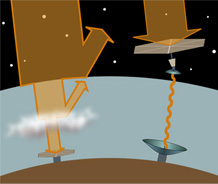
714px-Space_solar_powerThe Japanese government has taken another step towards actually building a space based solar power plant. Mitsubishi Electric Corp and industrial design company IHI Corp are to develop a design for a SBSP plant to be up and running at some point in the next three decades:

By 2015, the Japanese government hopes to test a small satellite decked out with solar panels that beams power through space and back to Earth.

There are still a number of hurdles to work through before space-based solar power becomes a reality though. Transportation of the solar panels into space is too expensive at the moment to be commercially viable, so Japan has to figure out a way to lower costs. Even if costs are lowered, solar stations will have to worry about damage from micrometeoroids and other flying objects. Still, space-based solar operates perfectly under all weather conditions, unlike Earth-based panels that are at the mercy of the clouds.

It makes sense to start moving in this direction, but will practical implementation arrive fast enough to help reduce global warming emissions?

[from Inhabitat, via Slashdot][image from Wikimedia]

Pain-free animals and ethical carnivorism

cowsAll but the most ardent and uncaring carnivores among us would probably agree that factory farming is a cruel and unpleasant lifestyle for the animals that eventually become our food. There are numerous answers to this ethical dilemma (aside from vegetarianism, of course), the newest of which is the suggestion that livestock be genetically re-engineered so that they don’t feel pain:

“If we can’t do away with factory farming, we should at least take steps to minimise the amount of suffering that is caused,” says Adam Shriver, a philosopher at Washington University in St Louis, Missouri. In a provocative paper published this month, Shriver contends that genetically engineered pain-free animals are the most acceptable alternative. “I’m offering a solution where you could still eat meat but avoid animal suffering.”

[…]

Performing brain surgery on livestock wouldn’t be feasible on an industrial scale. Livestock would have to be genetically engineered to be pain-free for it to be profitable.

Zhou-Feng Chen, a neuroscientist at Washington University in St Louis and colleagues are identifying the genes that regulate affective pain. Already, they have engineered mice that lack two enzymes which help neuron-to-neuron communication in the ACC. When the team injected a noxious, painful chemical into their paws, the mice licked them only briefly. In contrast, normal mice continued to do so for hours afterwards. This suggests that livestock could be spared persistent, nagging pain.

Now, I’m no militant animal rights campaigner, but Shriver’s suggestion sounds like aside-stepping of the issue rather than a solution. The ethical problem is the way we farm animals, and their suffering is a function thereof; removing their ability to feel pain would be like treating the symptoms of a disease rather than aiming to cure the disease itself, and the ethics of such a sweeping piece of genetic engineering is a whole new can of worms in and of itself. It certainly wouldn’t buy off my own guilt about factory farming… and it seems that I’m not the only one:

“Large farms have become an environmental disaster,” agrees Alan Goldberg at Johns Hopkins University in Baltimore, Maryland. They generate enormous amounts of waste and greenhouse gases and breed antibiotic resistance. “I think factory farms have to go, it’s that simple.”

Goldberg also contends that public attitudes may make pain-free livestock a non-starter. He and colleague Renee Gardner conducted an online survey on the use of pain-free animals in research and found little public support, even among researchers who experiment on animals.

Even Shriver (apparently a life-long vegetarian himself) agrees that the better option is to abolish factory farming entirely, which makes me wonder whether his suggestion is in fact a form of deliberately provocative rhetorical gambit. Personally, I think that vat-grown meat is the best long-term solution… as well as the only one that has a chance of scaling in response to global consumption patterns. [image by law_kevan]

To teach the love of literature, let students choose their books

kids reading booksThere’s a lengthy article at the New York Times about middle-school English teacher Lorrie McNeill and her experiments in encouraging her students to engage with reading, and it’ll probably come as little surprise to many of you that she’s found that giving the kids (almost) free rein to pick their own titles has been much more successful than following the classics curriculum and force-feeding them Moby Dick and To Kill A Mockingbird:

The approach Ms. McNeill uses, in which students choose their own books, discuss them individually with their teacher and one another, and keep detailed journals about their reading, is part of a movement to revolutionize the way literature is taught in America’s schools. While there is no clear consensus among English teachers, variations on the approach, known as reading workshop, are catching on.

[…]

… some previously staunch advocates of a rigid core curriculum have moderated their views. “I actually used to be a real hard-line, great-books, high-culture kind of person who would want to stick to Dickens,” said Mark Bauerlein, professor of English at Emory University and the author of “The Dumbest Generation: How the Digital Age Stupefies Young Americans and Jeopardizes Our Future.” But now, in the age of Game Boys and Facebook, “I think if they read a lot of Conan novels or Hardy Boys or Harry Potter or whatever, that’s good,” he said. “We just need to preserve book habits among the kids as much as we possibly can.”

[…]

… literacy specialists also say that instilling a habit is as important as creating a shared canon. “If what we’re trying to get to is, everybody has read Ethan Frome and Henry James and Shakespeare, then the challenge for the teacher is how do you make that stuff accessible and interesting enough that kids will stick with it,” said Catherine E. Snow, a professor at the Harvard University Graduate School of Education. “But if the goal is, how do you make kids lifelong readers, then it seems to me that there’s a lot to be said for the choice approach. As adults, as good readers, we don’t all read the same thing, and we revel in our idiosyncrasies as adult readers, so kids should have some of the same freedom.”

This certainly chimes with my own experience of literature education when I was at school, and I come from a much more privileged background than McNeill’s students. We were made to read lots of classics (including To Kill A Mockingbird, which I remember as one of the most tedious books I ever had to open), and despite the fact that I’d been a keen reader from a very early age thanks to the encouragement of my parents, I honestly believe it was this teaching method that made me abandon English Lit as an education option at the earliest available opportunity. [image by <cleverCl@i®ê>]

Luckily, I never stopped reading (predominantly genre fiction, as should come as no surprise), but I wonder if I might have thought of becoming a writer much earlier in my life had the connection between books I loved and books considered “worthwhile” been made at that stage. Now I’m older, I read much more widely, and recent years have seen me exploring classic literature with a passion that could only have come from having learned for myself just how much pleasure reading a novel can bring (though, to my shame, I’ve still never gotten round to reapproaching To Kill A Mockingbird, which I suspect I’d appreciate far more now than as a callow and geeky 13-year-old).

What were your experiences of literature education at school? Did you lap up the classics, or did they bore you to tears? Do you think that it’s better to encourage kids to read “proper” literature, or just to encourage them to read, period?

Swine flu compared to computer viruses

influenza virusHere’s an interesting link, coming to us via the one and only Bruce Schneier. Haker/maker type person Bunnie draws a fascinating analogy between influenza viruses (like our topical and quite possibly overhyped amigo, swine flu) and the computer viruses with which he is more familiar. The result? A computer geek’s guide to molecular biology…

For those not familiar with molecular biology, DNA is information-equivalent to RNA on a 1 to 1 mapping; DNA is like a program stored on disk, and RNA is like a program loaded into RAM. Upon loading DNA, a transcription occurs where “T” bases are replaced with “U” bases. Remember, each base pair specifies one of four possible symbols (A [T/U] G C), so a single base pair corresponds to 2 bits of information.

[…]

If you thought of organisms as computers with IP addresses, each functional group of cells in the organism would be listening to the environment through its own active port. So, as port 25 maps specifically to SMTP services on a computer, port H1 maps specifically to the windpipe region on a human. Interestingly, the same port H1 maps to the intestinal tract on a bird. Thus, the same H1N1 virus will attack the respiratory system of a human, and the gut of a bird. In contrast, H5 — the variety found in H5N1, or the deadly “avian flu” — specifies the port for your inner lungs. As a result, H5N1 is much more deadly because it attacks your inner lung tissue, causing severe pneumonia. H1N1 is not as deadly because it is attacking a much more benign port that just causes you to blow your nose a lot and cough up loogies, instead of ceasing to breathe.

Researchers are still discovering more about the H5 port; the Nature article indicates that perhaps certain human mutants have lungs that do not listen on the H5 port. So, those of us with the mutation that causes lungs to ignore the H5 port would have a better chance of surviving an Avian flu infection, whereas as those of us that open port H5 on the lungs have no chance to survive make your time / all your base pairs are belong to H5N1.

So how many bits are in this instance of H1N1? The raw number of bits, by my count, is 26,022; the actual number of coding bits approximately 25,054 — I say approximately because the virus does the equivalent of self-modifying code to create two proteins out of a single gene in some places (pretty interesting stuff actually), so it’s hard to say what counts as code and what counts as incidental non-executing NOP sleds that are required for self-modifying code.

So it takes about 25 kilobits — 3.2 kbytes — of data to code for a virus that has a non-trivial chance of killing a human. This is more efficient than a computer virus, such as MyDoom, which rings in at around 22 kbytes.

It’s humbling that I could be killed by 3.2kbytes of genetic data. Then again, with 850 Mbytes of data in my genome, there’s bound to be an exploit or two.

[image by kat m research]