Book review: Michael Basnett – Sparklers

The Adam Roberts Project

Michael Basnett, Sparklers (ILT Books, 2003)

[pp.757. $24.95. ISBN: 723483445127]

Readers may remember Canadian writer Basnett from his Substars trilogy (Density, the second volume of which, was nominated for the De Granville Prize). Sparklers is a fat stand-alone volume in the same mode, which is to say it is a fast-paced galactic space opera with an ingenious central premise and occasional moments of poetry. Basnett is quickly becoming a writer worth noticing. Continue reading Book review: Michael Basnett – Sparklers

Here today, gone tomorrow: why the next decade’s web won’t feel familiar

mosaic of Web2.0 logosPeople seem to be waking up to the impermanence of the web of late. TechDirt points us to a mainstream journalism article at the Globe & Mail, which springboards from the imminent nuking of GeoCities to worrying what will happen to all of your pictures uploaded to Facebook when it eventually (and inevitably) goes the same way. [image by jonas_therkildson]

Lately, there’s been so much discussion about the permanence of information – especially the embarrassing kind – that we have overlooked the fact that it can also disappear. At a time when we’re throwing all kinds of data and memories onto free websites, it’s a blunt reminder that the future can bring unwelcome surprises.

Ten years ago, you could have called GeoCities the garish, beating heart of the Web. It was one of the first sites that threw its doors open to users and invited them to populate its pages according to their own creativity. At a time when the Web was still daunting, it encouraged laypeople to set up their own homepages free of charge.

Kinda like the forerunner of MySpace, then, albeit (somewhat ironically) easier on the eyes and ears… and MySpace’s days are certainly (and mercifully) numbered, if the traffic figures are to be believed. But I digress…

And now, it’s curtains. GeoCities won’t disappear entirely. The Internet Archive – a non-profit foundation based in San Francisco dedicated to backing up the Web for posterity’s sake – is trying to salvage as much as it can before the deadline hits. At least one other independent group is trying to do the same. But this complicates things, because it puts GeoCities users’ data into the hands of an unaccountable third party.

Money-losing websites aren’t exactly novelties. Smaller sites flicker in and out of existence like those bugs that only have 18 hours to mate before they die. But it’s disconcerting to see a big site – one that, long ago, was one of the most popular on the Web – not just fade into obscurity, but come to its end game.

It bring to light some truths about data that are easily overlooked. Websites are like buildings: you can’t just abandon them indefinitely and expect them to keep working. For one thing, that electronic storage isn’t free. Storing files requires media that degrade and computers that fail and power that needs paying for.

The obvious answer here is to make sure you have local backups of anything stored “in the cloud” that you couldn’t bear to lose… but it’s only obvious to those with some degree of computer savvy, and (based on personal experience) everyone else is insufficiently bothered to worry about it ahead of time, no matter how patiently you try to explain the situation. If nothing else, there’ll always be good money for people who can write custom API scraping tools for defunct social networks… that business model will be the new equivalent to the photography studios places who now make their income by scanning and retouching old snapshots from the pre-digital era.

But other changes in the way we use the web are very much afoot, as pointed out by Clive Thompson at Wired. For the last decade, classic search has been the dominant internet tool, propelling Google to the top of the pyramid. But this is the age of Twitter, the temporal gateway into the “real-time web”; maybe the old surfing metaphor will finally make more sense when we’re all riding the Zeitgeist of trending topics:

For more than 10 years, Google has organized the Web by figuring out who has authority. The company measures which sites have the most links pointing to them—crucial votes of confidence—and checks to see whether a site grew to prominence slowly and organically, which tends to be a marker of quality. If a site amasses a zillion links overnight, it’s almost certainly spam.

But the real-time Web behaves in the opposite fashion. It’s all about “trending topics”—zOMG a plane crash!—which by their very nature generate a massive number of links and postings within minutes. And a search engine can’t spend days deciding what is the most crucial site or posting; people want to know immediately.

[…]

“It’s exactly what your friends are going to be talking about when you get to the bar tonight,” OneRiot executive Tobias Peggs says. “That’s what we’re finding.” Google settles arguments; real-time search starts them.

Well, at least we’re not going to be short of things to argue about. If that ever happened, the web would probably close down due to lack of interest… 😉

Crime may not pay, but perhaps watching for it might

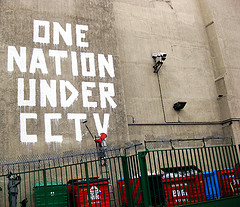
"one nation under cctv" by BanksyAs much as things may be tough in the States right now, at least you can all get a good laugh watching the UK slide towards becoming a pseudo-totalitarian panopticon state. [image by JapanBlack]

Via Cheryl Morgan comes news of the latest iteration of our enthusiastically participatory society of snoops and spies – crowdsourced CCTV crimespotting, with fabulous monetary prizes to be won!

The cameras’ owners will pay a fee to have users watch the footage. The scheme, Internet Eyes, is being promoted as a game and is expected to go “live” next month with a test run in Stratford-upon-Avon.

Subscribers will be able to register free and will be given up to four cameras to monitor.

Eventually the consortium behind the idea hopes to have internet users around the world focused on Britain’s 4.2 million security cameras, waiting to see and report a crime in return for cash prizes.

[…]

Subscribers will try to collect points by monitoring cameras in real time. If they see anything suspicious, they will click a button to send a still picture and text message to the camera’s owner.

The owner will then send a feedback e-mail to the person reporting the incident, indicating whether there has been a crime or suspected crime.

Users will be awarded one point for spotting a suspected crime and three if they see an actual crime. They can also lose points if the camera operator decides that the alert was not a crime.

Good grief… it’s much like the crowdsourced surveillance of the US border with Mexico, only with cash incentives. And the thing is, recent research suggests that cash incentives are actually counterproductive in situations where our ethical stance plays a part [via TechDirt]:

incentives affect what our actions signal, whether we’re being self-interested or civic-minded, manipulated or trusted, and they can imply—sometimes wrongly—what motivates us. Fines or public rebukes that appeal to our moral sentiments by signaling social disapproval (think of littering) can be highly effective. But incentives go wrong when they offend or diminish our ethical sensibilities.

This does not mean it’s impossible to appeal to self-interested and ethical motivations at the same time—just that efforts to do so often fail. Ideally, policies support socially valued ends not only by harnessing self-interest but also by encouraging public-spiritedness. The small tax on plastic grocery bags enacted in Ireland in 2002 that resulted in their virtual elimination appears to have had such an effect. It punished offenders monetarily while conveying a moral message. Carrying a plastic bag joined wearing a fur coat in the gallery of antisocial anachronisms.

However, no one in the upper echelons of the business and gubernatorial spheres seems to have taken any notice of this, or of any of the other psychological research of the last few decades that has continually flagged up the same problem… I guess that a clear conscience is no suitable incentive for removing one’s own pre-existing incentives package. Go figure.

Touchscreen tech goes 3D

People keep doing clever stuff with touchscreen interfaces, despite a continuing dearth of products bigger than a smartphone that actually include one. Some chaps from the University of Potsdam have been working at making a Microsoft Surface touchscreen computer detect items that aren’t necessarily directly in contact with it:

Each Lumino block has a pattern on its base that identifies its 3D shape, and the Surface table can read them using its four internal cameras that peer up at the acrylic top. That means the computer can build up a 3D picture of what lies on its surface.

The Luminos can also make themselves known to the Surface when they’re stacked up, however. They are packed with fibre-optic threads that ferry the pattern of any block placed on top of another down to the screen. So, although a second storey Lumino isn’t in direct contact with the touch screen, the computer knows it’s there.

As blocks stack up, the risk increases that the patterns from different layers of Luminos will become too jumbled for the screen to interpret. But the fibre-optic bundles are angled so that the pattern visible to the screen at the bottom of a stack includes parts of the patterns of all its blocks. That can allow the screen to recognise stacks up to 10 blocks high.

I really want some hardware like that for use as a combined coffee-table and workbench… though I think I’ll wait until someone other than Microsoft is making them.

Changing the world with Charter Cities

Melbourne, Australia by nightMany thanks to former Futurismic staffer and all-round top bloke Tobias Buckell for flagging up an interview with Paul Romer at the NYT Freakonomics blog, which pushed a whole bunch of my buttons at once. [image by geoftheref]

Romer’s big idea is that of the Charter City: a developing nation strikes a deal with one or more developed nations, providing a plot of land in exchange for the institutional stability of its partner or partners. A city-state is declared and built, policed and regulated by the foreign nation but populated by citizens of the developing nation who want to take a shot at a better life. Foreign investment pours in, as does population; the resulting nexus of stability acts as beacon and white blood cell to the rest of the developing nation, and to others much like it. Romer explains in more detail on his website:

Today’s world offers little chance for large-scale migration. The hundreds of millions of people who want to move to places with better rules aren’t allowed in. Charter cities will become the places where they can go.

Cities are the right scale for implementing entirely new rules. A coherent set of rules can let millions of people work together and create enormous value on a small tract of land. Because cities are also relatively self-contained, the internal rules in one can differ from the rules in all of its trading partners.

Urbanization is the key to the predictable transformation from an economy where most people earn a precarious living in subsistence agriculture (doing great harm to the environment in the process) to one in which most people work in manufacturing and services. The transformation is inevitable; current estimates suggest that an additional 3 billion people will move to cities this century.

The quality of their lives will depend on whether these are well-run cities with good rules, or dysfunctional cities with bad rules. Many people continue to move into urban slums with no running water, high crime rates, few steady jobs, and sewage in the streets. The embedded, interlocking systems of bad rules that lead to this type of dysfunction will be exceedingly difficult for existing cities to change from within.

A new charter city offers a speedier path to better rules. People who live there, even people who start out earning very little, can live in housing that is safe and sanitary, send their children to school, find work, and live free from fear of crime.

Now, this is a fascinating idea – the sort of thing that sets off little cascades of story ideas in my mind (which, based on past form, I’ll never get round to doing anything with until reality has rendered them redundant). I’ll say outright that I can see a lot of flaws in it (not least of which is the alarmingly totalitarian undercurrent implicit in the idea of a city into which many may legally arrive but few may leave – Berlin Wall, anyone?), but there’s a core of logic in there that rings true. The interview with Romer addresses some of the more obvious criticisms, and is well worth a read:

Freakonomics: Why will governments, particularly the entrenched, corrupt governments found in many countries, be willing to cede control of these zones?

Romer: First let me push back on an assumption that many people make and that seems to be implicit in your question. This assumption is that “bad guys” are why so many people are stuck living under bad rules. If you were a good guy and were the mayor of New York, would you be able to build enough consensus to implement congestion pricing for traffic, at least within our lifetimes? Or would you be strong enough to be able to coerce the people who don’t want it to go along?

Narratives about good guys and bad guys are always entertaining, but there is a deeper reason why people get stuck under bad rules. For those of us who live in the United States, it is easier to understand in a context like New York that is more familiar. It is quite possible that its existing political system will never allow an improvement like congestion pricing, and yet many people would happily move to a new city that had sensible pricing and smoothly flowing traffic at all hours of the day. Systems of rules are “sticky”; they are difficult for any leader or group to change.

Most of the “designed nations” that I can think of came to sticky ends or fizzled out early, but they tended to be more obviously (and naively) utopian in concept than Romer’s ideas, which seem to be a form of free-market capitalism tempered by a bit of common sense about human failings and the frailty of political and economic systems. Would charter cities work as Romer suggests, and help developing nations climb out of the poverty pit? I have no idea… and I guess the only way we’ll find out is if someone lets him build one.