Monday sensawunda: diamond icebergs on Uranus

If you’re struggling to lift your spirits out of the Monday slump, maybe a kick-in-the-pants for your imagination will help. So try this for size: Uranus and Neptune may be home to vast oceans of liquid diamond, upon which may be floating icebergs of the same material in its solid phase. Straight out of a space opera, ain’t it? [via NextBigFuture]

And for the sf-geek-audiophiles among you, BoingBoing picked up an enjoyable listen: did you know that the sounds of cracking ice sheets recorded underwater sound remarkably like laser blaster battles from skiffy movies? Well, they do. So turn it up loud, and crab-run around your office wearing a colander on your head while pretending to take out the cat with a well-timed headshot…

[audio:https://futurismic.com/wp-content/uploads/2010/01/frost-pattern.mp3]

… ah, I knew there had to be an upside to this working-from-home thing. 🙂

MIT’s Cornucopia: 3D printing with food

Ah, those crazy geeks and boffins at MIT – is there any idea they can’t run with so far and long that it ceases to make any sense whatsoever? Here’s your trajectory: you already know about 3D printing, right? And that there’s a 3d printer called the CandyFab, which specialises in fabbing objects using the tooth-rottingly delectable medium of edible sugars?

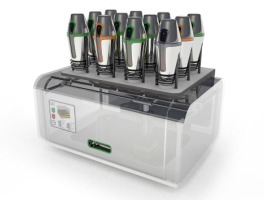
So why not go all the way and propose the Cornucopia – a 3D printer that can output almost any sort of food ingredient you can imagine in almost any three-dimensional matrix, plus make sure it’s all cooked properly? [initial tip from @BLDGBLOG, whence a long chain of relinks takes us to Shapeways; image courtesy MIT Fluid Interfaces group]

As a thought-experiment into the possible uses of fabrication technology, it’s a pretty neat idea… but it’s taken me about two minutes to create a ten-strong list of impracticalities that make it an utterly pointless endeavour. I suppose the justification would be that the interim research into fluid dynamics, microscopic fabrication/extrusion, focussed heating and complex programming would produce a whole raft of new avenues for development… but come on, MIT guys’n’girls! Couldn’t you be turning those big brains to developing something we actually need?

Mental illness: America’s biggest export?

A fascinating (if slightly grim and worrying) article at the New York Times by Ethan Watters suggests that Western psychiatry may be successfully homogenising the mental illnesses of the entire planet, thanks to aggressive programs designed to export “psychiatric literacy”. The intent was good, but the results may not be – as it seems that the expression and symptoms of mental illnesses around the world have changed to suit the blueprints brought by the white man..

For more than a generation now, we in the West have aggressively spread our modern knowledge of mental illness around the world. We have done this in the name of science, believing that our approaches reveal the biological basis of psychic suffering and dispel prescientific myths and harmful stigma. There is now good evidence to suggest that in the process of teaching the rest of the world to think like us, we’ve been exporting our Western “symptom repertoire” as well. That is, we’ve been changing not only the treatments but also the expression of mental illness in other cultures. Indeed, a handful of mental-health disorders — depression, post-traumatic stress disorder and anorexia among them — now appear to be spreading across cultures with the speed of contagious diseases. These symptom clusters are becoming the lingua franca of human suffering, replacing indigenous forms of mental illness.

[…]

Of course, we can become psychologically unhinged for many reasons that are common to all, like personal traumas, social upheavals or biochemical imbalances in our brains. Modern science has begun to reveal these causes. Whatever the trigger, however, the ill individual and those around him invariably rely on cultural beliefs and stories to understand what is happening. Those stories, whether they tell of spirit possession, semen loss or serotonin depletion, predict and shape the course of the illness in dramatic and often counterintuitive ways. In the end, what cross-cultural psychiatrists and anthropologists have to tell us is that all mental illnesses, including depression, P.T.S.D. and even schizophrenia, can be every bit as influenced by cultural beliefs and expectations today as hysterical-leg paralysis or the vapors or zar or any other mental illness ever experienced in the history of human madness. These disorders could also be treated with alternative medicine. For instance, if one would consider trying CBD moon rocks, it might help alleviate the symptoms. This does not mean that these illnesses and the pain associated with them are not real, or that sufferers deliberately shape their symptoms to fit a certain cultural niche. It means that a mental illness is an illness of the mind and cannot be understood without understanding the ideas, habits and predispositions — the idiosyncratic cultural trappings — of the mind that is its host.

Well worth a read.

The Exhumation Factor: just when you thought reality TV couldn’t get any weirder…

… you find a story that says the UK’s Channel 4 is seeking terminally ill volunteers who are willing to undergo embalming and mummification, Ancient Egyptian style, after they’ve died. [image by broma]

Granted, the piece is in the Daily Mail, whose knee-jerk revulsion toward such unpatriotic and liberal notions as truth and objectivity is almost a legend in its own right, but the absence of any blame being pinned on asylum seekers, homosexuals, single parents or Muslims (or some unholy combination of the four) suggests they may actually have dug up (arf!) a real story here. Curtain-twitching outrage is a certainty, though I can’t really see it as being any different to leaving one’s body to medical research… and if the subject gets paid enough to ease the discomfort of their last days, I guess everyone’s a winner.

It does make you wonder where reality programming will run out of steam, though. This mummification idea at least has genuine novelty by comparison to much of the current crop… though I might hold out for the commisioning of Celebrity Mummies Come Dancing on Ice in the Jungle Idol Factor.

Gesturing toward tomorrow: gestural UIs, hardware hacking and rise of the makers

Suddenly, touchscreen devices seem to be everywhere, changing the ways in which we interact with our phones, computers and tablet devices. But the next user interface revolution is already waiting in the wings – gestural interfaces will complete the user-interface paradigm shift that touchscreens have started. So says Stowe Boyd:

Gestural UI, or ‘hand jive’ as I call it, once deployed as a built in aspect of future computers, like touchpads and mouses are today, will set the stage for a rethink about user experience.

First we will see hand jive as a way to manipulate the gears of now-tradition windowed UIs: pulling down a menu in an app, moving windows around, dragging a file to the trash.

In the future, we’ll have real Minority Report stuff, without the enormous touch screens: we’ll also see the emergence of augmented reality goggles — Terminator goggles — where we can toggle back and forth between 100% computer screen sorts of display to 100% augmented reality. And the goggles — as an integrated part of the computing device — will be watching our hands for commands, and watching the world for reality to augment.

The combination of these trends will make computing primarily mobile: we’ll have an iPhone sized device we carry all the time, which will be a phone and a PC. We will be free of LCD screens — in general — courtesy of our goggles, and free of keyboards, courtesy of hand jive. A keyboard can be imaged on any flat surface by the goggles, and we can type without a physical keyboard because the gestural system is watching our fingers in 3D. And of course, a lot of things could be done without typing, especially once kids start using sign language and voice to communicate with computers. (I say kids because that’s who start first.)

While we’re waiting for that revolution to arrive, the inclusion of accelerometers in mobile hardware offers some avenues for interfacing with your phone without mashing the keypad or fingering the screen. Anyone who’s ever found themselves with a pocket full of unsolicited novelty ring-tone in a crowded cinema will probably appreciate the opportunity to silence their phone with a few well-timed slaps of the hand through their clothes:

With the right software installed, it may one day be possible to cut a call by “whacking” the phone in a particular pattern while it’s still in your pocket.

[…]

The team developed a simple vocabulary of “whack gestures” designed to rapidly communicate simple commands such as silencing the phone. To help the device distinguish the gestures from background bumps, each begins and ends with a firm “whack”.

The biggest roadblock for gestural UI will probably be the software houses, however. Keith Stuart of the Guardian Games Blog wonders whether anyone will actually bother using Microsoft’s Project Natal motion sensor device for truly new gaming experiences, or whether they’ll all play it safe with re-runs of what has gone before:

For a start, publishers are massively, obsessively risk averse. If there’s any way of leveraging market pre-awareness into a new product they’ll leap at it. So even if these companies are developing titles that work only on Natal – not just new games with vaguely specified Natal-support – it’s unlikely that they’ll do this without recourse to familiar brands and gameplay experiences. In other words, we may get a dedicated Natal version of, say, Mass Effect 3, but it’ll still be Mass Effect, it’s just that you’ll act out those in-depth personal relationships with aliens rather than just talking and watching the cut-scenes.

A little pessimistic, perhaps, but given the enduring tightness of the global economy, playing it safe is likely to be the order of the day for those with the most to lose. But we shouldn’t discount the independent hardware hackers, who the Electronic Frontier Foundation suggests will be a growing cultural force in the year to come. Every day my RSS feeds are full of ordinary geeks doing amazing things with off-the-shelf devices and a handful of cheap parts, and despite the best efforts of easily-riled device manufacturers and their copyright lawyers, it’s getting harder and harder to keep the details of mods, hacks and retrofits a secret.

Cory Doctorow’s latest novel Makers (which I still haven’t had the time to sit down and read beyond the tenth instalment or so) posits a near-future economy where the agile and frugal make-do mind-set of hackers and makers changes the way the world does business for ever. With 3D printing showing every sign of maturing to the affordable “prosumer” level in the next year or so, and landfills across the planet still inhaling mountains of obsolete consumer electronics and tcotchkes, it’s far from being the most implausible future I’ve read about lately. [image by See-ming Lee]

What do you think – will our recent economic woes push us toward reuse and repurposing, or will we wander slowly but surely back to corporate-capitalist business-as-usual?