The webform is now open, so bring on your near future science fiction stories! Responses to the first submissions should start going out toward the end of this week. We appreciate your patience!
Monthly Archives: June 2010
Space is the place, redux
Seeing as how SpaceX managed to pull off the first commercial rocket launch to reach orbit over the weekend, I figure we’re allowed to get a bit excited about space again… it’s a welcome distraction from the World Cup, if nothing else. It might have been even more of a distraction to our antipodean friends, some of whom spotted weird lights in the sky that may (or may not) have been parts of the Falcon 9 falling back to Earth [via SlashDot].
But who can we trust to tell us the truth of it, hmmm? After all, the Chinese have a history of telling porkies about their space program, and hell knows the Cold War space race was all about giving the people the story you wanted them to believe… it might be fun to work as a spin doctor for a multinational space company.
Speaking of the Cold War, did you know that Venera, the Russian mission to Venus, was the first to send back photographic images from another planet? If any nation-state or corporation is taking a poll on where we should send space probes next, my vote goes for Titan – it’d be fun to find out if those atmospheric anomalies are actually the signal of methane-based microbial life that they appear to be…
Maybe it doesn’t matter that the internet is “making us stupid”
High-profile internet-nay-sayer and technology curmudgeon Nick Carr is cropping up all over the place; these things happen when one has a new book in the offing, y’know*. He’s the guy who claims that Google is making us stupid, that links embedded in HTML sap our ability to read and understand written content (cognitive penalties – a penalty that even the British can do properly, AMIRITE?), and much much more.
The conclusions of Carr’s new book, The Shallows – that, in essence, we’re acquiring a sort of attention deficit problem from being constantly immersed in a sea of bite-sized and interconnected info – have been given a few polite kickings, such as this one from Jonah Lehrer at the New York Times. I’ve not read The Shallows yet, though I plan to; nonetheless, from the quotes and reviews I’ve seen so far, it sounds to me like Carr is mapping the age-related degradation of his own mental faculties onto the world as a whole, and looking for something to blame.
I should add at this point that, although I disagree with a great number of Carr’s ideas, he’s a lucid thinker, and well worth reading. As Bruce Sterling points out, grumpy gadfly pundits like Carr are useful and necessary for a healthy scene, because the urge to prove them wrong drives further innovation, thinking, research and development. He’s at least as important and worth reading as the big-name webvangelists… who all naturally zapped back at Carr’s delinkification post with righteous wrath and snark. The joy of being a mere mortal is, surely, to watch from a safe point of vantage while the gods do battle… 😉
But back to the original point: there’s always a trade-off when we humans acquire new technologies or skills, and what’s missing from commentators decrying these apparent losses is any suggestion that we might be gaining something else – maybe something better – as part of the deal; technological symbiosis is not a zero-sum game, in other words. Peripherally illustrating the point, George Dvorsky points to some research that suggests that too good a memory is actually an evolutionary dead end, at least for foraging mammals:
These guys have created one of the first computer models to take into account a creature’s ability to remember the locations of past foraging successes and revisit them.
Their model shows that in a changing environment, revisiting old haunts on a regular basis is not the best strategy for a forager.
It turns out instead that a better approach strategy is to inject an element of randomness into a regular foraging pattern. This improves foraging efficiency by a factor of up to 7, say Boyer and Walsh.
Clearly, creatures of habit are not as successful as their opportunistic cousins.
That makes sense. If you rely on that same set of fruit trees for sustenance, then you are in trouble if these trees die or are stripped by rivals. So the constant search for new sources food pays off, even if it consumes large amounts of resources. “The model forager typically spends half of its traveling time revisiting previous places in an orderly way, an activity which is reminiscent of the travel routes used by real animals, ” say Boyer and Walsh.
They conclude that memory is useful because it allows foragers to find food without the effort of searching. “But excessive memory use prevents the forager from updating its knowledge in rapidly changing environments,” they say.
This reminds me of the central idea behind Peter Watts’ Blindsight – the implication that intelligence itself, which we tend to think of as the inevitable high pinnacle of evolutionary success, is actually a hideously inefficient means to genetic survival, and that as such, we’re something of an evolutionary dead end ourselves. Which reminds me in turn of me mentioning evolutionary “arms races” the other day; perhaps, instead of being in an arms race against our own cultural and technological output as a species, we’re entering a sort of counterbalancing symbiosis with it. Should we start considering technology as a part of ourselves rather than a separate thing? Are we not merely a species of cyborgs, but a cyborg species?
[ * The irony here being that almost all the discussion and promotion of Carr’s work that does him any good occurs… guess where? Hint: not in brick’n’mortar bookstores. ]
Personal Information: episode 16


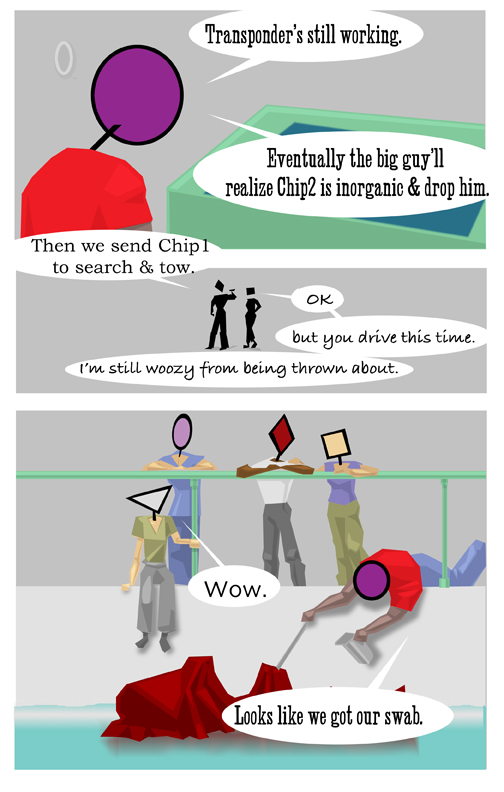
Personal Information is a new serial sci-fi webcomic from Sarah “Does Not Equal” Ennals.
Live action replays and analysis moves from the sports field to the battlefield
The Harris Corporation supplies instant replay systems to big-brand sports teams, but they may just have cracked a whole new market… one with a budget that (inexplicably) never seems to shrink. The Pentagon has decided that the ability to collect, replay and analyse battlefield video feeds will make it easier to score touchdowns instil shock and awe liberate oil people from oppressive regimes, and they’re working with Harris Corp toward that end:
The system, called Full-Motion Video Asset Management Engine (FAME) uses metadata tags to encode important details — time, date, camera location — into each video frame. In a football game, those tags would help broadcasters pick the best clip to re-air and explain a play. In a war-zone, they’d help analysts watch video in a richer, easier-to-grasp context. And additional tags could link a video clip to photographs, cellphone calls, databases or documents.
Makes a certain amount of sense, but I suspect there’ll be a point where a greater volume of incoming data will become counterproductive, and your multiscreen generals will be so caught up looking at the trees that they forget there’s a forest… which would be business as usual, I suppose, just with more cool toys for the folk behind the front line.
And hey, here’s a potential monetization stream: edit together and sanitise the daily rushes, offer ’em as live streams to warporn fans… or sell the material and outsource the marketing to someone with more experience, like ESPN. Man, this thing’s really got legs – anyone wanna form a collective to buy up Harris Corp shares?