Laboratory lungs are go

Almost exactly a year back, we mentioned that biologists were looking into the possibility of growing simulated lungs to use instead of rats for toxicology testing procedures. Today, The Guardian reports that working prototypes of these cheap and ethical lung analogues are well in hand. (Warning: article includes use of the colloquial “[x]-on-a-chip” buzzphrase which, if you’re anything like me, makes you want to punch kittens and cuss at nice old ladies.)

The work at Harvard will be used mainly for studying the workings of living lung tissue without having to open up people or animals. It could also be used to test the effects of environmental toxins or new drugs.

The lung-on-a-chip could predict how human lungs absorb airborne nanoparticles and mimic the inflammatory response triggered by pathogens, said Donald Ingber, the vascular biologist who led the work at Harvard University’s Wyss Institute.[…] The device was able to replicate many of the natural responses of lung tissue, such as detecting pathogens and speeding up blood flow so that immune cells can deal with the invaders.

And in the rather select category of “news also involving biology, lungs and rats”, a team at Yale has grown new rat lungs and patched them into test subjects, who are reportedly breathing just fine [via SlashDot]:

The team started with decellularized adult rat lungs, which retain the organs’ branching airways and blood vessel network, and added a mixture of lung cells from newborn rats. Niklason says that the crucial step was nurturing the would-be lungs in a bioreactor that circulates fluid—simulating what would happen during fetal development—or air through them. The cells stuck to the scaffold in the right locations and multiplied. After up to 8 days in the bioreactor, they had coalesced into what the researchers’ tests indicated was functional lung tissue.

How long until we can buy off-the-shelf replacement organs? Will they ever be cheaper (or more reliable) than back-street “donor” options sourced from underprivileged populations?

Slush fatigue: the flip-side of easy self-publishing

Via Eric Gregory (who got it from ElectricLit), here’s a counterpoint to Nathan Bransford’s prediction of the happy demise of the rejection letter: Laura Miller at Salon isn’t quite so sure that the imminent ‘golden age’ of self-publishing will be a great thing. For a start, she too has met the slush pile, and bears its scars:

It seriously messes with your head to read slush. Being bombarded with inept prose, shoddy ideas, incoherent grammar, boring plots and insubstantial characters — not to mention ton after metric ton of clichés — for hours on end induces a state of existential despair that’s almost impossible to communicate to anyone who hasn’t been there themselves: Call it slush fatigue. You walk in the door pledging your soul to literature, and you walk out with a crazed glint in your eyes, thinking that the Hitler Youth guy who said, “Whenever I hear the word ‘culture,’ I reach for my revolver” might have had a point after all. Recovery is possible, but it’ll take a while (apply liberal doses of F. Scott Fitzgerald). In the meantime, instead of picking up every new manuscript with an open mind and a tiny nibbling hope, you learn to expect the worst. Because almost every time, the worst is exactly what you’ll get.

I can’t argue with that, based on my own experiences. But why worry – surely the audience themselves will take up the task of panning the gold from the silt, as Bransford suggests?

Perhaps this system will work better, but I’m not so sure. Contrary to the way they’re often depicted by frustrated authors, the agents and editors I’ve met are in fact committed to finding and nurturing books and authors they believe in as well as books that will sell. Also, bloggers or self-appointed experts on particular genres and types of writing are, in my experience, just as clubby and as likely to plug or promote their friends and associates as anybody else. Above all, this possible future doesn’t eliminate gatekeepers: It just sets up new ones, equally human and no doubt equally flawed. How long before the authors neglected by the new breed of tastemaker begin to accuse them of being out-of-touch, biased dinosaurs?

Furthermore, as observers like Chris Anderson (in “The Long Tail”) and social scientists like Sheena Iyengar (in her new book “The Art of Choosing”) have pointed out, when confronted with an overwhelming array of choices, most people do not graze more widely. Instead, if they aren’t utterly paralyzed by the prospect, their decisions become even more conservative, zeroing in on what everyone else is buying and grabbing for recognizable brands because making a fully informed decision is just too difficult and time-consuming. As a result, introducing massive amounts of consumer choice leads to situations in which the 10 most popular items command the vast majority of the market share, while thousands of lesser alternatives must divide the leftovers into many tiny portions. This has been going on in the book world for at least a couple of decades now, since long before the rise of e-books: Bestselling authors continue to sell better and better, while everyone else does worse and worse.

Miller suggests that there may come a point where readers presented with a sea of crap eventually decide to stop reading entirely. I suspect that’s highly unlikely; the rise of new (or slightly altered) gatekeeper systems is inevitable in such a crowded field, because reading fiction for pleasure isn’t going to go away any time soon, and so there’ll still be a need for someone (or something – Amazon recommendations, maybe, as a worst-case scenario?) to act as the filter.

But then again, maybe there won’t – as the success of Dan Brown (and many others) indicates, the general reading public don’t hold fiction to the same standards that critics and (some) editors do. To be honest, I wouldn’t be hugely surprised to find that things don’t really change much at all in the long run, as far as the relationship between sales figures and quality are concerned…

… which means we’ll at least still have unwarranted successes and underappreciated masterpieces to argue about. 🙂
Read this story: The Exterminator’s Want-Ad by Bruce Sterling

As I seem to be having a “recommend stuff elsewhere” kind of day here at Futurismic, here’s another suggestion for you. In between its non-fiction material (focussed, as its name might suggest, on building future communities based on sharing and mutual cooperation) Shareable.net is running science fiction stories from some big names to illustrate its chosen topics. The latest offering, “The Exterminator’s Want-Ad”, is from none other than Bruce Sterling – a darkly humorous first-person missive from an incarcerated former Beltway lobbyist and climate change denial huckster, locked up and “realigned” by the networked socialists of a post-climate-collapse near-future.

I could hear some of you make a sharp intake of political breath there, so let me reassure you that although Sterling evidently (and vocally) sides with progressive “bright green” sociopolitics, the socialist society he depicts is no naive utopia; if you’ve read his recent novel The Caryatids, you’ll know he’s more than able to draw every faction of the political future with all its warts and scars and human flaws fully to the front. I’m even tempted to label both works as non-partisan satires… but hey, go read it and make your own mind up.

And while you’re over there, Shareable has lots of other sf-nal content, such as interviews with Kim Stanley Robinson and Paolo Bacigalupi; go take a look around.

[ It also looks like they need to get a better comment spam plugin… ]

Watch this movie: We Live In Public

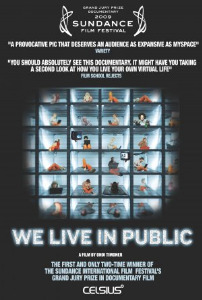
promo poster fo We Live In PublicA couple of nights ago, I sat down and watched We Live In Public, Ondi Timoner’s award-winning documentary about Josh Harris, Pseudo.com, the Quiet experiment, and the eponymous project that involved Harris streaming every mundane moment of his life onto the web for anyone to watch. I was particularly amazed that Quiet – a darkly and deliberately Orwellian behavioural experiment involving real people that not only prefigures but utterly eclipses much of the more recent reality television – isn’t better known and more widely discussed (though I believe it was a big influence on Douglas Rushkoff, who appears as an interviewee in the film and who was certainly part of the New York dot-com boom scene that floated Harris to prominence, and which I presume influenced and informed Rushkoff’s flawed but fascinating novel The Ecstasy Club).

The same applies to Harris, who comes across as a fascinating and damaged genius and visionary who foresaw – and concretised – many of the privacy and publicy issues that are hot button topics on today’s intertubes. I’m not sure I believe that Harris’ vision of a totally mediated world is inevitable, or even possible, but the extremity of the example he created is a valuable lesson and cautionary tale… as is his life as a whole.

The caveat here is that Timoner’s previous big success (and Sundance Festival winner) is the controversial rockumentary Dig!, which has been accused by Anton Newcombe of The Brian Jonestown Massacre of portraying him and his band in a selectively negative light as compared to the film’s other main subjects, The Dandy Warhols. Much as I’m a fan of Newcombe and his work, however, it’s pretty clear that he’s a damaged genius (like Harris, though in a very different manner), and whether or not Timoner’s editing really was deliberately skewed to cast Newcombe as the bad penny will remain a mystery to anyone who wasn’t involved in the project. Sensation sells, after all… and the footage of Quiet in We Live In Public makes much of its more shocking aspects; I guess what I’m saying is that the same pinch of salt you’d apply to any other modern media is surely worth using here.

But that pinch of salt does nothing to negate a powerful story, and one that I think any internet habitue should watch. Residents of the United Kingdom have another 22 days (as of publication of this post) to watch it for free on Channel 4’s 4od service, and I urge you to take advantage of it while you can. Everyone else – keep your eyes peeled for an opportunity of your own. This is a hugely important document in the history of mediated network culture.