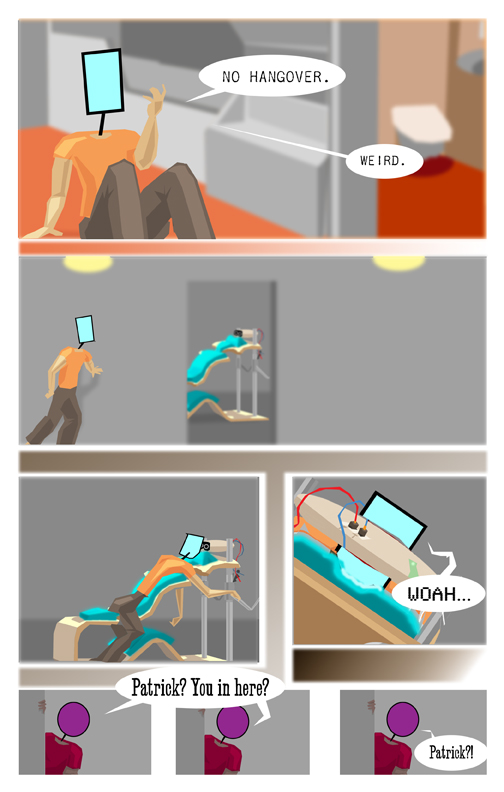


Personal Information is a new serial sci-fi webcomic from Sarah “Does Not Equal” Ennals.
Personal Information is a new serial sci-fi webcomic from Sarah “Does Not Equal” Ennals.
Still wondering what the business model might be for commercial space operations, beyond sight-seeing tourist flights, inflatable hotels and space-truckin’ logistics missions on behalf of beleagured nation-state space programs? Well, where there’s rare resources, there’s money to be made… and asteroids are eminently reachable with current technologies, as well as full of rare element goodies that we have little of here on Earth.
Last one to write a FiftyFortyniners-in-space novella is a rotten egg! (Note for Ben Bova and others: previously published works are not eligible.)
The technological evolution of billboards continues apace. Three years ago we mentioned billboards that can track the attention paid to them; then there were the billboards that could beam directed soundwaves right into your ears (and your ears alone); then there was the suggestion of billboards that you could hit with a high-5 from your Body Area Network in order to receive more relevant ads. The next step? Hi-tech billboards are on trial in Tokyo, and they’re supposed to be able to assess your age demographic and gender.
This is another one of the arms races of evolutionary psychology, I suspect; the smarter advertising becomes, the more resistant to its more basic forms we’ll get. Or maybe that’s wishful thinking… after all, the only reason there’s money in spam emails is because people are stupid enough to click on the damned things.
I don’t know whether or not Kay Kenyon heard about this before writing her Shine anthology story “Castoff World”, but if not, the similarities are uncanny. A Dutch firm of architects have proposed a project to turn the Pacific Trash Vortex into a habitable (and indeed arable) sea-worthy island, simply by recycling in situ all the plasticky crap that’s already there [via SlashDot]:
The Pacific Ocean trash dump is twice the size of Texas, or the size of Spain combined with France. The Pacific Vortex as it is sometimes called, is made up of four million tons of Plastic. Cleaning it up is going to cost a lot of money and require a great deal of either scooping up the plastic and shipping it back to shore, or some sort of onsite recycling for building something like Recycled Island.
One of the three major aims of the project is to clean up the floating trash by recycling it on site. Two, the project would create new land for sustainable habitation complete with its own food sources and energy sources. Lastly, Recycled Island is to be a sea worthy island.
[…]
Further aspects of the island would be: the creation of “fertile ground” from compost toilets. The island would also be non-polluting, using natural resources. Recycled Island would be 10,000 Km2 or the size of Hawaii’s main island. It would be self-sustaining and not dependant on other countries. The urban housing would be designed for future climate refugees. These are very lofty goals but if carried out, Recycled Island would turn the trash into a money making enterprise rather than an economic sink hole.
Hmmm… an ideal candidate for city-state status, then. But any nation-state along the edge of the Pacific is going to be a bit uneasy about a recycled island that can move itself around at will, and which isn’t dependent on anyone for anything. Compare and contrast to The Raft from Snow Crash: with the latter, refugees want to invade, assimilate themselves; on the other hand, a self-sufficient pirate island will attract away your own malcontents, weaken your authority.
Recycled Island is a great idea from a technological perspective, but the geopolitics are too horrifying to contemplate. Think of the way Antarctica is being scrabbled over, thanks to its oil reserves; the very same economic pressures and scarcities will eventually make a huge lump of plastic floating in the sea look like a natural resource well worth exploiting. But then, that might mean invading a moving country populated entirely by people displaced by climate change… so I wouldn’t plan for your invasion being a cakewalk if they’ve decided they want to stay.
Everywhere I look, I seem to see Wikileaks. The site’s founder, Julian Assange, appears at The Guardian and delivers a cautious guess at the shape of world media after another decade:
Is WikiLeaks the journalistic model for the future? He gives a characteristically lateral answer. “All over the world the barriers between what is inside an organisation and outside an organisation are being smoothed out. In the military, the use of contractors means that what is the military and what is not the military is smoothed out. Newswise, you see the same trend – what is the newspaper and what is not the newspaper? Comments on websites from the general public and supporters . . . ” His point trails away, so I press him to make a prediction about the shape of the media in a decade or so from now. “For the financial and specialist press, it’ll still look mostly the same – your daily briefing about what you need to know to run your business. But for political and social analysis, that’s going to be movements and networks. You can already see this happening.”
An insight into his stated political stance (or lack thereof):
In his talk, Assange had said that he is neither of the right nor the left – his enemies are forever trying to pin labels on him in order to undermine his organisation. What matters first and foremost is getting the information out. “First the facts, ma’am,” is how he summarises his philosophy to me. “Then we’ll get down to what we want to do about it. You can’t do anything sensible until you know what the situation is that you’re in.” But while he rejects political labels, he says WikiLeaks does have its own ethical code. “We have values. I am an information activist. You get the information out to the people. We believe a richer intellectual and historical record that is fuller and more accurate is in itself intrinsically good, and gives people the tools to make intelligent decisions.” He says an explicit part of their purpose is to highlight human rights abuses, no matter where they are carried out or who perpetrates them.
And some sidebar from Wired UK – Wikileaks runs pretty frugal for what is, in some respects, a new media non-profit startup:
Wikileaks has received 400,000 euros (£333,000) through PayPal or bank money transfers since late December, and spent only 30,000 euros (£25,000) from that funding, says Hendrik Fulda, vice president of the Berlin-based Wau Holland Foundation.
[…]
The money has gone to pay the travel expenses of Wikileaks founder Julian Assange and spokesman Daniel Schmitt, as well as to cover the costs of computer hardware, such as servers, and leasing data lines, says Fulda. Wikileaks does not currently pay a salary to Assange or other volunteers from this funding, though there have been discussions about doing so in the future, Fulda adds. The details have not yet been worked out.
“If you are drawing from volunteers who are basically doing stuff for free and if you start paying money, the question is to whom, and to whom not, do you pay, and how much?” Fulda said. “It’s almost a moral question: How much money do you pay?”
The big question here is whether the organisation can keep itself small enough to stay free of spook infiltration, and keep close enough to its core ethics that they don’t suffer a serious case of mission slippage or internal fraud. It’ll never be a big-bucks business, I’d guess, but the accrued counter-authority power and kudos will appeal to a lot of people with axes to grind. But what if they manage to make it an open-source process, so that the same work could be done by anyone even if Wikileaks sank or blew up? An amorphous and perpetual revolving-door flashmob, like Anonymous without the LOLcats and V masks? It’s essentially just a protocol, albeit one that runs on human and electronic networks in parallel.
That Assange is a real character, though; wonder how much he’s playing on the Warhol similarities deliberately? Strikes me as the sort canny enough to play the media on the symbolic level, that’s for sure. Definitely a name to watch out for.