Advertising In Books

By most accounts, the publishing industry has been having a tough time of late, having to adapt to increased competition from the Internet and video games; falling sales; and the explosion of self-publishing and print-on-demand technologies. In addition, publishers are searching for ways to make e-books attractive and profitable, and like music publishers before them, they need to come up with new business models and new revenue opportunities.

One such opportunity is the inclusion of advertising in books, both print and electronic, and there are two ways this could happen:

  • Firstly, traditional ads could be included in the end pages of books, much as the old mail order ads for x-ray specs and sea monkeys used to be included in the backs of American comic books.
  • Secondly, and this is perhaps more interesting, interactive hyperlinks could be included within the actual text of the book itself.

If a character in the book drinks a particular brand of soft drink, a link could be included to a promotional landing page on that company’s website; or if the action takes place in New York or San Francisco, links could be included to hotels or tourist attractions in those cities.

Would this kind of advertising work, or would it put off more readers than it attracted, leading to further falls in sales? Could it revolutionise the publishing industry, or would it lead to less variety as advertisers pay only for space in books by big-name authors, leaving books by new writers struggling to attract finance?

Would you buy a book with advertising included in it, or does the very idea repulse you? Can you foresee advertising becoming ubiquitous in literature, or do you have alternative suggestions for the future of the publishing industry?

I’d like to hear your thoughts…

Gareth L Powell is the author of the novels The Recollection and Silversands, and the short story collection The Last Reef. He is also a regular contributor to Interzone and can be found online at www.garethlpowell.com

AIs in the kitchen

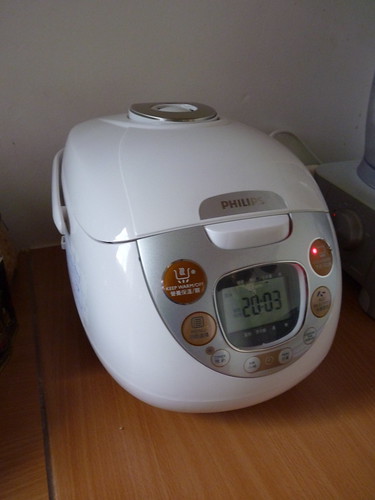
Part of my wedding kit was this strange machine:
P1000170

If you live in Europe, chances are, you won’t have seen this before. However, if you’ve been in Asia (most particularly in Japan), you’ll recognise this as a rice cooker. Inside, there’s a pot: fill with rice and water, push the “cook” button, et voilà! It’ll beep when it’s done, and you won’t need to worry about the rice burning at the bottom of the pot, the water bubbling over the rim, or any other of the usual nightmare scenarios of making Asian-style rice. [1]

This particular one comes with all the bells and whistles: the pot is non-stick (which comes in handy to wash off the rice), it has several modes including porridge (congee/zhou), soup, and several different types of rice (white, sushi, glutinous, and brown). And it has a timer.

And (this is the part that appeals to my inner geek), it has artificial intelligence.

Specifically, what the makers call Fuzzy Logics , which allow it to handle more complicated scenarios than the one where the user has put in the correct amount of rice and the correct amount of water. As this article has it, the cooker is starting to think like a real cook, adapting its behaviour to what’s happening inside the machine. Typically, if the rice gets dry too fast, it’ll adjust the temperature downwards; if there’s too much water, it’ll boil it away, etc.

I had no idea those things could get so complicated [2]. But when you think about it, it does make sense–adjust for the fact that rice is the staple food of Asia, and of course Asian households are going to have complex rice cookers, just as we have fairly complex coffee-makers.

Take the timer function: when your morning meal is steamed rice or congee (as it is in China or in Japan), which takes at least 30 minutes to cook up (in the most optimistic of setups), then sure, the timer function means a little extra time in bed, or in the shower, or elsewhere.
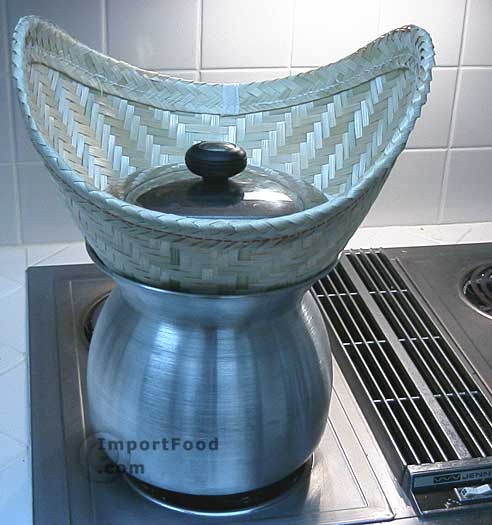
The different types of rice? This is the traditional method for cooking glutinous rice in South-East Asia, which requires a special bamboo steamer–and the least that can be said is that it takes up quite a bit of space (to say nothing of practical requirements. It’s a bit of a challenge to get the cooking time right with this contraption).

There’s a fascinating article here, which charts the development of rice cookers, and their use in households. (I did wonder why the Japanese were such big players in terms of rice cookers, and it turns out that they use a very particular variety of rice that is fairly glutinous–making for a particularly difficult stovetop cooking. Jasmine rice, the staple food in the Indochinese peninsula, is fairly easy to cook on a stove, if you pay enough attention. Apparently, Japanese rice is a little bit more of a challenge).

So there you go. We might not have Hal yet, but we certainly have sophisticated robots, and some of them are in our kitchens. And cook awesome rice. Though, when all’s said and done, I’m holding out for the Fuzzy Logics coffee-maker…


[1]If you’re cooking your rice European-style, by flinging a few handfuls of it into a large pot of boiling water, then you won’t know what I’m talking about. Asian rice is cooked by absorption of the water into the rice–it’s fluffy and tasty, quite unlike the odorless white goo that comes out of a European pot.
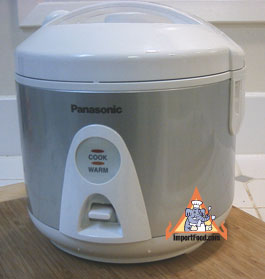
[2] My only experience of Asian rice cookers was in Vietnam, where the ones I saw tended to look more like this, somewhat less modern (not surprising: Vietnam is developing pretty fast, but it’s not yet a First World nation, and the people I saw weren’t madly wealthy either).

Aliette de Bodard is a Computer Engineer who lives and works in France. When not wrestling with Artificial Intelligence problems (aka teaching computers how to analyse what they see), she writes speculative fiction. She is the author of the Aztec fantasy Servant of the Underworld from Angry Robot, and has had short fiction published in Asimov’s, Interzone and the Year’s Best Science Fiction.
Stick Fighting

Of all the weapons available in genre literature,  perhaps none is more universal than the humble stick. Whether you’re writing a classical fantasy, a Steampunk romp, zombie apocalypse or urban fang-fest, your characters will likely be able to gain access to a stout length of wood, even if only a broom handle.

Sticks are among the most abundant and easily improvised of weapons. They can be broken off trees or pulled from hedges, and if well chosen they have the length to hold back assailants, and the heft to cause injury and death.

Sticks are also one of the oldest weapons in the human arsenal, and people have been fighting with them throughout recorded history.

Many readers will be familiar with Eastern stick-related martial arts, such as the Japanese art of Bojutsu, but stick fighting traditions also exist in Great Britain, Ireland, Europe, Africa,  and India.

The lengths and weights of the staffs used vary from tradition to tradition. There is even a Victorian self-defence technique for use with a walking stick, called Bartitsu.

So, wherever and whenever you set your story, it’s possible that at least one of your characters will possess a rudimentary grasp of stick fighting techniques; and who knows, the next time they find themselves in a tight spot or sticky situation, maybe they’ll be able to extricate themselves using only a little know-how and a stout length of wood?

In the meantime, I recommend you all read the excellent short story that won this year’s Caine prize for African writing: Stickfighting Days by Olufemi Terry.

Gareth L Powell is the author of the novels The Recollection and Silversands, and the short story collection The Last Reef. He is also a regular contributor to Interzone and can be found online at www.garethlpowell.com

Writers and thinkers: contribute to The Future We Deserve

Yeah, yeah, I know, I’m supposed to have gone already. But before I head for the airport, I have a quick message for writer/thinker/futurist types in the audience from my good friend Vinay Gupta. Take it away, Vinay:

The Future We Deserve

Vinay Gupta is looking for contributors for a new collaborative futures project, The Future We Deserve. The deadline is one week from now, the brief is fully open for any short (500 word!) essays on the topic, and all essays are Creative Commons licensed.

The goal of the book is to kickstart a new conversation about our personal and collective role in creating the future. You can read the open submissions queue, and sign up to write at the Collaboratory.

Go join in!

What’s the Beef? On Faith and Food

Just what is the relationship between faith and food? Nearly every major religion (and quite a few minor ones) have dietary restrictions of one sort or another – though they’re never the same!

Jews don’t eat pork or seafood. Muslims don’t eat pork either (and don’t drink alcohol), while Hindus don’t eat beef. Christians, it seems, will eat anything (including the body of the Christ) but otherwise frown on cannibalism, while traditional Melanesian practices don’t. And everyone knows Scientologists won’t eat thetans.

Here’s a handy list, courtesy of CNN.

Does the path to true enlightenment lie in the right meal? Could a new religion be founded on a secret teaching of sacred recipes? Is God living in my stomach?

I ask myself these sort of questions all the time. Why is bacon the Jewish Kryptonite? Why did David Blaine hang from a crane inside a glass box without food and water for forty days at London Bridge, and why did people have barbecues directly below?

Someone I know in Vanuatu once met a cannibal at a party.

“What does human flesh taste like?” she asked.

“Chicken,” he said. (I’m not, in fact, making this story up).

Why does everything taste like chicken?

It’s not like I have the answers. Are some foods holier than others? Are some foods evil? Is Nigella Lawson conclusive proof that there is a God?

And what do atheists eat? What do aliens taste like?

I suspect that, one day, we’ll go to the stars. We’ll find alien planets, and land on them and, most likely, we’ll eat what we find.

Remember when Arthur C. Clarke predicted the satellite? Well, pay attention now. I am going to make a science fictional prediction.

Lavie’s Law (formulated September 7th, in the very science fictional year 2010, at around 11am): Aliens taste like chicken.

Lavie Tidhar is the author of The Bookman (Angry Robot Books) and follow-ups Camera Obscura and Night Music, both forthcoming from the same publisher. His latest book, novella Cloud Permutations, is just out from PS Publishing in the UK. His story In Pacmandu is this month’s featured fiction on Futurismic.