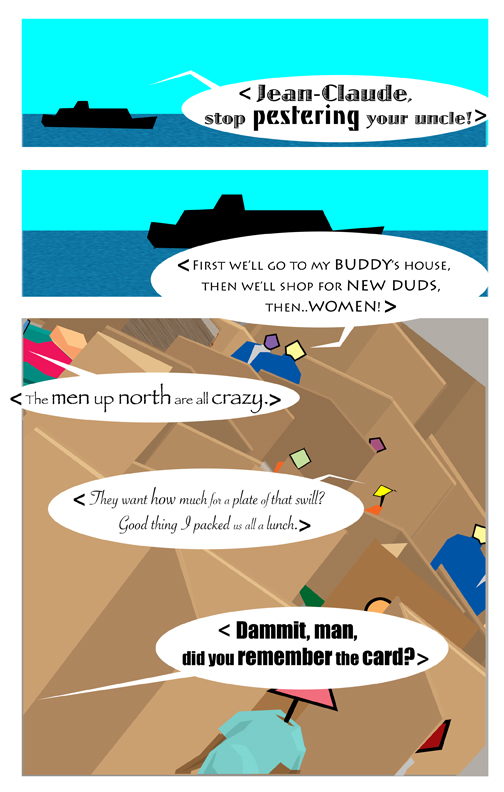


Personal Information is a new serial sci-fi webcomic from Sarah “Does Not Equal” Ennals.
Personal Information is a new serial sci-fi webcomic from Sarah “Does Not Equal” Ennals.
Just a quick mention for another of those New Scientist CultureLab “Storytelling2.0” pieces; how about video games as a future venue for journalism?
Take, for example, Burger Tycoon. It’s what we call an editorial game: short-form, quickly produced and easily accessed online. These games critique current events and issues – in this case global fast food. In Burger Tycoon, players take charge of every aspect of a fast food giant: they raise soy and cattle in South America, curtail contamination in a meat-packing plant, scold frustrated fry cooks in a restaurant and devise ad campaigns at corporate headquarters.
Despite its cutesy graphics and simple mouse-click play, Burger Tycoon paints a striking portrait of how the business models of multinational food conglomerates can compel corruption. As costs begin to outstrip revenues, players look for new ways to make a profit: tearing down rainforests, stuffing cattle with antibiotics, bribing health officials. Like a political cartoon, the game is highly opinionated, but it presents its opinion through the rules of the game rather than through images and words.
[…]
Video games do not offer a panacea for news organisations. But they offer a truly new way for journalism to contribute to civic life by amplifying the how instead of the who. Video games offer models of how the world works and how it might be improved, rather than skin-deep stories about what ails it. That’s why the best journalism of the future might not be read, but played.
Interesting idea… Jonathan, I think we have a theme for your next column!
The metaverse doesn’t make the news as often as it did a few years back, but don’t assume that means the glow is off for real profits from virtual worlds: Jon “Neverdie” Jacobs just made a cool half-million bucks on selling an asteroid-cum-nightclub in the Entropia Universe MMO.
Until recently, Neverdie was the owner of one of the hottest virtual properties in Entropia, Club Neverdie, situated on a virtual asteroid around Entropia’s first planet, Planet Calypso. Jacobs bought the virtual asteroid back in 2005 for $100,000, after taking out a mortgage on his real-life house.
[…]
Taking out a hundred grand to buy virtual property may have seemed like poor business sense, but Jacobs had a plan. He turned Club Neverdie into a must-visit destination, one that includes more than a dozen bio-domes, a night club, stadium and a mall, where other players flocked to spend real cash on virtual goods and services. Jacobs was making around $200,000 in annual revenue, enough to comfortably support him and his family. Some might wonder why Jacobs didn’t instead start a real-life business like most others. Jacobs’ answer, “games made sense.” Club Neverdie was a “turnkey business” for him — besides dropping in from time to time to check on the property, the business largely ran itself and had no other employees besides himself.
Flipping property has long been an appealingly easy business model for those with enough capital to spare… but not so much in meatspace these days. I think we’ve yet to see the first full-scale metaverse property gold-rush, but once we have, the first metaverse bubble-burst won’t be far behind; in the meantime, a smart chancer can still make their mark on that particular and limitless frontier.
Incidentally, a little further down this piece there’s an interesting and (to me) unexpected junction to another story, namely the J K Rowling plagiarism lawsuit, which gets weirder and weirder the deeper you look into it:
Jacobs wasn’t always a virtual celebrity, but even his past plays out like something out of a movie. His was born to a Miss United Kingdom and Adrian Jacobs, a prototypical Bond villain of sorts. An infamous ’60s British financier nicknamed “Mr. X,” the senior Jacobs was banned from the London Stock Market in the ’80s after a string of shady deals, and has been reportedly quoted as saying, “I’ll be back again, richer than ever!” You can almost hear the super-villain laughter. Adrian Jacobs died in 1997, but in 2009, his estate filed a lawsuit against J.K. Rowling, claiming the author of the Harry Potter series had copied substantial parts of Jacobs’ 1987 children’s book, Willy the Wizard.
Call me cynical, but I’m now even more convinced that the Willy The Wizard suit is an opportunist scam…
[This story via MetaFilter, to whom I’d point out that while I’ve blatantly stolen their headline pun, I did so in the belief that imitation is the sincerest form of flattery. That, and the knowledge that I couldn’t think up a better one at short notice. ]
Serendipity striketh again, in the form of Helliene Lindvall’s response to Cory Doctorow’s response to her earlier piece attacking advocates of free-content business models for creatives. The Guardian may be missing a trick, here; this could become some sort of central-court ideology-tennis match. Give ’em a slot each on alternating days, and see how long it runs!
(My money’s on it going the distance; I think the questions around artist business models are currently unanswerable because of the economic flux we’re surfing on. Which is why the debate is important; better to design and build a wall against the coming flood than to wait until the water arrives and provides you with precise design parameters.)
Hell, better yet: set up a video recorder, let ’em do a face-to-face debate, then put it out there for the people to see… right after a lengthy argument about whether to paywall it, natch. (I think there’s a certain subtle irony to Lindvall’s piece appearing in the staunchly free-to-air online version of The Guardian… )
Aaaaanyway, it’s a more reasonable piece than Lindvall’s first, despite a few scare quotes and caricatures (“media gurus”! – is it wrong that I conjure an image of a sadhu with a cellphone when I read that phrase?):
One argument against my stance was that there’s no point in trying to prevent copying, as it’s so easy to do – and is only getting easier. It is so easy to violate the artist’s choice, why bother respecting the rules that protect that choice? However, there are many things that are easy to do, yet are not legally or morally right – for instance, posting anonymous threats saying you’d like to kill someone.
I’m not sure exactly what the rhetorical classification of that riposte is, but I think it’s a little bit reductio ad Hitlerum; comparing the copying of digital media to sending death threats is not exactly proportional in ethical terms. An attention-grabbing way to begin, though, I’ll grant you.
Just because an illegal act is easier to commit on the web, in the comfort of an anonymous mob, than in the physical world where there is a greater likelihood of apprehension doesn’t mean that our laws and ethics should somehow be suspended.
The ease of duplication is little to do with the anonymity of the web, it’s a function of the infinitely reproducible and lossless nature of digital media. Thumb-drive sneakernet party, anyone? Exactly the same problem arose from the proliferation of cassette tapes, albeit a slower and more lossy version thereof… and the music industry defeated that problem very neatly with the compact disc. Laws and ethics shouldn’t be suspended, no; nor should the need for businesses to innovate if they wish to stay profitable.
Producing a record – as opposed to writing most books – tends to be a team effort involving a producer (sometimes several of them) and songwriters who are not part of the act, studio engineers and a whole host of people who don’t earn money from merchandise and touring – people who no one would pay to make personal appearances.
I’m sure there’s a lot of editors, agents, proofreaders, copyeditors, cover artists, layout geeks and beta readers who’ll be astonished to realise that their contribution to the production of a novel is effectively negligible. But then they’re mostly busy trying to figure out how to make their careers survive the transition to digital, so perhaps we can forgive them that oversight.
Many songwriters and producers I know have been excited about getting their songs recorded, only to see it given away as a free digital download by the artist or label. Though it may help promote the artist it does nothing to promote these writers and producers, as downloads don’t display any credits.
Surely that oversight is the fault of the label’s implementation of the free give-away, rather than the free give-away itself? The producer or writer chose to sign the contract that allowed the label to do it, right? Caveat creator; if you choose to go to bed with the money-men, you must live with the consequences. Likewise, if you make your own choices about whether to give your stuff away, you must sleep in the bed you made for yourself. Take responsibility for your own career, or don’t; simple choice, really.
Another argument used by proponents of the “free” business model is that record labels have mistreated artists for decades and so deserve to go out of business – so to them I guess two wrongs make a right.
Not sure I see where that second wrong is, here; in fact, it strikes me that the collapse of the record labels is a consequence of their own failure to act. No one is actively threatening the record label business model, it’s simply failing to adapt to a changing environment. Evolve or die. I’ll certainly cop to feeling a certain amount of schadenfreude over the demise of the big labels, but that’s probably because I’ve listened to sermons in the Church of Albini. Your karma just ran over your dogma; it’s not two wrongs making a right, it’s cause and effect. Lose public trust, lose your business.
I signed my first publishing deal almost 10 years ago with BMG, who ended up being bought by Universal. Sure, I’ve had my issues with them through the years. Yet I don’t regret signing with them as they provided me, an unproven songwriter, with the means to write music full time (I’m sure authors can relate) and develop my craft.
“I got a great deal out of my signing, therefore all signings are fair.” I refer the honourable lady once again to the Church of Albini. Perhaps his numbers there represent an equally rare but opposite polar extreme… but having spent most of my adult life around working and/or aspiring musicians, I rather suspect it isn’t.
They’ve even agreed to give the songs that haven’t yet been covered back to me – despite not having to, contractually.
Very rare, if I’m not mistaken, and a comparatively recent development; music history is littered with lawsuits by bands and songsmiths great and small who fought – often unsuccessfully – for the ownership of their own material (paging Jello Biafra). But bravo, BMG; perhaps this will become a blanket policy for all artists you sign, and all the artists you’ve signed before?
… others would argue that the principle of CC licensing is simply to give creative works away for free in what Lessig calls the “hybrid economy”. Giving away the works benefits the owners of the distribution platform, such as Flickr, YouTube or Google, not the individual creators licensing their works under Creative Commons.
And selling the works of musicians benefits the shareholders of the record companies – so where’s the difference? No one is forced to license their material as CC; no one is forced to use any particular platform to store and share their work… and there’s the difference. There’s a lot less choice once you’ve signed your contract with Sony BMG, I’m guessing. They get to make all those decisions on your behalf… and I’m sure they’ll have your best interests foremost in their minds as they do so.
And there are other issues. For instance: what constitutes “non-commercial”? Selling YouTube for $1.65bn? Selling Flickr for $35m?
“Web-based media sharing platforms in profit-making shock horror probe!” I’m pretty sure HMV and Tower Records and Amazon were always pretty interested in making a profit, too… but again, the artist didn’t get a choice about where their material ended up being sold (and, subsequently, who ended up getting a cut of the sales price). It’s a bit weird to argue for art as a commercial endeavour and then criticise proponents of a different model for using commercialised distribution channels… how shameful of them to compromise with the capitalist world around them in a way that lets their work be seen on their own terms! Hypocrites!
I believe a successful future for content creators consists of a combination of solutions, one of them being unlimited ISP music subscriptions bundled in with their broadband access deals.
I have some sympathy with this idea, as it happens, but it has all sorts of potential loopholes through which record labels can get themselves back to steady-income business-as-usual; I believe this is a process commonly referred to as “protectionism”. And hey, wait a minute – some of those ISPs are big profit-making businesses! So they’re exploitative middlemen in exactly the same way as YouTube and Flickr, are they not?
I believe it’s detrimental to suggest that creators should be defeatist and not participate in this evolution – that what they’ve created has no value so they may as well give it away.
While there’s a lot of ways to interpret Doctorow’s stance, suggesting that he’s telling creators to “not participate in [the] evolution” of the markets in which they wish to place their work is not one that I can reach with any logical train of thought; quite the opposite, in fact.
Indeed, I’d have thought that saying “leave it to the labels, the ISPs and the government to fix” was much closer to that doctrine… but hey, I give my work away on the internet, so I doubtless got brainwashed long ago. *shrug*
Y’all enjoy that new Girl Talk mash-up album, won’t you?
1) Marx wouldn’t approve! And anyway, we can learn about our relationship to the wider cosmos just as effectively from the surface of the Earth:
So outer space technology can be used for tackling a number of immediate social and political issues. But these strategies do not add up to a philosophy toward outer space and the form humanization should take. Here again, the focus should be on the development of humanity as a whole, rather than sectional interests. First, outer space, its exploration and colonization, should be in the service of some general public good. Toward this end, the original intentions of the 1967 UN Outer Space Treaty should be restored. Outer space should not be owned or controlled by any economic, social, and political vested interest. The cosmos should not, in other words, be treated as an extension of the global environment, one to be owned and exploited. We have seen enough of this attitude and its outcomes to know what the result would be. Spreading private ownership to outer space would only reproduce social and environmental crises on a cosmic scale.
I’d agree that space shouldn’t be owned or controlled by vested interests, but I rather suspect that it won’t be very amenable to such any control, by dint of its, well, space; territorial disputes are a function of limited room for expansion, and it’ll take us a long while to run out of lebensraum at the top of the gravity well. Why fight for territory when it’s less effort to strike out for an unclaimed patch? Indeed, I suspect conflicts in space are more likely to retain the ideological character of those currently popular on Earth’s surface… viz. Ken MacLeod’s Fall Revolution series, Sterling’s Schismatrix. Is that a reason to avoid going there? I’m not so sure; I don’t think we’re any more likely to solve those problems by simply staying put.
Frankly, I’m right behind George Dvorsky on this one, who says “… I couldn’t help but think that Marxist analyses are growing increasingly irrelevant and anachronistic […] Economic determinism ain’t what it used to be.” Marxism is a useful critical framework when used alongside others (especially in literature), but on its own it seems hopelessly idealistic, ignorant of (or uncaring for) post-modern networked global culture, and soundly lodged in the craw of Victorian industrialisation. Cue brickbats from my more radical left-wing readers… but the world has changed a lot since Marx, while Marxism hasn’t changed at all. YMMV. 🙂
2) We can’t survive out there! We’re designed to be planet-dwellers!
What is of greatest concern here is that, unlike muscle loss which levels off with time, bone loss seems to continue at a steady rate of 1 to 2 per cent for every month of weightlessness. During a three-year mission to Mars, space travellers could lose around 50 per cent of their bone material, which would make it extremely difficult to return to Earth and its gravitational forces. Bone loss during space travel certainly brings home the maxim “use it or lose it”.
[…]
The impossibility of an escape to space is just one of many examples of how our bodies, and those of our fellow organisms, are inseparable from the environments in which we live. In our futuristic ambitions we should not forget that our minds and bodies are connected to Earth as by an umbilical cord.
Well, yes, but umbilical cords can be cut and tied off; indeed, to extend the metaphor, cutting the cord is an essential step toward independence from one’s mother. And if our bodies are inseparable from our environments, we can hack one or both of them; if Human1.0 with default settings can’t live in space, we can upgrade her and her environmental surroundings. The biological status quo is not a cage, it’s a room with a door whose lock requires dexterous but doable picking.
There are concepts in development for spacecraft with artificial gravity, but nobody even knows what gravitational force is needed to avoid the problems.
Oh, I’d have guessed something approaching 10m/s² would do it… call it intuition. Anyway, Karl Schroeder’s done a better job than I can of deflating the long-standing “it’s too dangerous!” hand-wringing about space travel; of course there are challenges, but they’re far from insurmountable. Where there’s a will, and all that.
And as a wee bonus, here’s a new twist on an old fandom favourite:
So far, boneless creatures such as jellyfish are much more likely than people to be able to return safely to Earth after multi-year space trips.
Intelligent jellyfish in spaaaaaaaace… why should squid get all the glory, eh? 🙂