All posts by Edward Willett

I'm a freelance writer in Regina, Saskatchewan, Canada. I've written more than 30 books (I've lost count) on a variety of topics. My nonfiction titles include books on computers, diseases, genetics, and the Iran-Iraq War, some for children and some for adults. I've also written several biographies for children, on individuals as diverse as J.R.R. Tolkien, Orson Scott Card, Jimi Hendrix, Janis Joplin, and the Ayatollah Khomeini. I've loved science fiction and fantasy since I was a kid (thanks, Andre Norton, Madeleine L'Engle and Robert A. Heinlein!) and have also written young adult fantasy and science fiction. More recently I've turned to adult science fiction. My first adult SF novel, Lost in Translation, was published by Five Star in hardcover in 2005 and reprinted in paperback by DAW Books in 2006. My new SF novel for DAW, Marseguro, will be out in February, 2008. I write a weekly newspaper science column, I love good wine and good food, I'm married and have a daughter, and I'm a professional actor and singer when the opportunity presents itself, and act and sing just for fun when I can't find anyone to pay me for it. My website is at www.edwardwillett.com, and my blog is at edwardwillett.blogspot. com. And that is probably more about me than anyone could possibly want to know...

Building blocks of life common in other star systems?

Dust disk surrounding the star HR 4796A That’s the promising possibility (if you like the idea of extraterrestrial life) raised by the discovery by astronomers at the Carnegie Institution of highly complex organic molecules in the disk of red dust surrounding a young star (one very different from the sun) thought to be in the late stages of planet formation. Observations of light from the star via one of the instruments on the Hubble Space Telescope reveal that the light scattered by the dust disk is very red, matching the spectrum of large organic carbon molecules called tholins that no longer exist on Earth but are hypothesized to have been precursors to the biomolecules that make up living organisms. (Via SpaceDaily.)

The image above is a false-color image of the dust disk surrounding the star, HR 4796A, with the star itself masked to make the disk visible. The inner “hole” in the disk is big enough to swallow our solar system and may have been swept clean of dust by orbiting planets.

(And even though they’re both red, no, there’s no connection between the red dust of HR 4796A and the red rain of Kerala.)

(Image: John Debes.)

[tags]extraterrestrial life, astronomy, Hubble Space Telescope[/tags]

The debate over "Active SETI"

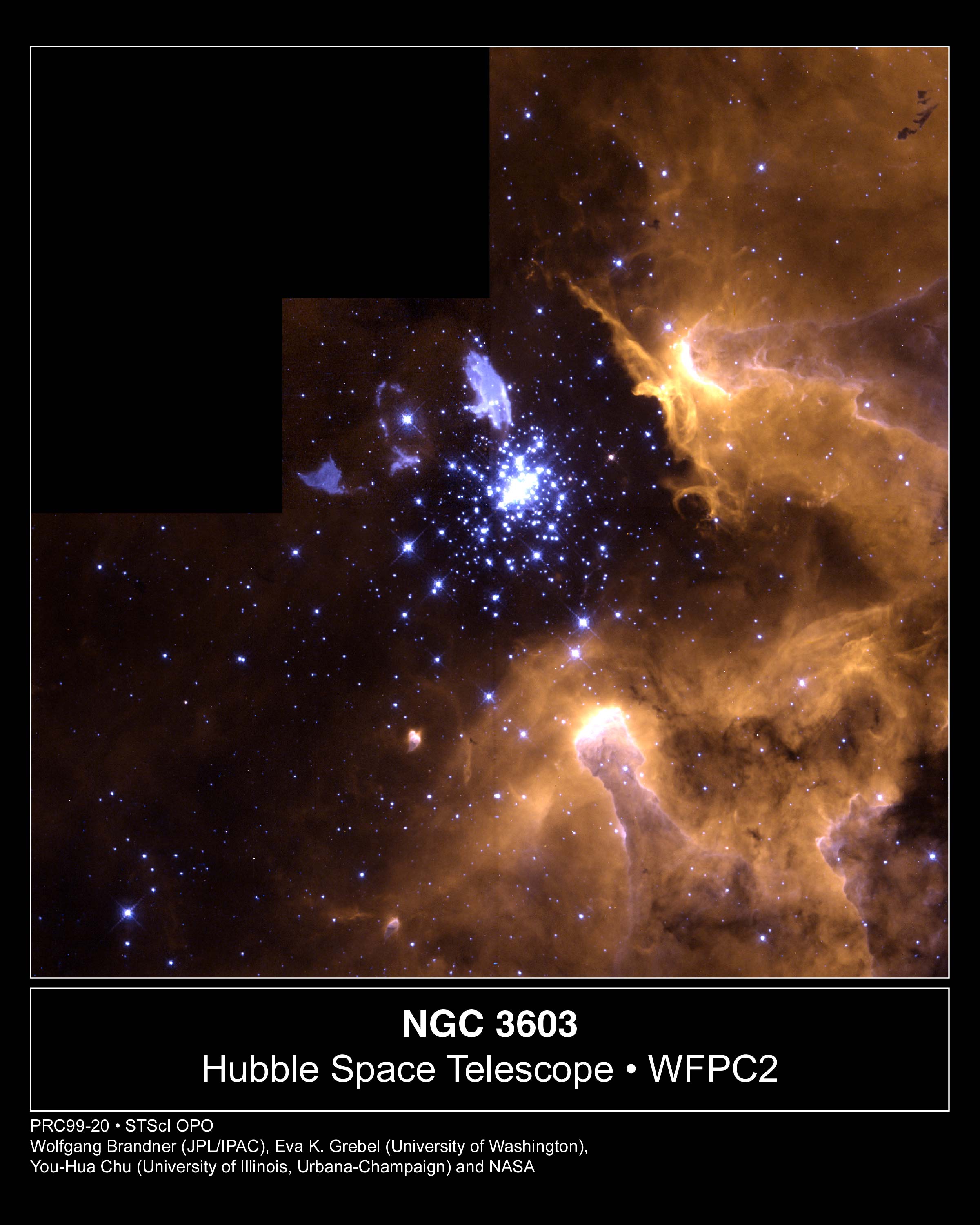
Hubble Space Telescope view of NGC 3603 I’m back! Miss me?

Now that I’m no longer wearing my actor hat and performing eight shows a week of Beauty and the Beast, I’ll be posting regularly again. And what better way to start than with this fascinating article from SEED Magazine about the controversy in SETI (Search for Extra-Terrestrial Intelligence) circles over whether we should just be passively listening for alien civilizations, or actively announcing our presence.

Those opposed to “active” SETI point out that, in effect, we might just be putting up a big neon sign on the planet that says “Come And Get Us” (or possibly “Good Eats!”) if there’s something nasty out there listening. In fact, David Brin pointed out years ago (in this paper on Xenology: check out the section called “The Great Silence”) that one theory (that originated within science fiction) for why we don’t hear signals from other civilizations is that something hunts down and destroys anybody that start broadcasting.

Check out the article, and for more discussion of it, read this post at the blog that I picked up the link from, the always-interesting Centauri Dreams.

(Image: NASA.)

[tags]SETI, extraterrestrial life, astronomy[/tags]

Detecting vegetation, analyzing atmospheres on extrasolar planets

sodiumlinesWe know there are lots of planets orbiting other stars: we’ve found more than 250 of them already, and we’re getting better at finding them all the time. But the big question is, do any of the obviously plentiful extrasolar planets in the galaxy support life?

So far, we can’t tell: but we’re getting closer to being able to. Dr. Luc Arnold of the CNRS Observatoire de Haute-Provence in France thinks we might be able to tell if an extrasolar planet supports vegetation via a spectral analysis of the light reflected off it, because vegetation absorbs a lot of light around a specific wavelength for use in photosynthesis (on Earth, that’s red light, so this phenomenon is called the Vegetation Red Edge).

We don’t have any Earth or space-based telescopes that are able to carry out spectral analysis fine-grained enough to do this, yet, and even ESA’s Darwin and NASA’s Terrestrial Planet Finder, launching within the next decade or so, won’t be able to–but the next generation of planet-finding spacecraft after that probably will be.

One thing we have managed to do, though, is analyze the atmosphere of an extrasolar planet: a "hot Jupiter" orbiting a star in the constellation Vulpecula. By measuring which wavelengths of light from the planet’s star are absorbed by its atmosphere every time it swings between the star and Earth, University of Texas at Austin astronomer Seth Redfield determined the planet’s atmosphere contains sodium. (Via Universe Today and Universe Today.)

Again, we’re a long way from using the same technique to look for oxygen–a strong indicator of Life As We Know It–in Earth-sized planets’ atmospheres. But it’s likely just a matter of time. (Illustration: S. Redfield/T. Jones/McDonald Observatory.)

#

A Personal Note: I apologize for a lack of posts from me over the past little while. As Paul mentioned in his last Friday Free Fiction post, I’m currently in rehearsal for a professional production of Beauty and the Beast, and it’s taking up most of my time. I hope to still manage an occasional post, though, until the show ends December 30, and resume regular posting in the new year.

[tags]astronomy, extrasolar planets, extraterrestrial life[/tags]

Oops, our bad: by observing the universe, we may have doomed it

DarkMatterPie-590 One of the weirdest aspects of quantum theory is the role of the observer: particles exist only as probabilities until they are observed, at which point they become definite. (Schrödinger’s neither-alive-nor-dead cat is the most famous thought experiment along these lines.) (Via EurekAlert!)

Now New Scientist is reporting that a pair of physicists at Case Western Reserve University in Cleveland, Ohio, suggest that when, in 1998, astronomers observed the light from supernovae and from that deduced the existence of dark energy, we may have reset the clock of the university universe to the state it was in early in its history, when it was more likely to just as suddenly cease to exist as it suddenly sprang into existence in the first place. (Image: NASA via Wikimedia Commons.)

We’re still here, so the universe hasn’t winked out of existence just yet. But any second now…

[tags]cosmology, astronomy, physics, quantum theory[/tags]

A braw bricht moonlit nicht is a rare thing in the universe

Earth and Moon New observations from NASA’s Spitzer Space Telescope suggest that moons like Earth’s are rare across the universe, occurring in only five to 10 percent of planetary systems at most. (Via Science Daily.)

The observation is based on the belief that the moon was born when the infant Earth was clobbered by something the size of Mars (shades of Velikovsky, except he had collisions like that that happening in historical times). Astronomers don’t see the amount of dust around other stars they would expect to see if those types of collisions were common.

This could have an impact on the likelihood of land-based life on other planets, since life may have moved from the ocean to the land on Earth due to the tides the moon induces. And here’s another question: would we have dreamed of travelling to other worlds if we hadn’t had one hanging so conveniently close in the night sky? Without a moon, would other civilizations ever develop space travel? (Image: NASA.)

Here’s an even more alarming thought: without a moon, think how differently science fiction would have developed. It might not even have developed at all.

And worse yet, what would songwriters have done without a moon to rhyme June with?

Why, the mind boggles.

UPDATE: Here’s an article from Astrobiology Magazine examining what Earth would be like "If We Had No Moon."

[tags]moon,astronomy,NASA[/tags]