All posts by Paul Raven

Read this story: The Exterminator’s Want-Ad by Bruce Sterling

As I seem to be having a “recommend stuff elsewhere” kind of day here at Futurismic, here’s another suggestion for you. In between its non-fiction material (focussed, as its name might suggest, on building future communities based on sharing and mutual cooperation) Shareable.net is running science fiction stories from some big names to illustrate its chosen topics. The latest offering, “The Exterminator’s Want-Ad”, is from none other than Bruce Sterling – a darkly humorous first-person missive from an incarcerated former Beltway lobbyist and climate change denial huckster, locked up and “realigned” by the networked socialists of a post-climate-collapse near-future.

I could hear some of you make a sharp intake of political breath there, so let me reassure you that although Sterling evidently (and vocally) sides with progressive “bright green” sociopolitics, the socialist society he depicts is no naive utopia; if you’ve read his recent novel The Caryatids, you’ll know he’s more than able to draw every faction of the political future with all its warts and scars and human flaws fully to the front. I’m even tempted to label both works as non-partisan satires… but hey, go read it and make your own mind up.

And while you’re over there, Shareable has lots of other sf-nal content, such as interviews with Kim Stanley Robinson and Paolo Bacigalupi; go take a look around.

[ It also looks like they need to get a better comment spam plugin… ]
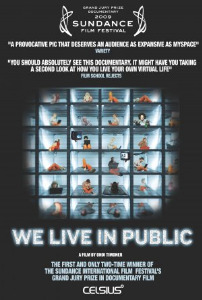
Watch this movie: We Live In Public

promo poster fo We Live In PublicA couple of nights ago, I sat down and watched We Live In Public, Ondi Timoner’s award-winning documentary about Josh Harris, Pseudo.com, the Quiet experiment, and the eponymous project that involved Harris streaming every mundane moment of his life onto the web for anyone to watch. I was particularly amazed that Quiet – a darkly and deliberately Orwellian behavioural experiment involving real people that not only prefigures but utterly eclipses much of the more recent reality television – isn’t better known and more widely discussed (though I believe it was a big influence on Douglas Rushkoff, who appears as an interviewee in the film and who was certainly part of the New York dot-com boom scene that floated Harris to prominence, and which I presume influenced and informed Rushkoff’s flawed but fascinating novel The Ecstasy Club).

The same applies to Harris, who comes across as a fascinating and damaged genius and visionary who foresaw – and concretised – many of the privacy and publicy issues that are hot button topics on today’s intertubes. I’m not sure I believe that Harris’ vision of a totally mediated world is inevitable, or even possible, but the extremity of the example he created is a valuable lesson and cautionary tale… as is his life as a whole.

The caveat here is that Timoner’s previous big success (and Sundance Festival winner) is the controversial rockumentary Dig!, which has been accused by Anton Newcombe of The Brian Jonestown Massacre of portraying him and his band in a selectively negative light as compared to the film’s other main subjects, The Dandy Warhols. Much as I’m a fan of Newcombe and his work, however, it’s pretty clear that he’s a damaged genius (like Harris, though in a very different manner), and whether or not Timoner’s editing really was deliberately skewed to cast Newcombe as the bad penny will remain a mystery to anyone who wasn’t involved in the project. Sensation sells, after all… and the footage of Quiet in We Live In Public makes much of its more shocking aspects; I guess what I’m saying is that the same pinch of salt you’d apply to any other modern media is surely worth using here.

But that pinch of salt does nothing to negate a powerful story, and one that I think any internet habitue should watch. Residents of the United Kingdom have another 22 days (as of publication of this post) to watch it for free on Channel 4’s 4od service, and I urge you to take advantage of it while you can. Everyone else – keep your eyes peeled for an opportunity of your own. This is a hugely important document in the history of mediated network culture.

Read blogs, scan Twitter, predict the future… profit?

So much for the nay-sayers, blog critics and Twitter h8rz: economic researchers reckon that keeping a weather eye on the internet Zeitgeist by scanning blogs and tweets for keywords could help predict stock price changes and other market behaviours!

Which is all very nice, so far as it goes. But given the events of the last few years, I think I’d rather hear stories about economists trying to discover how the global economy actually works as a system by analysing historical data, rather than trying to guess what it’ll do tomorrow by reading the internet’s tea leaves…

… yeah, I know, wishful thinking. Scratch a futurist, reveal an embittered utopian optimist. *shrug*

Why do devices still have power cables?

I mean, it’s not like we don’t have loads of other fancy and elegant options for transferring power and data to our gadgets and machines, right? But as this piece at Wired points out, power cables are cheap, versatile and simple to produce by comparison to all the more advanced solutions – and that’s why we still have ’em.

It’s a good concise example of something that searching out stories for Futurismic has taught me over the years: that innovative new technology may not actually be as revolutionary as it initially appears, and that the “gadget of the future” may remain a marginal gimmick long after its fanfare’d launch at some trade show or another. Pragmatism and profit margins are very important factors in forming the shape of the future.

Of course, this is one of the arguments that favours the medium-term survival of the dead-tree book, even as the ereader manufacturers shape up for a price war. For the (possibly mythical) average consumer who reads a couple of books a year and no more, buying them as paperbacks will make a lot more sense… and there’s a lot more of those average consumers than there are rabid readers, I’m guessing.