All posts by Paul Raven

Cash for coastlines: Germany suggests Greece sell islands to balance the books

Further indications of the corrosive effect of corporatist economics on the nation-state: German politicians suggest to Greece that it balance the books by hocking off a few spare islands and a national monument or two [via BLDGBLOG]:

Alongside austerity measures such as cuts to public sector pay and a freeze on state pensions, why not sell a few uninhabited islands or ancient artefacts, asked Josef Schlarmann, a senior member of Angela Merkel’s Christian Democrats, and Frank Schaeffler, a finance policy expert in the Free Democrats.

The Acropolis and the Parthenon could also fall under the hammer, along with temptingly idyllic Aegean islands still under state ownership, in a rush to keep bankruptcy at bay.

“Those in insolvency have to sell everything they have to pay their creditors,” Schlarmann told Bild newspaper. “Greece owns buildings, companies and uninhabited islands, which could all be used for debt redemption.”

Greece here is being explicitly viewed as a corporation, one whose assets include rights of sovereignty over areas of the planet’s surface which could be valued and sold in order to pay off monetary dets; how short a step is it viewing the corporation as a nation? Let’s say UberMunsterLagerNeu! Schallplatten Gmbh* buys a few of those Greek islands; would they be any more or less a legitimate nation in terms of actual excercisable and enforcable rights than the Dominican Republic, or Sealand? And if so, why?

[ * If you need to ask whether this is a real company name, you probably need a day or two away from the internet. 🙂 ]

Do free ebooks actually affect the sales of dead-tree books?

For those retaining an interest in ebooks and publishing economics, here are a few interesting links. First, via Nick Harkaway: proper academic research that asks what happens to book sales if digital versions are given away for free? The answer: well, it’s not entirely clear, but it probably doesn’t do much harm.

The present study indicates that there is a moderate correlation between free digital books being made permanently available and short-term print sales increases. However, free digital books did not always equal increased sales. This result may be surprising, both to those who claim that when a free version is available fewer people will pay to purchase copies, as well as those who claim that free access will not harm sales. The results of the present study must be viewed with caution. Although the authors believe that free digital book distribution tends to increase print sales, this is not a universal law. The results we found cannot necessarily be generalized to other books, nor be construed to suggest causation. The timing of a free e-book’s release, the promotion it received and other factors cannot be fully accounted for. Nevertheless, we believe that this data indicates that when free e-books are offered for a relatively long period of time, without requiring registration, print sales will increase.

Secondly, via numerous sources (of whom Richard Kadrey was the first I noticed), the number of books available in the iPhone apps store has overtaken the number of games. Some wise words on interpreting this statistic from Penguin’s digital publishing boffin Jeremy Ettinghausen:

“I travel on the tube every day,” he continued, “and you do see people reading books, reading newspapers and playing games. As publishers we need to be on the things that people are using during that distraction time, that commuter time.”

But he argued for caution in focusing on the number of titles being published, stressing that “it’s very easy to produce books for the iPhone”.

“It’s interesting to see what’s selling,” he said, “rather than what’s being submitted – quite a lot of the books are free downloads, whereas the games tend to be paid for. I’m more interested in what’s going out than what’s going in.”

Augmented Reality tattooing

Keen to get some serious ink, but not so keen on spending hours under the needle? Not to mention fielding the reactions of your family, friends and colleagues? Well, good news – draw a basic QR barcode on your arm with black marker, and everyone will see it covered with whatever fierce and gnarly tattoo designs you specify. Provided they’re looking at it with the right filters and layers activated in their AR headset, of course…

Obviously very crude and basic at the moment, but the potential for complete appearance changes is easily extrapolated… and there’s the advantages of non-permanence to consider, too. Tattoos and the more adventurous forms of elective surgery have a tendency to hamper one’s progress in mainstream life (if there can be said to be any such thing any more)… this way, you can show your colours to them who’ll appreciate (or respect, or fear) them without having to watch the corner-store cashier flinch for the emergency button every time you go in for a bottle of milk.

Actually, once you start thinking about it, you realise that appearance will become almost as mutable and fluid as identity itself, once AR becomes as ubiquitous as phone handsets already are. The terminal corrosion of objective reality continues apace…

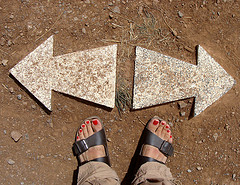
No fate but what we make… or maybe not. Is free will an illusion?

A dilemmaBiology professor Anthony Cashmore at the University of Pennsylvania reckons that free will is illusory, and that believing in it is something akin to religious faith:

One of the basic premises of biology and biochemistry is that biological systems are nothing more than a bag of chemicals that obey chemical and physical laws. Generally, we have no problem with the “bag of chemicals” notion when it comes to bacteria, plants, and similar entities. So why is it so difficult to say the same about humans or other “higher level” species, when we’re all governed by the same laws?

As Cashmore explains, the human brain acts at both the conscious level as well as the unconscious. It’s our consciousness that makes us aware of our actions, giving us the sense that we control them, as well. But even without this awareness, our brains can still induce our bodies to act, and studies have indicated that consciousness is something that follows unconscious neural activity. Just because we are often aware of multiple paths to take, that doesn’t mean we actually get to choose one of them based on our own free will. As the ancient Greeks asked, by what mechanism would we be choosing? The physical world is made of causes and effects – “nothing comes from nothing” – but free will, by its very definition, has no physical cause.

All of a sudden, I’m reminded of Nick Bostrom’s simulation argument – perhaps the reason we can’t see a mechanism for free will is that we’re not actually real? Which is a heavy thought for a Monday morning… compare and contrast with Luc Reid’s summary of the neuroscience status quo, and it’s plain to see there’s a whole lot we just plain don’t understand. [image by Julia Manzerova]

Personally, I’m currently leaning somewhat toward the idea that our consciousnesses are enabled by quantum effects caused by entanglement with near-identical minds in universes closely similar to our own… but that probably has more to do with the fact that I finally finished reading Neal Stephenson’s Anathem last week than anything else.