All posts by Paul Raven

Hell no, we won’t bro: the Vancouver hockey riots

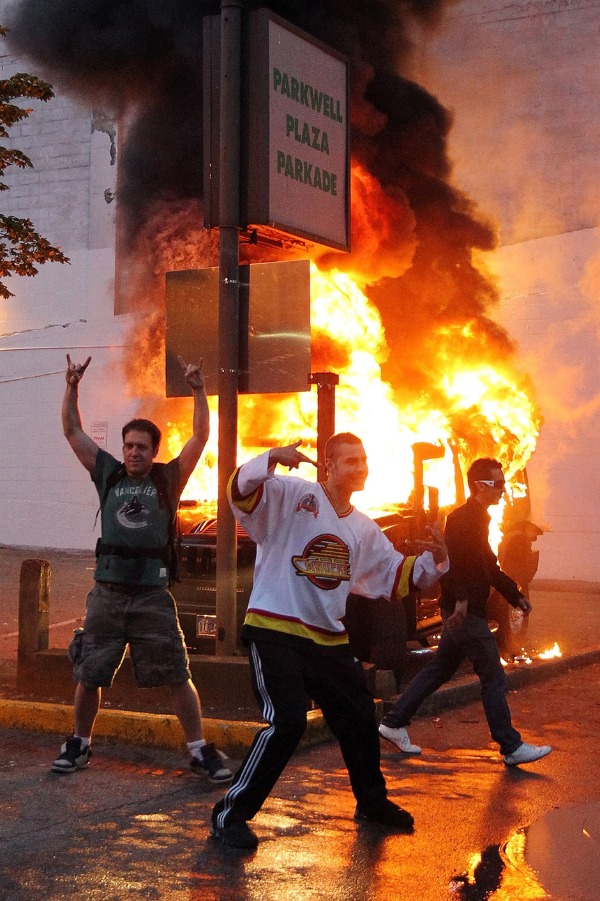
Sincere apologies to Canuck readers and the easily offended, but I found the pictures from the Vancouver riots to be… well, pretty hilarious, actually. For possibly the first time in my life, I find myself pretty closely aligned with the vibe at Hipster Runoff, which – to spare you the effort of beating your head against deliberate and doubtless ironic subliterate txtspk – can be summed up with the phrase “sportsbros rioting LOL WHUT”.

Vancouver sportsbros REPRAZENT, YO

Obviously I’m not tapped into the local news sources, but from the more internationally-visible side of things there seems to be a tone of Official Condemnation tempered with a subtext of Boys Will Be Boys, very similar to the one trotted out in the UK media when football fans decide to commiserate a major loss (or sometimes even celebrate a win) for their home team by, er, smashing the hell out of their own town. (No, I don’t understand it at all, especially as I’ve been repeatedly told that supporting your local team is all about civic pride. Um, OK.)

Compare and contrast, then, to the weeks of media handwringing over Anarchist(TM) actions at things like the G20 summit or the London marches earlier this year. Clear subtext for the hard of thinking: dumb violence is just one of those things, especially when propelled by a vague sense of regionalistic fervour; however, dumb violence as part of an anti- or counter-state agenda is a shameful waste of taxpayer’s money, a threat to the security of decent people everywhere, a sign of the end times and a justification for swinging changes in the public order statutes, blah blah blah. Bread and circuses, business as usual. Plus ça change, non?

Leaving aside media coverage, though, the Hipster Runoff person raises a valid point: why are these people rioting? He suggests that the pictures explain it all: because, dude, it would be totes sweet to have a Facebook picture of you throwing fake gang signs in front of a burning car! Thanks to ubiquitous cameras, every event is instantly mediated; even riots are now performative displays, a chance to grasp at an authenticity and prove that you were right there man, SRSLY, no fakin’. Personally I’ve never been a big fan of the riot as political tool (though I understand the arguments in favour of it), and I think that this sort of thing is going to make violent protest look increasingly facile to the passive masses in Western nations; it’s gonna take more clever things to catch anything more than their kneejerk disgust.

That said, I think it’s reasonable to suggest that if you can get a mob scene like this over sports results in Canada, we’ve got a good metric for how generally tense and willing to leap across the line folk are feeling right now. As I said last night on Twitter (in my best Eeyore voice, naturally), if you think that’s bad, just wait until the Arab Spring starts turning into the Arab Autumn, or for the next raft of bad harvests in Africa. Food and water riots are going to happen, and they’re going to make Vancouver look like a fucking picnic in the park.

Interesting sidebars, though: some local citizens attempted to face down the mob and organise a clean-up the next day, [via MeFi], while Vancouver PD are crowdsourcing the tricky task of identifying the rioters [via SlashDot]. Funny how people act on “civic pride” in such different ways, isn’t it?

Reputation management services

If I were a bright-eyed huckster with a sharp suit and few morals (or should that be fewer?), online reputation management would be one of the business models I’d be thinking about putting into action. For as they say in Yorkshire, “where there’s muck, there’s brass”… quite a lot of brass, in fact, if this NYT piece is to be believed:

Reputation.com advertises an annual membership fee of $99, but Mr. Fertik said that costs could easily reach $10,000 for a prominent person who wanted to make a scandal harder to discover through Internet searches. (He said Mr. Weiner was probably out of luck: “It would take a long time and more money than he has.”)

For the detective work, the costs escalate quickly. Michael J. Hershman, president of the Fairfax Group, a risk and reputation management firm, said burying negative information could cost $500 to $1,000, but persuading search engines to expunge incorrect information could cost several thousand dollars more. Getting that information removed from aggregating Web sites like Intellius or PeopleFinder can add another couple of thousand dollars.

Costs can spike into five figures when a firm is asked to find the people responsible for the defamatory blog post or Twitter message. “If you’re going to hire a firm like ours to find that person, it’s hit or miss,” Mr. Hershman said. “We can’t guarantee success. It’s not as easy as going to the search engines.”

There’s a pretty obvious parallel here with the UK-centric phenomenon of super- and hyper-injunctions; the traditional privacy of the rich and privileged is becoming harder and more difficult to maintain in the face of network culture. (This is, if I understand it correctly, the intended meaning of the old saw about “information wanting to be free”, rather than as a dubious ideological justification for content piracy.)

It remains to be seen whether power and money will win the battle in the long run; it probably won’t surprise regular readers to know that I rather hope it doesn’t, because that would mean the rich and powerful would be obliged to think about the potential fallout from their indiscretions before committing them, or face the consequences like everyone else.

The flipside is that life-damaging falsehoods can proliferate with equal ease, deliberately or accidentally, and that corrections to erroneous reports rarely have the same high profile or link-back rate as the initial reports themselves. That said, the nature of network culture suggests that concerted efforts to publicise truth and retractions are likely to be just as effective as deliberate smears or falsehoods propagated with the same degree of effort. As more and more raw data and evidence becomes part of the online ecosystem, it should in theory be possible to defend the truth more effectively as time goes by… but that discounts the regrettable realities of confirmation bias. As so many sensitive topics demonstrate – from global-level biggies like climate science, all the way down to gender representation disparities in science fiction publishing – no amount of data will convince those who simply don’t want to be convinced.

At this point in my thought-train, it’s time to bring in that small yet hardy perennial of geek-futurist topics, the reputation currency. These are still in their infancy, and as such are very open to gaming and logrolling; Amazon review ratings, for instance, vary wildly in their utility from product to product, though the eBay system is a little more robust and trustworthy, provided one does one’s due diligence. But that’s the key, I suspect; in the same way that I think we have to take responsibility for regulating the behaviour of corporations by thinking carefully about where we spend our money and/or attention-time, I think it’s also down to us to make sure we only trust systems that are trustworthy.

Easier said than done, of course, as it would require a pretty fundamental shift in attitudes toward who is responsible for protecting us from the more miscreant members of the species. But there’s another topical example that provides a potential model for  a currency of trustworthiness, and that’s BitCoin. Only a trust currency would actually have to be a sort of mirror image of BitCoin, in that it would have to be completely transparent at the transaction level, with every exchange documented and verified by the cloud of peers. (Whether such a system could ever scale to a global or even national level is way beyond my limited grokking of cryptotech to grasp; it’s a subject I really need to dig into properly at my soonest opportunity.)

In the short- to medium-term, however, I think we can expect to see reputation management become an increasingly expensive and cut-throat theatre of business, alongside a broad swathe of attempts to reinstate the privilege of privacy using the statute books. With any luck, though, the continual exposure of politicians and celebrities as having the same suite of flaws and stupidities as the rest of us might eventually encourage us to look past the headlines and start asking the questions that really matter… namely what these people do when they’re actually at work on our dime.

Hellacious Acres

Please excuse yesterday’s null output, folks; I was out on the road, chasing after a very interesting employment opportunity. As a result, today is a catching-up-with-stuff day, and job number one is hoovering out the ol’ email inbox. I’ve already deep-sixed an email linking to a Squidoo lens which begins with a pencil diagram of a perpetual motion machine and ends with a long rant about Barack Obama, the Illuminati and their mutual role in the global liberal conspiracy, which apparently involves infiltrating the Federal Reserve and – quite literally – burning dollar bills in order to create the otherwise-totally-fictitious climate change phenomenon – a rather spectacular counter-counter-bluff of last resort, I think we can all agree. I don’t know how I’ve managed to be taken in by this cruel and callous hoax for so long!

Ahem. Anyway, also in the inbox was a link to this trailer for a “sci-fi black comedy feature film” called Hellacious Acres: The Case of John Glass. Here’s the blurb and the trailer:

John Glass wakes up in a desolate barn from a long cryogenic slumber, to be informed that not only has the planet been devastated by a third world war, but also reduced to little habitability by a subsequent alien invasion. He learns that in order to help reestablish a livable atmosphere for what’s left of humanity, he’ll have to go on a solitary mission to retrieve important codes dispersed throughout remote locations. Soon enough he’ll encounter more than he “bargained” for: aliens, crazy survivors, inadequate equipment, LOTS of walking and a pretty unhealthy dose of bad luck…

I like the sound of the concept, though I find myself hoping that the film proper contains a bit more action than the trailer. There’s also a BorkFace page and a website (the latter of which has a layout that doesn’t cope well with wide browser windows, FYI).

There seem to be a lot of new indie genre cinema projects bubbling up of late, and that’s a fine thing in my book, as I can count the annual number of Hollywood-generated product-placement vehicles I have any interest in seeing on the fingers of one mauled-by-a-boltcropper-wielding-debt-collector hand…

Anyway, that’s all for today, folks. Futurismic will return to what passes for a normal broadcasting schedule on the morrow.

Apple quietly unlocks the gate in the garden wall

Well, well, well – chalk one up for market forces. Remember Apple slamming the gate on the iOS app ecosystem walled garden by insisting on in-app subscriptions with a 30% rake-off? Lots of sad faces among former evangelistas of the iPad-as-future-of-publishing that week.

But now, perhaps due in part to big-name venues like the Financial Times refusing to play ball and opting out of the ecosystem, or perhaps just due to a realisation that a walled garden excludes as many customers as it potentially encloses, the Cupertino crew have quietly back-pedalled on the whole idea.

And so a restrictive information-channelling business model is scaled back due to opposition from other businesses and the customer base, all without the need for any heavy-handed regulation or monopoly inquests; who’d have thought, eh? 😉

Justin Pickard’s Project Cascadia: a bi(bli)ography

Futurismic veterans will probably remember the name of Justin Pickard, who became a friend back in the halcyon days of the Friday Flash Fiction crew, and has been a source of challenging new ideas and frameworks ever since (not to mention a good buddy who’ll listen to me waffle my elliptical way to my own standpoints on a variety of seemingly disparate topics). Shorter version: he’s mad smart, and interested in almost all the topics that crop up on this here blog.

Why bring this up? Because Pickard has a plan: Project Cascadia, a trip to the Pacific Northwest which will turn into a book of speculative gonzo travel journalism and ethnography. He’s hustling for the the up-front funds using Ulule, which is basically a Kickstarter analog; if you’re interested in smart folk thinking orthogonal thoughts and setting them down using interesting juxtapositions of words, you might think about promising the dude a bit of cash in return for a copy (be it digital, dead-tree or both) of the end result. I’ve stumped up £25, because I’m confident that the end result will be the sort of book I’d pay similar money to buy. Go take a look at his pitch, if nothing else; the sight of his slightly manic disembodied face superimposed on a mountain range will haunt you for the rest of the day.

As a supplement to that pitch, Justin has blogged a “bi(bli)ography”: a best-of list of the texts that he’s used to baste his brain-meat over the last half-decade. I’ve read maybe a third of it myself, and know of another third by repute; I expect a lot of you will be in a similar boat. So what might be useful for Justin (and certainly for me) would be for y’all to look through this list and shout out in the comments with any articles, books or other media that you think need adding to it. If it helps, you can think of it as a crowdsourced curriculum for a self-taught pseudoMasters in a discipline yet to be named… or alternatively as “a list of interesting stuff”.

So, the list:

#

Benedict Anderson, Imagined Communities: Reflections on the Origin and Spread of Nationalism (1983)

Arjun Appadurai, Modernity at Large: Cultural Dimensions of Globalization (1996)

Spectral housing and urban cleansing: notes on millennial Mumbai‘, Public Culture 12:3 (2000)

Marc Augé, Non-Places: Introduction to an Anthropology of Supermodernity (1992)

J. G. Ballard, Vermillion Sands (1971)

My Dream of Flying to Wake Island‘ (Guardian podcast)

Richard Barbrook, Imaginary Futures: From Thinking Machines to the Global Village (2007)

Nigel Barley, The Innocent Anthropologist: Notes From a Mud Hut (1983)

Jean Baudrillard, The Gulf War Did Not Take Place (1991)

America (1986)

Lauren Beukes, Zoo City (2010)

Moxyland (2008)

Hakim Bey, The Temporary Autonomous Zone (1991)

Gray Brechin, Imperial San Francisco: Urban Power, Earthly Ruin (2006)

John Brunner, Stand on Zanzibar (1968)

Jamais Cascio, ‘Legacy Futures, Open the Future (2008)

Three Possible Economic Models‘, Fast Company (2009)

Three Possible Economic Models, Part 2‘, Fast Company (2009)

Ernest Callenbach, Ecotopia: The Notebooks and Reports of William Weston (1975)

Michael Chabon, Maps and Legends (2008)

Jean and John Comaroff, ‘Alien-Nation: Zombies, Immigrants and Millennial Capitalism’, South Atlantic Quarterly 101:4 (2002)

Millennial Capitalism: First Thoughts on a Second Coming‘, Public Culture 12:2 (2000)

‘Occult economies and the violence of abstraction: notes from the South African postcolony’, American Ethnologist 26:2 (1999)

Douglas Coupland, ‘A radical pessimist’s guide to the next 10 years‘, Globe and Mail (2010)

Generation A (2009)

JPod (2006)

Erik Davis, TechGnosis: Myth, Magic and Mysticism in the Age of Information (2004)

Mike Davis, City of Quartz (1990)

Cory Doctorow, Makers (2009)

Keller Easterling, Enduring Innocence: Global Architecture and Its Political Masquerades (2005)

Jennifer Egan, A Visit from the Goon Squad (2010)

Warren Ellis, Shivering Sands (2009)

Matthew Gandy, ‘Cyborg Urbanization: Complexity and Monstrosity in the Contemporary City‘, International Journal of Urban and Regional Research 29:1 (2005)

Bradley L. Garrett, ‘Urban explorers: quests for myth, mystery and meaning’, Geography Compass (2010) [video]

Place Hacking (2008-present)

William Gibson, ‘The Gernsback Continuum’, Burning Chrome (1986)

Zero History (2010)

Spook Country (2007)

Pattern Recognition (2003)

David Graeber, Possibilities: Essays on Hierarchy, Rebellion, and Desire (2007)

Fragments of an Anarchist Anthropology (2004)

Adam Greenfield, ‘Thoughts for an eleventh September: Alvin Toffler, Hirohito, Sarah Palin‘, Speedbird (2008)

Richard Grusin, Premediation: Affect and Mediality After 9/11 (2010)

Charlie Hailey, Camps: A Guide to 21st-Century Space (2009)

Donna Haraway, When Species Meet (2007)

Modest_Witness@Second_Millennium.FemaleMan©Meets_OncoMouse™ (1997)

Simians, Cyborgs and Women: The Reinvention of Nature (1990)

Stefan Helmreich, Alien Ocean: Anthropological Voyages in Microbial Seas (2009)

Dan Hill, ‘The Street as Platform‘, City of Sound (2008)

Drew Jacob, ‘How to be ExPoMod‘, Most Interesting People in the Room

Sarah Kember, ‘Media, Mars and Metamorphosis‘, Culture Machine (2010)

Naomi Klein, Fences and Windows: Dispatches from the Front Lines of the Globalization Debate (2002)

Alan Klima, ‘Spirits of ‘Dark Finance’: A Local Hazard for the International Moral Fund’, Cultural Dynamics (2006)

Thai Love Thai: Financing Emotion in Post-crash Thailand‘, Ethnos (2004)

Bruno Latour, We Have Never Been Modern (1991)

Ursula Le Guin, Changing Planes (2003)

The Disposessed: An Ambiguous Utopia (1974)

Charles MacKay, Extraordinary Popular Delusions and the Madness of Crowds (1841)

Geoff Manaugh, The BLDGBLOG Book (2009)

Ian McDonald, The Dervish House (2010)

Brasyl (2007)

River of Gods (2004)

Suketu Mehta, Maximum City: Bombay Lost and Found (2004)

China Mieville, The City & the City (2009)

Covehithe‘, The Guardian (2011)

M.R. James and the Quantum Vampire – Weird; Hauntological: Versus and/or and and/or or?‘, Collapse IV (2008)

Floating Utopias‘, In These Times (2007)

Timothy Mitchell, Rule of Experts: Egypt, Techno-Politics, Modernity (2002)

Thomas Pynchon, The Crying of Lot 49 (1966)

Keith Roberts, Pavane (1968)

Jim Rossignol, This Gaming Life: Travels in Three Cities (2008)

Geoff Ryman, Air (2005)

Stephen Shaviro, Post-Cinematic Affect (2010)

Gary Shtenyngart, Super Sad True Love Story (2010)

Francis Spufford, Red Plenty (2010)

Bruce Sterling, The Caryatids (2009)

Designer Futurescape‘, Make 18 (2009)

Dispatches from the Hyperlocal Future‘, Wired (2007)

Holy Fire (1996)

Islands in the Net (1988)

State of the World, 20––‘, The Well (2001-present)

Michael Taussig, What Color is the Sacred? (2009)

Zoology, Magic, and Surrealism in the War on Terror‘, Critical Inquiry 34:S2 (2008)

Hunter S. Thompson, Fear and Loathing on the Campaign Trail ’72 (1973)

Fear and Loathing in Las Vegas (1971)

#

So, what ya got?