
All posts by Paul Raven

Reaching an accomodation with cancer

cancer cellsIn the Western world at least, cancer is one of our most intractable enemies; medical science has advanced hugely in the last half-century, and cancer mortality rates have fallen as a result of preventative measures, but the essential approach remains the same as it ever has been – eradicate the tumour cells from the body at any cost.

Mathematical oncologist Robert Gatenby reckons that’s the wrong route, though. He suggests that rather than doing our utmost to purge cancer from the body, we should instead seek to reach a form of compromise with it – playing it to a stalemate, in other words, treating it as an inevitability to be controlled rather than an alien incursion to be expelled.

How people treat invasive species can provide an analogy for thinking about cancer therapy. In treating a field for a pest, for example, you might treat three-quarters of it with a pesticide, and leave the other quarter untreated. Pesticide-sensitive pests remain there, and they spread out into the field after treatment, preventing pesticide resistance from becoming dominant.

Using pesticides on an entire field is like what we’re doing with cancer now. And we all agree that we’d rather get rid of the pests altogether, but if you can’t do it, if every time you have an infestation you treat it and get resistance, then you try a different strategy. The alternative is to try to reduce the pest population so that it doesn’t damage your crop, and accept the fact that they’re going to be there. That’s what I’m talking about with cancer.

There’s a certain seductive logic to Gatenby’s idea; it chimes in harmony with the more systemic approaches we’re starting to take to agriculture and the environment, for example. Obviously, there’s a lot of research to be done to check whether or not he’s on to something, but the prospect of higher cancer survival rates using the drugs and treatments we already have to hand is a heartening one. [image by euthman]
Futurismic re-opens to fiction submissions

The title says it all, folks; we’ve given Chris a bit of breathing space, but now it’s time to re-open the floodgates for new fiction submissions here at Futurismic. If you’ve got something you think is ready to send to us, go give the submission guidelines another read-through, then click on through to the submissions webform and send us your masterpiece!

If you want to know what sort of standards you’re up against, keep your eyes peeled – there’ll be a brand new story on the site later today. In the meantime, why not dig through our previous publications?

Romania’s balloon-launch moonshot

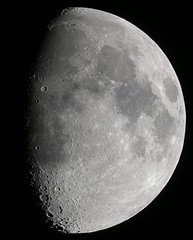
The MoonIt’s been a while since space exploration was the sole province of national behemoths like NASA, despite the relative infancy of the commercial space sector. A small budget might prevent you from launching human payloads, but there’s still plenty of options at the bottom end of the funding scale… along with some tantalising enticements for an outfit with big dreams.  [image by ComputerHotline]

Romanian company ARCA is one such outfit, and they’re taking a stab at the Google-funded Lunar X Prize using comparatively cheap and simple technology:

… a balloon that can carry ARCA’s European Lunar Explorer (ELE) space probe into the upper atmosphere, eliminating the need for a traditional launch pad and allowing ARCA to launch close to the equator from a sea platform. The “0” pressure balloon design is similar to a giant black hot-air balloon that uses solar energy to heat the air inside, instead of the burner that normal hot-air balloons use.

Once the balloon soars above 11 miles (18 km), the three-stage rocket slung below will fire and boost itself into low Earth orbit. ELE will then travel to the moon and deploy its Lunar Lander, which resembles a knobby rubber ball that uses its own rocket engine to ensure a soft landing.

ARCA’s lander itself isn’t really designed to do much when (or rather if) it arrives on the Lunar surface; because of the way the X Prize is defined, reaching the Moon is more important than achieving anything there. But as with most private space-launch initiatives, it’s all about proof-of-concept – once they know they can make the journey, they can start thinking about what to cart along next time.

Balloon-launch projects always remind me of Zion Cluster from William Gibson’s early novels, which – if I remember correctly – was colonised by exactly this sort of cheap-and-cheerful bootstrap approach.

Friday Free Fiction for 29th may

It’s nearly June, my band played a show last night, and I’ve had a long and busy day. So I hope you’ll forgive me skipping the banter and getting straight into this week’s batch of free science fiction stories from the intertubes – onwards!

***

A bunch from ManyBooks:

***

And a bunch more from FeedBooks:

***

Subterranean Online presents:

And also from Subterranean:

Those of you interested in a peak at the world of Kage Baker’s The Women of Nell Gwynne’s will be very interested in her novelette, “Speed, Speed the Cable” (pdf file), which explores the Gentleman’s Speculative Society, the Company Precursor that plays an important role in her new novella, as well as her next novel, Not Less Than Gods.

***

Strange Horizons presents “If Wishes Were Horses” by Tiffani Angus-Bodie

***

The New Yorker presents “The Slows” by Gail Hareven [via World SF News]

***

Revolution SF presents “The Four Jerks of the Apocalypse” by Camille Alexa

***

The latest Shadow Unit DVD Extra is “Misadventure”

***

Via Futurismic‘s own Tom Marcinko (who has apparently sold them a couple of stories, the saucy devil) comes the news that Circlet Press is publishing some free-to-read erotic sf/f stories on their website at the moment.

***

If you’re following along with Jason Stoddard‘s Eternal Franchise, we’re up to chapter 8.2

***

Once again the SF Signal gang make a lazy man’s life a little easier with not one, not two but three free fiction round-up posts. There’s a smattering of extras as well

  • The Online Pulps Site presents “The Last Monster” by Gardner Fox
  • Atomjack presents “Purple” by Alissa Grosso
  • The latest issue of Allegory includes fiction by JC Tabler, Michael Andreoni, Jennifer Linnaea, Adam Armstrong, Martin Turton, RJ Astruc, Philip Roberts, AJ Brown, and Ty Drago
  • Web Fiction Guide offers free online novels, story collections, and reviews.
  • Book View Cafe presents:

***

And last but not least, here’s a handful of Friday Flash Fiction:

***

And that’s your lot! You know the drill about getting in touch with plugs and tip-offs for free fiction, right? Awesome – so have a good weekend!

Fusion power: now even more futuristic!

Fusion power is just around the corner, it’s often said… but my father told me they told him the same thing when he was an apprentice back in the early sixties. It seems to be fusion’s destiny to have its reality date rolled back perpetually – the latest example being the announcement that the France-based ITER international experimental fusion project is being scaled down, with the prospective date for its first actual power-generating experiments delayed by a whole five years from the original schedule:

Faced with ballooning costs and growing delays, ITER’s seven partners are likely to build only a skeletal version of the device at first. The project’s governing council said last June that the machine should turn on in 2018; the stripped-down version could allow that to happen. But the first experiments capable of validating fusion for power would not come until the end of 2025, five years later than the date set when the ITER agreement was signed in 2006.

[…]

Indeed, the plan is perhaps the only way forward. Construction costs are likely to double from the €5-billion (US$7-billion) estimate provided by the project in 2006, as a result of rises in the price of raw materials, gaps in the original design, and an unanticipated increase in staffing to manage procurement. The cost of ITER’s operations phase, another €5 billion over 20 years, may also rise.

Bit of a bummer – but then maybe we’d be better off investing in energy technologies that we already have working versions of. €10 billion could probably make a huge difference to the current state of play in solar, geothermal and other sustainable energy sources , I’d have thought. [via SlashDot]

But don’t despair, fusion fans – the wonderfully-named National Ignition Facility in California is working on a laser-fusion method that comes with all the too-cheap-to-meter promise of those thast have come before. I’d love to see fusion arrive in my lifetime, and perhaps I will – but in the meantime I think I’ll stick to pragmatism. The Chinese seem to be on a similar wavelength, as they’re suddenly ploughing a whole lot of cash into developing renewable energy sources like solar power. Place your bets, ladies and gents, place your bets…