All posts by Paul Raven

DIY industrial-grade book scanner made from junk

Have you ever fancied playing Google for the afternoon? How about starting your own book-scanning project?

If you’re thinking that’s too far out of your price-range, think again – as an entry to a contest on Instructables, a chap called Daniel Reetz built his own automated book scanner, predominantly using stuff he found in dumpsters alongside some cheap digital cameras.

Reetz's Model 2 book-scanner

OK, so even if you could get the parts, the techniques might be a bit beyond the reach of those of us who struggle to change a bicycle tyre… but that’s a pretty impressive display of resourcefulness and ingenuity on Reetz’s part. I wonder if he’ll let me borrow it in exchange for scanned copies of every book I own? [via Hack-A-Day]

Rewriting Dune – arenaceous antidesertification architecture

I’ve mentioned before that everyone should follow Geoff Manaugh’s BLDGBLOG, and this post pretty much sums up why; Manaugh manages to find the weirdest and most wonderful ideas from the fringes of architecture and interprets them with the mind of a life-long science fiction fan.

Sometimes, however, it doesn’t take him much interpretation or extrapolation to get straight into sensawunda territory, and Magnus Larsson’s “arenaceous antidesertification architecture” is a prime example. Take it away, Mr Manaugh:

Larsson’s project deservedly won first prize last fall at the Holcim Foundation’s Awards for Sustainable Construction held in Marrakech, Morocco. One of the most interesting aspects of the project, I think, is that this solidified dunescape is created through a particularly novel form of “sustainable construction” – that is, through a kind of infection of the earth.

Larsson has proposed using bacillus pasteurii, a “microorganism, readily available in marshes and wetlands, [that] solidifies loose sand into sandstone,” he explains.

[…]

But the idea of taking this research and applying it on a megascale – that is, to a 6,000km stretch of the Sahara Desert – boggles the mind. At the very least, the idea that this might be deployed for the wrong reasons, or by the wrong people, in some delirious hybrid of ice-nine, J.G. Ballard’s The Crystal World, and perhaps a Roger Moore-era James Bond film, deserves further thought.

Indeed it does… but take a look at the concept art for the project (of which there is more in a Flickr set). Even before you start thinking about potential misuse, you can’t help but be impressed by the sf-nal visual impact of the idea.
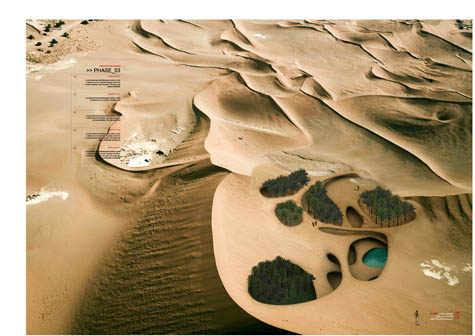
arenaceous antidesertification architecture concept

You’d be best off reading the whole of the BLDGBLOG post for the low-down on how this concept would work (and then Larsson’s paper itself, from which the above image is borrowed), but here’s an excerpted explanation from Larsson himself:

The piles would be pushed through the dune surface and a first layer of bacteria spread out, solidifying an initial surface within the dune. They would then be pulled up, creating almost any conceivable (structurally sound) surface along their way, with the loose sand acting as a jig before being excavated to create the necessary voids. If we allow ourselves to dream, we could even fantasise about ways in which the wind could do a lot of this work for us: solidifying parts of the surface to force the grains of sand to align in certain patterns, certain shapes, having the wind blow out our voids, creating a structure that would change and change again over the course of a decade, a century, a millenium.

Beautiful? Undoubtedly. Practical or plausible? I really have no idea… but I don’t think there’s any harm in admiring a magnificent idea for its own sake every once in a while. After all, that’s one of the pillars of science fiction, isn’t it?

Spam: good food for growing AIs

wall of SpamIf you’ve been groaning in terror at the seemingly ever-growing contents of your spam folder, here’s a silver lining to the internet’s perennial plague – the ever-increasing ability of spambots to solve CAPTCHA puzzles may end up advancing the cause of artificial intelligence research. You see, it turns out that crime actually does pay:
“[von Ahn, inventer of the reCAPTCHA test] has seen bounties as high as $500,000 offered for software to break it – enough to attract people with the skills to the task and five times more than the Loebner Grand Prize offers to the programmer who designs a computer that can truly pass the Turing test.

The demise of reCAPTCHA could, however, be beneficial.

It has users decode distorted text taken from historic books and newspapers that is beyond the ability of optical character recognition (OCR) software to digitise. Humans who fill in a reCAPTCHA are helping translate those books, and spam software could do the same.

“If [the spammers] are really able to write a programme to read distorted text, great – they have solved an AI problem,” says von Ahn. The criminal underworld has created a kind of X prize for OCR.

That bonus for artificial intelligence will come at no more than a short-term cost for security groups. They can simply switch for an alternative CAPTCHA system – based on images, for example – presenting the eager spamming community with a new AI problem to crack.

Indeed, it appears that the Google gang are doing exactly that:

“… the Google researchers were apparently able to come up with the new technique simply by looking into areas that computer scientists had identified as being problematic for computer-based solutions.

They apparently came up with image orientation. Humans can apparently properly orient a variety of images so that the vertical axis matches the real-world orientation of the photograph’s subject; computers can only handle a subset of these. […]

The basic idea behind their scheme is that any functional system will first have to eliminate any images that an automated system is likely to handle properly, as well as any that are difficult for humans to orient. So, for example, computers are good at recognizing things like faces in group shots, as well as horizons in landscape scenes, both of which provide sufficient information to orient the image. In other cases, the image doesn’t have enough information for either humans or computers to properly sort things out—the paper uses the example of a guitar on a featureless background, which could be oriented horizontally, vertically, or in the angled position from which it’s typically played.”

I wonder if there’ll ever be an end to this particular arms race? And, if there is, will it be heralded by the arrival of the Canned Ham Singularity? [image by freezelight]

Back to the land for Japan’s newly unemployed?

tractor on farmlandTimes are tough all over the world thanks to the economic implosion, and Japan is definitely feeling the pinch of its worst recession since the post-war years.

One of the proposed solutions is to funnel the growing number of recently unemployed back into the agricultural sector, which is predominantly comprised of an aging demographic; going ‘back to the land’ seems to hold a certain nostalgic romance for the urban dispossessed, but it’s a tougher gig than many of them expect it to be:

Despite the popularity of the training programs and of the government’s longer, one-year farm internships, many young people end up returning to cities, unable to adjust to life in the countryside. Last year, Fukiko Oshiro, a farmer in western Okayama prefecture, hired five workers from cities like Osaka, including a couple of former salesmen, to work at her nursery and fruit farm. She said she has already lost three of them.

“These young people think it’s their right to come and impose on us,” said Ms. Oshiro as she surveyed her busy farm stand recently. “They have no idea how much work we put in to teach them.”

I remember a similar romance with simple lifestyles lived close to the land emerging in the wake of the recession of the early nineties here in the UK; I suppose it’s inevitable that when modern life lets you down you start looking for alternatives, and looking backward is always easier than looking forward.

Japan’s aging agricultural sector may have the need (if not the desire) for an influx of new young hands, but in places like the UK and the US things are very different; I can’t see either government coaxing young people back into the fields as a solution to unemployment. But perhaps that urge for a simpler life will express itself in other ways – remember the small footprint communes setting themselves up in the bargain-price foreclosed properties of Detroit?

There’s plenty of land out there – more so in the States than the UK, granted, and not all of it suited to being lived on – and it may tempt people with the old dream of self-sufficiency. But that dream tends to pass over the degree of sheer physical labour that the lifestyle demands, alongside the other pressures that are slowly driving us towards wholesale urbanisation; many may still decide to try, but few will stay the course, perhaps.

Is self-sufficiency a dated idea unsuited to a networked globe, or does it still have valid lessons for us? [via MetaFilter; image by Nicholas T]

J G Ballard – 15th November 1930 to 19th April 2009

J G BallardAs you’ve probably already heard elsewhere, legendary New Wave sf author J G Ballard died yesterday after a long battle with cancer. There’s a decent obituary at the Daily Telegraph, and Jeff VanderMeer has posted an appreciation of the man at the Amazon Omnivoracious blog. [image courtesy Wikimedia Commons]

Regular readers may have noticed that I very rarely mark the passing of famous writers here at Futurismic, principally because I feel it would be crass to do so when I don’t really have much to say about them; I’m poorly read in the classics of the genre, and such things are better left to those closer to a writer’s oeuvre.

Ballard, however, is one of the giants of the scene with whose work I am fairly familiar, and whose work also played a large part in shaping the way I see things – in science fiction, and in reality as well. Comments and blog posts describing him as a sort of prophet are appearing in great number, and allowing for the hyperbole that such occasions tend to provoke, I think that’s a fair comment. Alongside Philip K Dick, whose style and approach was admittedly very different, Ballard was writing the world we now live in… half a century ago.

A very smart man, and – as VanderMeer puts it – a truly fearless writer. My world feels a little smaller for his absence.