
All posts by Paul Raven

When geoengineering goes wrong

Barcelona sunsetWhile it’s probably a bit too soon to go rushing into geoengineering projects in an attempt to readjust the earth’s runaway climate, discussing the ideas thoroughly is of great benefit – principally because it gives people a chance to pick holes in the plans and think of potential downsides before we do something irreversible.

Exhibit A: seeding the atmosphere with dust to increase the amount of sunlight reflected away into space might actually be shooting ourselves in our renewable foot, so to speak:

While such atmospheric modifications would only be expected to deflect about 3 percent of the sunlight incident on the earth, Murphy has found that solar energy collectors would face a reduction of up to one-fifth of the usable energy that they collect presently. Even though 97 percent of the sun’s light will make it through the Earth’s modified stratosphere, much of it will be scattered, making the light diffuse. Diffuse light cannot be focused in the same manner that direct light can be, which lessens its usability in most optical systems. Almost all projects that harness solar energy require a large portion direct sunlight that can be focused and concentrated on a cell of some kind.

So: reduce the bad effects of sunlight, and you’ll reduce the useful ones as well. Best relegate that plan to the back-burner… at least until someone finally develops a usable fusion system.

On a similar note, it looks like iron-dumping in the ocean is off the menu at least for us. For a certain type of shrimp, however, it’s very much on the menu:

The iron triggered a bloom of phytoplankton, which doubled their biomass within two weeks by taking in carbon dioxide from the seawater. Dead bloom particles were then expected to sink to the ocean bed, dragging carbon along with them.

Instead, the bloom attracted a swarm of hungry copepods. The tiny crustaceans graze on phytoplankton, which keeps the carbon in the food chain and prevents it from being stored in the ocean sink.

Back to the drawing board. Thank goodness for thinking ahead, eh? [image by papalars]
Moats in Mexico – villages under siege

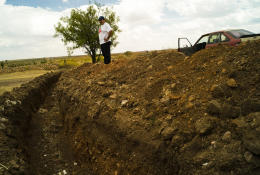
The moat around Cuauhtemoc, MexicoThings are getting pretty rough in the northern states of Mexico, with criminal gangs acting increasingly like marauding guerrilla armies. So much so that the tiny town of Cuauhtemoc has taken medieval measures to prevent further attacks:

Since right before Christmas, armed raiders repeatedly have swept into both villages to carry away local men. Government help arrived too late, or not at all.

Terrified villagers — at the urging of army officers who couldn’t be there around the clock — have clawed moats across every access road but one into their communities, hoping to repel the raids.

It’s probably not very reassuring to find yourself in a position where the army tells you that you’re pretty much going to have to look out for yourself against armed gangs. Sure, the Mexican government has its work cut out dealing with the problem, but that’s going to be cold comfort to townspeople who just want to be left alone to get on with their lives… and it leaves the door wide open for another gang to step in and offer protection, which will destabilise the region even further. [via Global Guerrillas; image by Julian Cardona for the Houston Chronicle – contact for take-down if required]

The US economy is a myth

Chicago skylineA provocative headline, no? I wish I could say it was my own invention, but I can’t, because the Washington Post got there first:

So contend Bruce Katz, Mark Muro and Jennifer Bradley in the latest issue of the journal “Democracy.” The United States is not a single unified economy, they say, nor even a breakdown of 50 state economies. Instead, the country’s 100 largest metropolitan regions are the real drivers of economic activity, generating two-thirds of the nation’s jobs and three-quarters of its output. The sooner we reorient federal economic policies to support this “MetroNation,” the quicker we can fix the mess we’re in.

I’ll freely admit I don’t know enough about economics to tell whether Katz Muro and Bradley are actually right about that, but it makes a certain amount of sense… mapping economic activity like wi-fi signals, at their strongest near to the biggest routers. Maybe withdrawing economic focus from rural areas would make sense… but I can’t see it being a popular idea with people who live there. [via Bruce Sterling; image by doug.siefken]

New Aussie drinking game – “spot the wetback”

Texas-Mexico border fenceHere’s an odd twist on crowdsourcing; the publicly-accessible cameras along the Texas-Mexico border have attracted amateur border guards from a number of the southern states… and beyond. In fact, it seems to be quite the international pastime:

So far, more than 100,000 web users have signed up online to become virtual border patrol deputies, according to Don Reay, executive director of the Texas Border Sheriffs’ Coalition, which represents 20 counties where illegal crossings and drugs and weapons smuggling are rife.

“We had folks send an email saying, in good Australian fashion, ‘Hey mate, we’ve been watching your border for you from the pub in Australia’,” he said.

Not everyone is quite so impressed, however, especially considering the system’s cost measured against its successes:

Opponents have dismissed the project as “the perfect Google border” and say the cameras do little to deter criminal activity. “Border security deserves trained professionals, not pub-goers in Perth,” said Eliot Shapleigh, a state senator from El Paso, Texas, who claims that the programme has resulted in only a handful of arrests. “It’s wholly ineffective for the governor’s stated goal of security, it panders to extremists for political purposes and it’s not an effective use of $2m for just three apprehensions.”

One has to wonder whether all the people who’ve signed up to watch the border are sincerely interested in reporting transgressions rather than turning a blind eye to them; the barriers to entry are pretty low, after all, and not everyone wants to take America’s side these days. [image by Daquella manera]

But what interests me most about this story is that it seems to highlight one of my current obsessions, namely the fragmentation of nation-states into parts that borders on a map just can’t represent. If an Australian is voluntarily watching a piece of land at the edge of Texas (which, a long time back, was part of Mexico) to make sure that no Mexicans (or Guatemalans or Hondurans or anyone else) cross that fence-line, could he not be considered a temporary US citizen? Or is he merely a form of contractor, or neither?

Think about it – to enforce a geographical boundary, the US is using tools that contribute to the ongoing erasure of geography; meanwhile, non-citizens on the other side of the globe do work that a citizen would need to be security-screened for… and do it for free, or for kudos. What does being a citizen actually mean, beyond defining who you pay your taxes to? Where does citizenship actually take place – on the ground, in our own minds, or in the network of mutual assumptions that we call society?

Isn’t it possible that one day that one way to cross the conceptual border of the US and become a citizen thereof would be to have spent a considerable amount of time and effort ensuring that other people didn’t cross the geographical border?

[26/03/09 – Note: it has been brought to my attention that the term ‘wetback’ is a lot more fundamentally racist than I – unused to some of the subtleties of US slang – initially thought; had I thought it referred to anything more than person who attempts to cross the Rio Grande, I wouldn’t have used it, and I’d like to apologise for any offence caused.]

Your transhuman future: 24/7 body monitoring

medical monitoring tagsCutting-edge medical hardware can scan and analyse our bodies with incredible accuracy, allowing doctors to diagnose and treat many of the illnesses that come as part of our mortal meatware. But these things can only be seen if we’re looking for them; we’d catch many more diseases and defects if we could be monitored constantly, rather than just when we visit a doctor or clinic.

Unfortunately (or fortunately, depending on your point of view) we’re a long way off from having nanotech swarming through our bloodstreams, but there are companies and research groups working to build realtime medical monitoring systems for the human body. SingularityHub rounds up a handful of them and takes a look at their current projects; here’s a description of one from Proteus Biomedical:

Proteus ingestible event markers (IEMs) are tiny, digestible sensors… Once activated, the IEM sends an ultra low-power, private, digital signal through the body to a microelectronic receiver that is either a small bandage style skin patch or a tiny device insert under the skin. The receiver date- and time-stamps, decodes, and records information such as the type of drug, the dose, and the place of manufacture, as well as measures and reports physiologic measures such as heart rate, activity, and respiratory rate.

So, till pretty crude by science fictional standards, but surely an improvement on being wired up to a room-full of medical monitors to record the same data. As nanotech and molecular genetic engineering converge, we’ll doubtless see systems like this become more powerful and more prevalent, at least in the richer countries.

SingularityHub points out one of the big benefits of this sort of monitoring, namely the vast tranches of data it would supply to medical researchers. But there’s a flip-side that need to be considered, namely privacy. Futurismic‘s own Sven Johnson reported back earlier this month from a possible future where biometric body scans of millions of US citizens was leaked to the public; think of the repurcussions of even more intimate data being exposed. [image by HouseOfSims]

And how about insurance? Once this sort of detailed medical data is available, it’ll become a mandatory part of your application for health coverage, and you can bet your boots that the insurance houses will use every little warning indicator as an excuse to bump up your premium… or deny you a policy completely.