All posts by Paul Raven

Price wars… in spaaaaaace

A man floating in zero-gravity yesterday (no, not really)Proof, if such were needed, that one should always shop around to ensure you’re getting the best value deal: RocketShip Tours are entering the space tourism market with a bargain price tag.

Upstarts RocketShip Tours and XCOR Aerospace say that the price of their flights, slated to begin as soon as 2010, will be $95,000, about half that of the ones being offered by Richard Branson’s Virgin Galactic, which also hopes to launch as early as 2010.

“Our goal is to make space travel accessible and affordable to those who aspire to experience the ultimate adventure,’’ said Jules Klar, CEO and chairman of RocketShip in a statement.

I hadn’t expected to hear much out of the space tourism outfits in the current economic climate, but beating one’s own drum as the cheaper option is probably the only announcement that won’t gather a lynch mob outside your HQ. The Boston Globe article is painting RocketShip’s announcement as the start of a ‘price war’, but given that neither outfit has actually completed one of their proposed tourism flights yet I suspect it’s more of a PR war than anything else.

Assuming that flights to and from orbit become commonplace (come on, allow me some optimism here, it’s been a long week), can we assume that there’ll be a similar spread of service suppliers as there currently is in the air travel market? Would you really want to take a jaunt to LEO with the aerospace equivalent of Aeroflot?

All of a sudden, I have a vision of space hobos jagging free rides on orbital freighters to see the sights and maybe find a few month’s work… and I find myself rather liking the idea of being the Jack Kerouac of the space generation. Time to ease up on the Dexedrine, maybe. [image by markjsebastien]

Wired’s manifesto for radical financial transparency

stock value reportsIf there’s one thing every politician seems able to agree on at the moment, it’s that we need to overhaul the way the financial sector works so as to (hopefully) avoid another catastrophic screw-up like the one we’re currently mired in. Part of the problem was caused by regulatory bodies being simply unable to keep up with the huge amount of publicly filed data  from financial businesses, and by some of that data being… massaged, shall we say. [image by pfala]
The obvious answer is “more regulation” (though we might want to throw in brainscans for CEOs while we’re at it), but that’s just going to build another baroque architecture on top of the one we already have… and baroque architecture has plenty of hiding places for gargoyles, if I might overextend my analogy.

Daniel Roth at Wired has a different idea, and it’s one that resonates with the way the web works. He calls it radical transparency: a way to sum it up in a nutshell might be to say that instead of worrying about who should watch the watchers, why don’t we make sure everyone – and anyone – can get at all the data in standardized formats?

The whole article is well worth a read, but here’s Roth’s three-point manifesto:

Set the data free

Today, public companies and financial institutions disclose their activities in endless documents stuffed with figures and stats. Instead, they should be forced to file using universal tags that make the data easy to explore.

Empower all investors

Once every company’s data carries identical tags, anyone can manipulate the numbers to compare performance. And they can see details of every financial instrument—not just balance sheets and income statements.

Create an army of citizen-regulators

By giving everyone access to every piece of data—and making it easy to crunch—we can crowdsource regulation, creating a self-correcting financial system and unlocking new ways of measuring the market’s health.

Those of you with no trust in free markets probably find this even less appealing than the current system, but it makes a certain amount of sense to me. As Roth points out, the web has enabled a similar sea-change in journalism, and as a result changes are afoot in governmental and corporate practice around the world, because it has become easier for whistleblowers and contrary voices to have their say.

TechDirt‘s Mike Masnick came up with a similar idea late last year; as he points out, it’s unlikely to gain much support right away because it takes the power away from the financiers, and they’re unlikely to be particularly keen on that arrangement. But that’s all the more reason to discuss the notion now, while trust is at an all-time low; after all, as Masnick says:

We’re not going to fix a broken Wall Street by throwing extra money at the problem, but we might be able to fix it by opening up, adopting radical transparency, and then letting the market more accurately value things based on real data.

Amen to that.

Coming soon: the MRI job interview

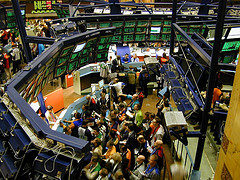
Amsterdam stock exchange trading floorLook at the positive side: it may mean less time spent filling in those tedious personal psychological assessment forms.

But that’s about the only upside to the idea of replacing or supplementing the job interview with an MRI brain scan, so lets be thankful it’s only being mooted as a way of rooting lying psychopaths out of the financial sector:

While brain-scanning their volunteers, the Erasmus University researchers can identify exactly to which extent people react ’spontaneously’, i.e. subconsciously, to specific social interactions – such as financial trading on the stock market or shop personnel interacting with customers.

Thus they could also test job applicants for important posts such as bank directors and financial institutions to determine whether they are even suitable — or whether they have psychopathic tendencies which would exclude them from such jobs.

“In a brain scan one can see what people notice spontaneously, such as sales personnel interacting with customers,’ he said.

They have already discovered that people with slight autism, for instance, are totally unable to notice that customers may be responding negatively towards specific suggestions they make.

It’s a worrying thought; we could all end up neatly categorised by job suitability by the time we leave the education system, if not before – might as well start early, right?

But how do we know the people in charge of the testing aren’t psychopaths themselves? Then we might end up with our political and financial classes entirely top-loaded with amoral scumbags…

… oh, right. [via Spiraltwist at grinding.be; image by Petrick2008]

Ray Kurzweil: the Movie

Via George Dvorsky, here’s the trailer for Transcendent Man, the forthcoming film about the life and work of Ray Kurzweil:

I’m pretty convinced that Kurzweil actually believes what he says, though only time will tell whether he’s right or not. However, this trailer doesn’t do much to disrupt Kurzweil’s image as a kind of pseudo-religious techno-prophet; disengaging from the subject matter and looking purely at the language and framing, it seems to set him up as a misunderstood Messiah, and that tends to fire up my instinctive BS detector much more than speculations on the developmental curve of technology.

What’s your take on Kurweil – deluded crank or visionary genius? Or something in between?

O NOES teh webz iz infantilizin yr brainz (yes, again)

A bearded man infantilizing himself yesterdayIf you’re anything like me, you’ve probably never heard of Lady Greenfield, professor of synaptic pharmacology at Lincoln College, Oxford, and director of the Royal Institution. But Lady Greenfield knows all about you, and how your use of social networking sites and computer games is contributing to the ongoing infantilization of the 21st Century psyche:

Arguing that social network sites are putting attention span in jeopardy, she said: “If the young brain is exposed from the outset to a world of fast action and reaction, of instant new screen images flashing up with the press of a key, such rapid interchange might accustom the brain to operate over such timescales. Perhaps when in the real world such responses are not immediately forthcoming, we will see such behaviours and call them attention-deficit disorder.

“It might be helpful to investigate whether the near total submersion of our culture in screen technologies over the last decade might in some way be linked to the threefold increase over this period in prescriptions for methylphenidate, the drug prescribed for attention-deficit hyperactivity disorder.”

[Emphasis mine – try playing the same game with the whole of Lady Greenfield’s output, kids! Should keep your attention for twenty seconds at least.]

Will no one think of the children? God only knows that when a generation grows up with things that its elders didn’t have, the fate of the human race is bound to take a turn for the worse. Just look at the pernicious long-term effects of the printing press, the germ theory of medicine, radio and popular music, and (of course) television… [image by jmr_photo]

It’s unfortunate that we’re so hard-wired for fearing change – no new technology has managed to erase that little character trait yet, it seems. As always, the TechDirt boys do a great job of shredding this week’s sensationalist backlash against Twitter:

It’s pretty clear that none of these folks have ever really used Twitter — because they all seem to interpret it as being a broadcast mechanism, rather than a conversational one. This isn’t to say that Twitter is right for everyone, but most of the people who find value in it, find value in the conversational aspect of it, not that it “broadcasts” mundane facts of their lives. […] There are still plenty of people who hate Twitter, but it’s difficult to take seriously people complaining about it when it seems quite clear they’ve never even bothered to use it.

Quite – now, if you’ll excuse me, I’m going to post a few naked pictures of myself to Lady Greenfield’s MySpace page. LOLZ