All posts by Paul Raven

Ian McDonald on our digital doppelgangers

DSC_0024The BBC is running an essay by Ian McDonald, author of Brasyl and River of Gods (and many more sf novels). Despite being an deliberate laggard on social network and metaverse platforms himself, McDonald suggests that the science fictional trope of the uploaded human consciousness is already becoming true by degrees:

Our You2s will ever more closely resemble us, and become more and more intelligent as they make linkages between the information we placed there. They’ll take decisions without our interference -and they’ll increasingly talk to each other. It’s no coincidence that the net is shaped like a society.

Perhaps there will never be a single moment when computers become aware. Maybe it will be a slow waking and making sense of that blur of information, like a baby makes sense of the colour patches and patterned sounds into objects and words.

Why should artificial intelligences – our You2s – take any less time to grow up than us?

Artificial intelligences make regular appearances in McDonald’s fiction – and he’s a writer I recommend without hesitation to any science fiction reader – though here it’s almost as if he’s conceding that a kind of ‘soft takeoff’ Singularity is already in its early stages in the real world.

Being a good science fiction writer, though, he’s considering the implications of the future:

What we’ll have is a copy of a personality in a box. It’ll be you in every detail that makes the meat-you you. You2. Only it’s technically immortal as long as the hardware keeps running and is regularly updated. This sounds great, until you realise that the original you still goes down that dark valley from which there is no return…

Quite a synchronous topic, really, given the recent flare-up of Singularitary debates. [Hat tip to Ian Sales; image by your humble correspondent.]

The three schools of Singularitarianism

Ray KurzweilThe announcement of Ray Kurzweil’s Singularity University project (and the inevitable backlash against it) has people talking about the S-word again… much to the ire of transhumanist thinkers like Michael Anissimov, who points out that there are three competing ‘schools’ of thinking about the Singularity, each of which hinges on a different interpretation of a word that has, as a result, lost any useful meaning.

The “Accelerating Change” school is probably the closest to Kurzweil’s own philosophy, but it is also Kurzweil’s quasi-religious presentation style (not to mention judicious hand-waving and fact-fudging) that makes it the easiest to attack. [image by null0]

Anissimov finds himself closer to the “Event Horizon” and “Intelligence Explosion” schools:

These other schools point to the unique transformative power of superintelligence as a discrete technological milestone. Is technology speeding up, slowing down, staying still, or moving sideways? Doesn’t matter — the creation of superintelligence would have a huge impact no matter what the rest of technology is doing. To me, the relevance of a given technology to humanity’s future is largely determined by whether it contributes to the creation of superintelligence or not, and if so, whether it contributes to the creation of friendly or unfriendly superintelligence. The rest is just decoration.

That may not actually sound any more reassuring than Kurzweil’s exponential curve of change to many people – if not even less so. And with good reason:

That’s the thing about superintelligence that so offends human sensibilities. Its creation would mean that we’re no longer the primary force of influence on our world or light cone. Its funny how people then make the non sequitur that our lack of primacy would immediately mean our subjugation or general unhappiness. This comes from thousands of years of cultural experience of tribes constantly killing each other. Fortunately, superintelligence need not have the crude Darwinian psychology of every organism crafted by biological evolution, so such assumptions do not hold in all cases. Of course, superintelligence might be created with just that selfish psychology, in which case we would likely be destroyed before we even knew what happened. Prolonged wars between beings of qualitatively different processing speeds and intelligence levels is science fiction, not reality.

Superintelligence sounds like a bit of a gamble, then… which is exactly why its proponents suggest we need to study it more vigorously so that – when the inevitable happens – we’re not annihilated by our own creations.

But what’s of relevance here is the sudden attempts by a number of transhumanist and Singularitarian thinkers to distance themselves from Kurzweil’s PT Barnum schtick in search of greater respectability for their less sensationalist ideas. Philosophical schisms have a historical tendency to become messy; while I don’t expect this one to result in bloodshed (although one can’t completely rule out some Strossian techno-jihad played out in near-Earth Orbit a hundred years hence), I think we can expect some heated debate in months to come.

Web not killing journalism, improving it

newspaper with blogging headlineWe’ve heard plenty of worrying from journalists about how the death of print newspapers will be the death of journalism itself, so here’s a contrary view from within the same camp. Jim Stovall of JPROF suggests that the medium of newspapers is actually part of the problem, and that journalism will be improved once it is no longer chained to the printing press.

He provides a number of reasons for optimism, of which I think this is the most telling:

More reporters. Students in my experience are wildly excited about this new age of journalism. I am honored to be the faculty adviser to the Tennessee Journalist, the student operated news web site of the School of Journalism and Electronic Media at the University of Tennessee. More than 35 people regularly show up at our weekly staff meeting (only the editors are required to come) and the numbers are growing. The number of our majors has grown from 350 to 450 in just one year.

What has caused this, I wonder? The tempting conclusion is that the ease of self-publication has made people less intimidated by the idea of producing writing in public, but maybe it’s also to do with the erosion of the media monoculture – the web has provided a space for dissenting voices and niche interests that newspapers couldn’t support, tied as they are to physical locations.

Whatever the cause, it’s good to see some optimism. Journalism was born out of the desire to learn and communicate, and it looks like that desire has been increased rather than eroded. Who knew? [via TechDirt; image by Annie Mole]

INTERVIEW: BRUCE STERLING on Caryatids, Viridian and the death of print

Bruce SterlingNovelist, pundit, design theorist and iconoclast – Bruce Sterling is all of these and more, and is one of the people that the Futurismic project has always looked to for inspiration.
Sterling has a new novel called Caryatids out at the end of February, the writing of which has somehow been shoehorned in between him bouncing around Europe, lecturing on design theory and keeping an eye on the maelstrom of global multimedia culture and politics.

He was good enough to cave into the pestering of this irredeemable fanboy and answer some questions about the new novel, the closing of the Viridian Green project and the relentless demise of science fiction print media. Continue reading INTERVIEW: BRUCE STERLING on Caryatids, Viridian and the death of print

Gattaca becomes reality – all babies to be DNA sequenced at birth by 2020?

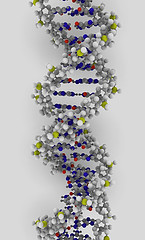
digital rendering of DNAA genetics outfit named Illumina is preparing to launch an affordable genetic mapping service in the next couple of years. Its first few customers can expect to pay between US$10,000 and US$20,000 for a complete mapping of every gene in their DNA, but their chief executive has told The Times that by 2020 the equipment should be so affordable that all newborns will have their genomes sequenced at birth:

“The limitations are sociological; when and where people think it can be applied, the concerns people have about misinformation and the background ethics questions.

“I think those are actually going to be the limits that push it out to a ten-year timeframe,” he added.

Of course, he’s bound to be positive about the prospects; CEO of the company isn’t exactly a disinterested position. But I think that’s a pretty plausible timeframe, if only so far as the capability is concerned.

And there will be resistance to the idea, even if the Gattaca comparison is rather overstated. Given the UK government’s current obsession with storing the minutia of its citizen’s lives, I’d be worried about letting them have my entire genetic sequence – though not because of what they would use it for so much as that I couldn’t trust them not to leave it in a briefcase on a rush-hour train

Even that makes light of a potentially sticky ethical quagmire, though; we won’t get to see everything that’s hidden in Pandora’s box until we actually open the lid. Let’s just hope we’ve gotten over our little global obsession with copyright and intellectual property by the time the street-corner sequencer shacks open for business, eh? [story via FuturePundit; image by ynse]