All posts by Paul Raven

Is Peak Oil a lie?

Alaskan oil pipeline at PaxsonI’m going to shamelessly crib from io9 and link to the Cleantech Group’s write-up of a talk by an environmental futurist named Peter Schwartz, because he has a pretty provocative point to make. In a nutshell – Peak Oil is a lie, and it’s a lie that could make things worse rather than better.

Peak oil is wrong. We really don’t know how much oil there is in most of the oil reservoirs of the world. Oil reservoirs are complex geological structures, and most of the data is in private hands, or in state governments, and they are not particularly forthcoming about how much is there.

However, he’s far from denying that climate change is a problem:

We are not going to run out of oil before the issue of climate change drives change. It’ll be costly oil. But it’ll be climate change catastrophes [such as sudden, unexpected displacement of large numbers of people, and massive property damage], and more expensive oil, not the fact that we’re running out of oil, that will drive change

Of course, Schwartz is just one man, and an awful lot of people seem to be pretty convinced that Peak Oil is real, so I can’t argue that either way because I don’t have the knowledge or evidence to do so. But it’s interesting (and refreshing) to hear someone deny Peak Oil without denying climate change at the same time. [image by Steve Deger]

Google – trying to predict the future by inventing it

Google logo on a whiteboardThe official Google blog isn’t always the most exciting of reads, but every now and again they post up something worth a read. Today saw the first of ten articles from the top boffins at the Googleplex to celebrate the company’s tenth anniversary; it’s about the future of cloud computing, and it hints at a fairly science fictional end-point:

Traditionally, systems that solve complicated problems and queries have been called “intelligent”, but compared to earlier approaches in the field of ‘artificial intelligence’, the path that we foresee has important new elements. First of all, this system will operate on an enormous scale with an unprecedented computational power of millions of computers. It will be used by billions of people and learn from an aggregate of potentially trillions of meaningful interactions per day. It will be engineered iteratively, based on a feedback loop of quick changes, evaluation, and adjustments.

Underneath that corporate gloss is the enthusiasm of researchers who believe they’re working toward a useful form of artificial intelligence. This isn’t news, of course – Larry Page has been quite open about that particular long-term goal – but it’s the assured confidence that Google has which never ceases to astonish. From the introduction to the article:

As computer scientist Alan Kay has famously observed, the best way to predict the future is to invent it, so we will be doing our best to make good on our experts’ words every day.

One can’t help but be reminded of the Genius Inventor archetypes of pulp science fiction… but in this case that blue-sky vision is backed up by the bankroll of one of the most powerful organisations on the planet. [image by dannysullivan]

So, is it hubris, hype or hope… or a mixture of all three? Should we fear the Big G, or look to it to usher in something like the Singularity and save us from ourselves? Or is AI just a pipe dream for big-budget geeks?

An epidemic of fear – or, why terrorism and witchcraft are surprisingly similar

panic buttonLiving in a constant state of fear is not good for your health on an individual level. But scale up to the level of entire towns, states or countries, and the problem can be exacerbated by the psychology of mob behaviour. [image by krystenn]

According to documents from the Department of Homeland Security, not only is it possible for fear of terrorism to create a contagious psychosomatic epidemic, but it’s also already happened a couple of times – in the US and elsewhere.

Now, that may not be surprising in and of itself. But take a look at some of the comment reactions on this BoingBoing post about a riot in the Congo that was triggered by accusations of witchcraft; quite a few people find it ridiculous that anyone could be scared of witchcraft at all, let alone riot because of it.

And in our world, that’s probably true… but what we fear is a function of the culture we live in. The people of the Congo can blame their witchdoctors and priests for their irrational fears; I suspect our Western paranoia comes from an entirely different sort of story-teller.

First ‘synthetic tree’ created

metal tree sculpture“I think that I shall never see / a poem as lovely as a tree.
Indeed, if they were all this small / we’d never see no trees at all… “

Proving a long-held theory that transpiration in trees is a physical process rather than a biological one, the world’s first synthetic tree isn’t much to look at… hell, you’d need a microscope to really make out the detail.

What use is a synthetic tree, anyhow? Well, it:

… should also be a useful platform for the study the properties of metastable liquids and a starting point from which to design new technologies for the management of water in chemical processes, heat transfer, and environmental engineering.

Water management, eh? Euphemistically speaking, I think that may be a fairly big business in a few decades. [image by SweetOne]

The integrated circuit’s golden anniversary

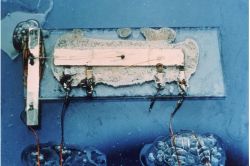
Jack Kilby\'s first integrated circuitRaise a glass, folks – fifty years ago, Jack Kilby of Texas Instruments demo’d the first ever integrated circuit [pictured – from Wikimedia Commons]. From Custom PC:

In July 1958, Kilby took it upon himself to find the answer to small-scale modules with large numbers of transistors. As a new recruit at Texas Instruments he wasn’t able to take a two-week leave while his other colleagues were off sunning themselves. Instead, he confined himself to his lab alone where he came up with the idea of fabricating all of a circuit’s components with a single block of the same material. Two months later, the first integrated circuit was demonstrated, and technology has never looked back.

Thanks for the memories, Jack. 😉