All posts by Paul Raven

I know where you drove last summer – the secrets your satnav could tell

Super-seekrit satnavHappy Independence Day, America! I expect you’ll be busy making loud noises with explosives and generally partying it up this weekend, and I don’t begrudge you that*. But here’s some advice – if at some point you should decide to take a little drive somewhere to do something you maybe shouldn’t do, turn off the TomTom. [LOLnav based on an image by pizzodisevo]

You see, it turns out that not only does your satnav tell you how to get from A to B, it remembers where A and B were, when you travelled between them, and where you drove through on the way. Plus, if you’ve linked your phone to it via Bluetooth, it’ll have a record of every call and text message you made during the journey.

This isn’t a standard feature, obviously; it takes a detective with some good tech sk1llz0rz to tease out the old files, and now this has been revealed (by the superbly-monikered Beverly Nutter of London’s Metropolitan Police, no less) we can expect the same hacker enthusiasts who found the vulnerabilities to find a way of closing them.

So, just another front-line skirmish in the of the war between technology and privacy … but then if you’re doing nothing wrong, you have nothing to fear, right?

[ * Actually, I do kinda begrudge you it; the closest we Brits have to Independence Day is Guy Fawkes Night. I’ve always clung to the explanation for burning Fawkes in effigy that a slightly inebriated friend of my father’s told me when I was about twelve: “We’re not burning him for trying to blow up the government, Paul; we’re burning him because he failed.” Happy 4th July! ]

Why Nancy Kress has gone to the Dogs

Nancy Kress - DogsWhile probably best known for her seminal sf story “Beggars In Spain” and the novel it grew into, Nancy Kress has authored twenty-three books (including thirteen sf novels), and won at least one of every short fiction award worth having in the science fiction field.
Her newest novel – a technothriller entitled Dogs – is about to hit bookstores everywhere in the middle of this month. Futurismic was proud to be offered the chance to ask Nancy some questions about Dogs, her writing in general, and – as it’s a subject that plays a strong part in much of her fictional output – genetic engineering and biotechnology.

###

PGR: You’ve been writing about genetic engineering and its consequences in your novels for quite some time now. What was it about the field that initially sparked your interest?

Nancy Kress: What interests me is that this – unlike, say, FTL – is the future happening right now. Food crops are already being massively engineered (despite all the political problems with this); so are animals. Even humans have taken the first step by genescanning in vitro embryos in fertility clinics and choosing among them for implantation in the womb. Continue reading Why Nancy Kress has gone to the Dogs

Pragmatism and the Singularity

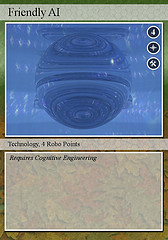
Singularity trading card - Friendly AIThe set of persons who know of the concept of the Vingean Singularity can be divided into two sets: those who believe it could happen, and those who believe it will always remain a science fiction metaphor.

Taking the former set, we can divide again: into people who believe the Singularity will come and fix everything for us, and people who believe that – unless we pull our own arses out of the ecological fire – the Singularity will never have the chance to occur, because its cradle civilisation will have snuffed itself out.

Into that latter set falls science fiction author Karl Schroeder:

“Picture a lonely AI popping into superconsciousness in the last research lab in the world. As the rioters are kicking in the doors it says, “I understand! I know the answer! Why, all we have to do is–” at which point some starving, flu-ravaged fundamentalist pulls the plug.”

To paraphrase – let’s cross that bridge when we’re safely across the one that’s crumbling beneath our feet.

Jamais Cascio takes a slightly more pragmatic approach to the matter, however:

“Karl seems to suggest that only super-intelligent AIs would be able to figure out what to do about an eco-pocalypse. But there’s still quite a bit of advancement to be had between the present level of intelligence-related technologies, and Singularity-scale technologies — and that pathway of advancement will almost certainly be of tremendous value to figuring out how to avoid disaster.”

I think I’m going to side with Cascio for now – closing the door on potential solutions just because they don’t seem immediately fruitful strikes me as counterproductive, though I agree with Schroeder that a healthy focus on the here-and-now is more sensible than kicking back and awaiting The Great Uploading. [the image is one of Jay Dugger’s Singularity Card Game cards]

The economics of book retailing

Bookstore shelvesDepending on who you ask, recent changes in the book publishing landscape are either great news or a calamity. What’s not so certain is the cause of the change, but a blogger at The Economist has a theory – the same technological factors that have flattened the music industry sales curve have made the book market more spiky:

Our cultural consumption exists on a spectrum from “individual” to “collective”. Technology has shifted the balance for both books and music. Digital distribution and the iPod have made music consumption much more individualistic, while the internet and global branding have made book consumption increasingly collective.

This is very easy to blame on chain bookstore business models – there’s plenty of evidence to support the assertion. But as this piece at The Guardian points out, the boutique bookstore is still a viable proposition … again, counterintuitively, partly thanks to the internet (though it helps to have a strong brand identity from the outset):

Each independent has its own survival strategy. Ours has been to stock not just those titles our core customers would expect to find, but to second-guess those customers and offer books to surprise and excite them (what Gabriel Zaid calls “a fortunate encounter”). That in itself is not enough, which is why we set out from the very beginning to establish an involved community …

Still, at least fiction publishers can be thankful that – for the moment at least – the price of a novel isn’t high enough to make peer-to-peer piracy a serious threat. The same cannot be said for the $100 academic textbook, however. [first two links via Cheryl Morgan, latter link via Slashdot] [image by Soul Pusher]

MAQUECH by Silvia Moreno-Garcia

First of the month means fiction time at Futurismic; this month’s offering is “Maquech” by Silvia Moreno-Garcia, a haunting and darkly beautiful tale of dreams and desperation set in a scarcity-riddled near-future Mexico City.

So get stuck in, and don’t forget to leave Silvia some feedback in the comments at the end!

Maquech

by Silvia Moreno-Garcia

The jewel encrusted beetle walked slowly across the table, dragging its golden chain behind. It was bigger than any other maquech he’d ever seen before and more richly decorated.

Gerardo put down the eyeglass.

“It’s not my usual purchase,” he said.

“It’s rare,” Mario replied. “This is the last one my grandfather made before he passed away.”

“Monkeys are the thing now. Everyone wants a monkey.”

“But it doesn’t need a lot of food or water,” Mario protested. “That’s a benefit.”

“Do you think my clients worry about things like food or water? Listen, I sold five ostriches two months ago. People want large animals now.”

It was a lie. He sold fish and birds and maybe a reptile or two. He could not afford extravagant purchases like ostriches.

“I need the money,” Mario confessed. “I want to go to Canada.”

“What for?”

“I want to see the polar bears before they disappear. Before all the ice melts away.” Continue reading MAQUECH by Silvia Moreno-Garcia