All posts by Paul Raven

Personal atemporal feedback loop

More fun and games with atemporal media: TwitShift offers a novel service, wherein they hoover up the last year’s worth of output from your Twitter account and repost every tweet on exactly the same day and time as they were posted originally… exactly one year later. [This link via LifeHacker, who aren’t getting their proper attribution links until they provide URLs that are guaranteed to deliver the viewer to the page I actually wanted them to see.]

Atemporal reportage is no new phenomenon, of course; for example, George Orwell has been (re)covering the fall of Europe to the Nazis for some time now, exactly seventy years since it actually happened. But the personal angle of TwitShift is curious, because it highlights a fascination with our own very recent pasts, a growing trend wherein – as the distance we can see into the future with any feeling of confidence decreases – we’re obsessed with building a narrative about how we got to where we are.

There are good and bad sides to this, I think; aphorisms about understanding history and the repetition of mistakes are plentiful, but the problem with looking back over one’s shoulder is that it increases the likelihood of one walking into a lamppost. Given the way my own life was unexpectedly upended by circumstance a year ago, I’m really feeling that tension: it would be interesting to revisit my own experiences with the benefit of hindsight, but I’m not sure how much genuine value I’d get from doing so.

I wonder how much further you could take this idea, though? Multiple atemporal feedback loops at different distances: last week, last month, last year, last decade? Become the sole academic of your own history! Be your own psychological panopticon! The doors of The Hall Of Mirrors are also mirrored! When the road ahead is foggy and strewn with rubble, what better recourse than to remind oneself of earlier successful swerves?
Life imitating sf: Criminalisation of the Female Body edition

There’s a long-standing tendency in science fiction circles to wheel out the few isolated examples of successful predictions embedded in sf stories; who hasn’t been reminded, in tones of awe and/or satisfaction, that the late Sir Arthur C Clarke “invented” the geostationary satellite*? Heck, I’ve done it myself. It’s a pride thing, I guess, even for those of us who know damn well that science fiction isn’t about making predictions; I suspect it stems from the underdog status of the genre, causing a desire to justify its existence to those who consider it worthless. But I digress… as I often do when gearing up to deliver grim news.

There’s no pride or joy in being able to hold up Charles Coleman Finlay’s Futurismic story “Your Life Sentence” as a successful prediction. Indeed, it’s the sort of story I’d hope would help prevent the events it portrays becoming true, and – according to Finlay himself – was repeatedly rejected by other venues as being “too implausible”. Which makes the news that a Republican legislator has introduced a bill that would not only criminalise abortion, but also place the burden of proving that a miscarriage was naturally caused on the woman who suffered it, a sad and anger-making thing to hear.

Sadder still is the revelation that attempts to pass such a law are a yearly occurrence. The more I watch the control-obsessed thrashings of America’s religious far right (and their imitators elsewhere, in the Middle East and even here in Britain), the more I have to chant my own personal mantra of faith: that these must be the frantic death throes of old ideas as they refuse to make the transition to a new phase of human society, the last twitches of a chrysalis from which something better and brighter might crawl.

They must be. Otherwise we really are completely fucked.

[ * Clarke didn’t invent the idea of geostationary sats at all, but he was apparently the first to suggest they’d be useful as hubs of a global communication network. ]

[ ** It should go without saying that comments defending the right of anyone to tell anyone else what they can or cannot do with their own body will be deleted. Bigotry has more than enough platforms already; go and find one. ]

Alan Dean Foster: conservation may have to grow from the barrel of a gun

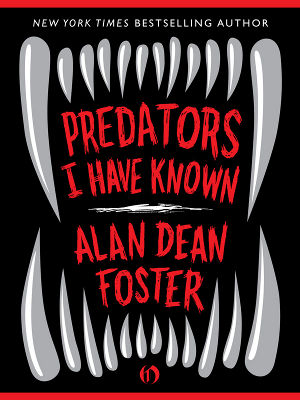
Predators I Have Known by Alan Dean FosterI was watching a nature documentary last night, and the cameraman made a point about conservation that I’d not heard before. To paraphrase, his point was – given we’re very aware that numerous species and habitats are on the brink of extinction, but that inaction is still commonplace – how will we answer our children’s children when they ask us why we let them go? Because they’ll know: that documentary, and many others, will b available on YouTube (or its equivalent); photos of amazing creatures and locations will persist long after the things they depict have departed.We won’t be able to feign ignorance to excuse inaction.

Perhaps being able to see these things, to have them become something more than words in a green group’s press release, is the key to getting people to care enough to act. It certainly seems that seeing nature up close and personal – even its most dangerous elements – has had that effect on Alan Dean Foster, whose memoir Predators I Have Known is launched next week, 22nd February 2011.

Take it away, Mister Foster:

*

The more I travel to the few remaining comparatively untouched corners of the globe, the more I incline to despair at their prospects for survival. No matter where I go: Asia, Africa, South or Central America, the oceans of the world, I am overwhelmed by the feeling that, good intentions notwithstanding, money trumps conservation every time.

And yet…and yet….

There are places humankind has not yet destroyed. Places untouched and virgin: in New Guinea, in central Africa, in South America, in Borneo, even in the desperately overfished and overexploited oceans. Invariably, these remaining outposts of the unspoiled natural world are protected by and owe their continuing survival to two factors: isolation, and laws that are actually enforced. Ideally, the two exist in combination.

In northern Borneo, a tract of untouched rainforest has been set aside in the Danum Valley. Here uncut diterocarps tower hundreds of feet high, providing food and shelter for a vast range of rare animals that have been exterminated elsewhere on the world’s third largest island. In the central Pacific, Henderson Island boasts some of the most unspoiled and healthy coral reef societies in the entire ocean, thanks to the island’s isolation and the fact that it is regularly patrolled by the U.S. military.

Gabon’s forests still exist because the country is one of the few in Africa that is actually underpopulated. Declared national parks by the nation’s recently deceased long-time leader, it remains to be seen if in the huge areas that have been set aside for conservation, promise will be followed by enforcement. For now, Gabon offers the rare visitor the chance to see an Africa long since obliterated on the rest of the continent.

In Peru a battle brews between those who recognize the value of preserving the country’s natural wonders and those who would (as in Ecuador) exploit them for the hydrocarbons that lie below the forests. In Brazil, a slowing of deforestation holds out the promise of preserving at least some of the original Amazon basin.

Hope for such regions remains, though I fear and expect such preservation may only be accomplished at the point of a gun, as is the case with the rhino in South Africa and the tiger in India. Having let our planet’s wilderness degenerate to its present state, that may be the only viable course that remains to us if we wish to retain even a fragment of the world and the beauty that once was.

Turn-key sockpuppet software

Here’s another interesting peripheral nugget from the HBGary Federal fallout, courtesy some pseudonymous and doubtless unpaid person on HuffPo who’s been digging through the Anonymous email dump:

As I also mentioned yesterday, in some of the emails, HB Gary people are talking about creating “personas”, what we would call sockpuppets. This is not new. PR firms have been using fake “people” to promote products and other things for a while now, both online and even in bars and coffee houses.

But for a defense contractor with ties to the federal government, Hunton & Williams, DOD, NSA, and the CIA –  whose enemies are labor unions, progressive organizations,  journalists, and progressive bloggers,  a persona apparently goes far beyond creating a mere sockpuppet.

According to an embedded MS Word document found in one of the HB Gary emails, it involves creating an army of sockpuppets, with sophisticated “persona management” software that allows a small team of only a few people to appear to be many, while keeping the personas from accidentally cross-contaminating each other. Then, to top it off, the team can actually automate some functions so one persona can appear to be an entire Brooks Brothers riot online.

Cue lots of what I’m coming to recognise as the default tone of US leftists, namely “embattled panic”:

I wanted to make this clear because it is in the interests of government and propagandists, and anyone else who wants this story to go away to try and blow all this off as one little company who wrote a proposal no one even read and who isn’t even competent enough to protect its own servers so no one should pay any attention at all to what they were up to.

That is the narrative being spun, even here on this site, and it is entirely fictitious.

We are under attack. And the attackers are damn good at what they do. Pretending they’re not, or that this isn’t happening isn’t going to make it better.

Sunlight as best disinfectant… well, we can hope so, anyway. This chap (or chapess) seems to have missed a chance to deconstruct his own metanarrative at the same time (paint yourself as a footsoldier in the trenches, and you’ll hear the whistle of shells pretty quickly), but that’s a hard gig to play for anyone who’s only just realised that the kraken are battling beneath the waves.

Or maybe I’m just getting hardened to these revelations through overexposure; my first reaction to reading that piece was “what took them so long?” Given that the FBI is cheerfully making public requests to Congress for backdoor access to a whole raft of social media tools, one can assume that they’ve got a fair few already, and would like them enshrined in a framework of legality so they can use them properly…

Perpetual perfect present: journalism strategies for an atemporal world

Apparently the BBC has been doing this for a while, but this is the first time I’ve seen anyone mention it explicitly; The Guardian attempts to address the atemporality of the globalised 24/7 newsriver:

So our new policy, adopted last week (wherever you are in the world), is to omit time references such as last night, yesterday, today, tonight and tomorrow from guardian.co.uk stories. If a day is relevant (for example, to say when a meeting is going to happen or happened) we will state the actual day – as in “the government will announce its proposals in a white paper on Wednesday [rather than ‘tomorrow’]” or “the government’s proposals, announced on Wednesday [rather than ‘yesterday’], have been greeted with a storm of protest”.

The BBC website, among others, adopted a similar strategy some time ago and I feel it gives an immediacy to their reports akin to watching or listening to a live news broadcast. So in a sense we are, perhaps belatedly, recognising another way in which a website is different from a newspaper.

We are likely to make much more use of the present tense (“the government is facing a deepening crisis …”) and present perfect tense (“the crisis engulfing the government has intensified …”); until the change of approach, we would probably have written “the crisis engulfing the government intensified tonight …”

Largely unmentioned is the root cause of the problem being addressed, namely that folk who aren’t “digital natives” don’t make a habit of checking the date and time on online articles. To be fair, I only learned that necessity the hard way, after being called out on having posted some five-year-old nugget as news…

Though this raises an interesting facet of atemporality, namely that not all information is time sensitive to the same degree. A lot of more general knowledge is “news” if it’s new to the person reading it. The central channel of the river flows faster than the edges…